EGYPTIAN
ARCHAEOLOGY
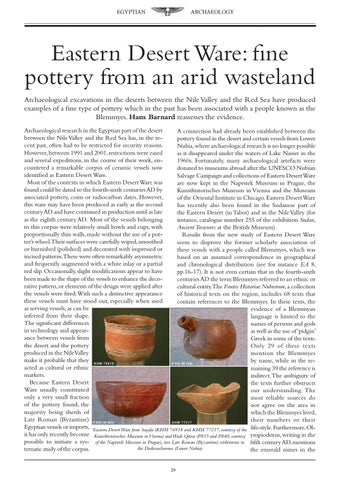
Eastern Desert Ware: fine pottery from an arid wasteland Archaeological excavations in the deserts between the Nile Valley and the Red Sea have produced examples of a fine type of pottery which in the past has been associated with a people known as the Blemmyes. Hans Barnard reassesses the evidence. Archaeological research in the Egyptian part of the desert A connection had already been established between the between the Nile Valley and the Red Sea has, in the repottery found in the desert and certain vessels from Lower cent past, often had to be restricted for security reasons. Nubia,where archaeological research is no longer possible However,between 1991 and 2001,restrictions were eased as it disappeared under the waters of Lake Nasser in the and several expeditions, in the course of their work, en1960s. Fortunately, many archaeological artefacts were countered a remarkable corpus of ceramic vessels now donated to museums abroad after the UNESCO Nubian identified as Eastern Desert Ware. Salvage Campaign and collections of Eastern DesertWare Most of the contexts in which Eastern Desert Ware was are now kept in the Naprstek Museum in Prague, the found could be dated to the fourth-sixth centuries AD by Kunsthistorisches Museum in Vienna and the Museum associated pottery, coins or radiocarbon dates. However, of the Oriental Institute in Chicago. Eastern Desert Ware this ware may have been produced as early as the second has recently also been found in the Sudanese part of century AD and have continued in production until as late the Eastern Desert (in Tabot) and in the Nile Valley (for as the eighth century AD. Most of the vessels belonging instance, catalogue number 255 of the exhibition Sudan, to this corpus were relatively small bowls and cups, with Ancient Treasures at the British Museum). proportionally thin walls, made without the use of a potResults from the new study of Eastern Desert Ware ter’s wheel.Their surfaces were carefully wiped,smoothed seem to disprove the former scholarly association of or burnished (polished) and decorated with impressed or these vessels with a people called Blemmyes, which was incised patterns.These were often remarkably asymmetric based on an assumed correspondence in geographical and frequently augmented with a white inlay or a partial and chronological distribution (see for instance EA 8, red slip. Occasionally, slight modifications appear to have pp.16-17). It is not even certain that in the fourth-sixth been made to the shape of the vessels to enhance the decocenturies AD the term Blemmyes referred to an ethnic or rative pattern,or elements of the design were applied after cultural entity.The Fontes Historiae Nubiorum, a collection the vessels were fired.With such a distinctive appearance of historical texts on the region, includes 68 texts that these vessels must have stood out, especially when used contain references to the Blemmyes. In these texts, the as serving vessels, as can be evidence of a Blemmyan inferred from their shape. language is limited to the The significant differences names of persons and gods in technology and appearas well as the use of ‘pidgin’ ance between vessels from Greek in some of the texts. the desert and the pottery Only 29 of these texts produced in the NileValley mention the Blemmyes make it probable that they by name, while in the reacted as cultural or ethnic maining 39 the reference is markers. indirect.The ambiguity of Because Eastern Desert the texts further obstructs Ware usually constituted our understanding. The only a very small fraction most reliable sources do of the pottery found, the not agree on the area in majority being sherds of which the Blemmyes lived, Late Roman (Byzantine) their numbers or their Egyptian vessels or imports, Eastern Desert Ware from Sayala (KHM 76918 and KHM 77217, courtesy of the life-style.Furthermore,Olit has only recently become Kunsthistorisches Museum in Vienna) and Wadi Qitna (P835 and P840, courtesy ympiodorus, writing in the possible to initiate a sys- of the Naprstek Museum in Prague), two Late Roman (Byzantine) settlements in fifth century AD, mentions the Dodecaschoenus (Lower Nubia) tematic study of the corpus. the emerald mines in the 29