EGYPTIAN
ARCHAEOLOGY
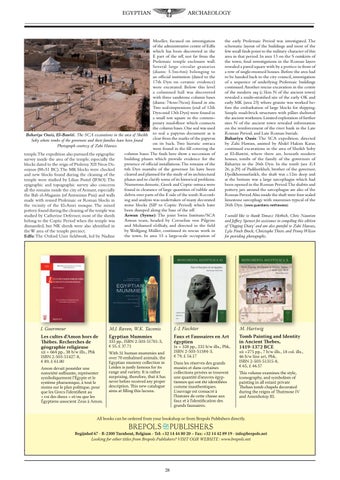
Moeller, focused on investigation of the administrative centre of Edfu which has been discovered in the E part of the tell, not far from the Ptolemaic temple enclosure wall. Several large circular granaries (diams: 5.5m-6m) belonging to an official institution (dated to the 17th Dyn on ceramic evidence) were excavated. Below this level a columned hall was discovered with three sandstone column bases (diams: 74cm-76cm) found in situ. Two seal-impressions (end of 12th Dyn-mid 13th Dyn) were found in a small test square in the contemporary mud-floor which connects the column bases.One seal was used Bahariya Oasis, El-Bawiti. The SCA excavations in the area of Sheikh to seal a papyrus document as is clear from the marks of the papyrus Soby where tombs of the governors and their families have been found on its back. Two hieratic ostraca Photograph courtesy of Zahi Hawass were found in the fill covering the column bases.The finds here show a succession of temple.The expedition also pursued the epigraphic building phases which provide evidence for the survey inside the area of the temple, especially the presence of official installations.The remains of the blocks dated to the reign of Ptolemy XII Neos Di6th Dyn mastaba of the governor Izi have been onysos (88-51 BC).The MK blocks were checked cleared and planned for the study of its architectural and new blocks found during the cleaning of the phases and to clarify some of its historical problems. temple were studied by Lilian Postel (IFAO). The Numerous demotic, Greek and Coptic ostraca were epigraphic and topographic survey also concerns found in clearance of large quantities of rubble and all the remains inside the city of Armant, especially debris over parts of the E side of the tomb. Recordthe Bab el-Maganin (of Antoninus Pius) and walls ing and analysis was undertaken of many decorated made with reused Ptolemaic or Roman blocks in stone blocks (SIP to Coptic Period) which have the vicinity of the El-Amri mosque. The mixed been dumped along the base of the tell. pottery found during the cleaning of the temple was Aswan (Syene): The joint Swiss Institute/SCA studied by Catherine Defernez; most of the sherds Aswan team, headed by Cornelius von Pilgrim belong to the Coptic Period when the temple was and Mohamed el-Bialy, and directed in the field dismantled, but NK sherds were also identified in by Wolfgang Müller, continued its rescue work in the W area of the temple precinct. the town. In area 15 a large-scale occupation of Edfu:The Oxford Univ fieldwork, led by Nadine
28
the early Ptolemaic Period was investigated. The schematic layout of the buildings and most of the few small finds point to the military character of this area in that period. In area 13 on the S outskirts of the town, final investigations in the Roman layers revealed a paved square with by a portico in front of a row of single-roomed houses. Before the area had to be handed back to the city council, investigation of a sequence of underlying Ptolemaic buildings continued.Another rescue excavation in the centre of the modern suq (c.1km N of the ancient town) revealed a multi-stratified site of the early OK and early MK (area 23) where granite was worked before the embarkation of large blocks for shipping. Simple mud-brick structures with pillars sheltered the ancient workmen.Limited exploration of further sites N of the ancient town revealed information on the reinforcement of the river bank in the Late Roman Period, and Late Roman burials. Bahariya Oasis: The SCA expedition, directed by Zahi Hawass, assisted by Abdel Hakim Karar, continued excavations in the area of Sheikh Soby at El-Bawiti, where there are, beneath modern houses, tombs of the family of the governors of Bahariya in the 26th Dyn. In the tomb (see EA 26, p.29) of Padiherkheb, brother of the governor, Djedkhonsuefankh, the shaft was c.12m deep and at the bottom was a large sarcophagus which had been opened in the Roman Period.The shabtis and pottery jars around the sarcophagus are also of the Roman Period.Also inside the shaft were four sealed limestone sarcophagi with mummies typical of the 26th Dyn. (www.guardians.net/hawass) I would like to thank Tomasz Herbich, Chris Naunton and Jeffrey Spencer for assistance in compiling this edition of ‘Digging Diary’ and am also grateful to Zahi Hawass, Lyla Pinch Brock, Christophe Thiers and Penny Wilson for providing photographs.