EGYPTIAN
part of a MK limestone-cased mastaba and its brick enclosure wall were excavated.The mastaba had two niches, decorated with standard offering chamber scenes, on the E side. Remains of high-quality sunk relief inscriptions must originate from the outer faces of the mastaba. Many fragments of a granite offering table were also recovered with inscriptions indicating that the tomb owner lived until the time of Amenemhat III and that part of his name may have been ‘Senwosret’.Work also continued on the reliefs from the pyramid temple, the chapels of the queens and princesses, the post-NK burials and the reconstructions of sections of the Khnumhotep mastaba and the inner enclosure wall of the king’s pyramid. (www.metmuseum.org) Bakchias (Kom Umm el-Atl):The Bologna Univ expedition, under the overall direction of Sergio Pernigotti and directed in the field by Christian Tassinari, continued excavation in the ‘new’ sacred area already identified and partially excavated in February 2005. In particular, work continued on the uncovering of the great temple dedicated to the crocodile god Soknobraisis (50m x 23m),located inside an enclosure wall (70m x 57m) and preceded by a 50m long causeway which is oriented to the S.The temple dates back to the late Ptolemaic Period, with stone enlargements of the Roman Period. (www2. unibo.it/archeologia/ricerca/scavi/bakchias/bak1.htm) Medinet Madi:The programme of the joint Pisa Univ/Messina Univ expedition, directed by Edda Bresciani, was to prepare a catalogue of fragmentary finds of scientific interest of previous seasons (200004). In addition, investigation has been extended to the SE of the painted hall where the buildings have been found to be in very bad condition (possibly damaged by the earthquake of AD 307) and in part also ruined by fire.The excavations provided only a few objects, small fragments of Greek papyri (some late) and fragmentary pottery and faience items. Antinoopolis (El-Sheikh Ibada):The mission of the Istituto Papirologico G Vitelli, Florence, led by Rosario Pintaudi, has completed the second part of its excavation campaign in the N necropolis.Results obtained were very profitable,both in terms of written documents and of buildings recovered.Among the written materials, some important Greek and Coptic parchments were found. These, as well as coins, papyri, ostraca, pottery and textiles, can all be dated in the period from the fifth to the seventh centuries AD. The team also began work at the temple of Ramesses II to prepare it for conservation and recording (see further pp.39-41). Karnak: The CFEETK expedition, directed by Emmanuel Laroze and Mansour Boraik, with Dominque Valbelle as Scientific Director, began excavation of the northern wadjyt-hall with small soundings against the base of the Hatshepsut obelisk. A foundation deposit with the names of Hatshepsut and Tuthmosis III was discovered within a joint in the pavement. Excavation in the SE corner of the Middle Kingdom courtyard was undertaken to clarify the different constructional stages of this area. Some ten limestone blocks of Amenhotep I, reused as a foundation, were removed and stored on new benches. Dismantling of Seti II’s W gate continued, revealing hitherto hidden decoration of the Sixth Pylon and further blocks of the Annals.Excavation at the base of the wall led to the discovery of a beautiful foundation deposit of Hatshepsut.The clearing and architectural study of the enclosure wall attributed to Tuthmosis III has been continued and has shown that the 18th Dyn wall is preserved beneath that of the 30th Dyn. Conservation of the wall, using new mud-bricks, has begun on the N part. A project for the complete restoration of the Opet Temple has been launched, beginning with the painted decoration in the N room and some consolidation in the courtyard. 3D scanning of the Opet temple has been completed. (www.cfeetk.cnrs.fr) Luxor:The Epigraphic Survey OI,Univ of Chicago team, directed by W Raymond Johnson, resumed
ARCHAEOLOGY
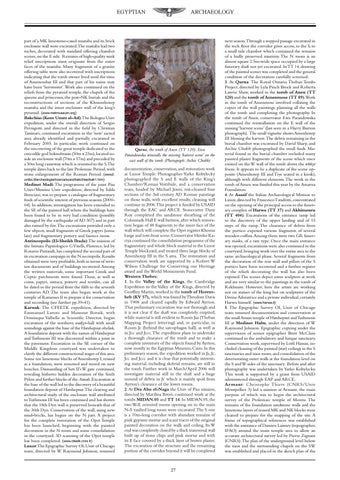
Qurna, the tomb of Anen (TT 120). Ewa Parandowska reinstalls the missing ‘harvest scene’ on the east wall of the tomb. (Photograph:Archie Chubb) documentation, conservation, and restoration work at Luxor Temple. Photographer Yarko Kobylecky photographed the S and E walls of the King’s Chamber/Roman Vestibule, and a conservation team, headed by Michael Jones, test-cleaned four sections of the 3rd century AD Roman paintings on those walls, with excellent results; cleaning will continue in 2006.This project is funded by USAID through the EAC and ARCE. Stonecutter Dany Roy completed the sandstone sheathing of the Colonnade Hall E wall buttress, after which restoration began of 48 fragments to the inner face of the wall which will complete the Opet register Khonsu barge and tow-boat scene. Conservator Hiroko Kariya continued the consolidation programme of the fragmentary and whole block material in the Luxor Temple blockyard, and treated three large blocks of Amenhotep III in the S area. The restoration and conservation work are supported by a Robert W Wilson Challenge for Conserving our Heritage award and the World Monuments Fund. Western Thebes: 1. In the Valley of the Kings, the Cambridge Expedition to the Valley of the Kings, directed by Geoffrey Martin, worked in the tomb of Horemheb (KV 57), which was found byTheodore Davis in 1908 and cleared rapidly by Edward Ayrton. That preliminary excavation was not thorough and it is not clear if the shaft was completely emptied, while material is still evident in Room Jaa (Theban Mapping Project lettering) and, in particular, in Room Jc (behind the sarcophagus hall), as well as in Jcc and Jccc.The expedition plans to undertake a thorough clearance of the tomb and to make a complete inventory of the objects found by Ayrton, now mostly in the Egyptian Museum, Cairo. In this preliminary season, the expedition worked in Ja, Jc, Jcc and Jccc and it is clear that potentially interesting material, including skeletal remains, are still in the tomb. Further work in March/April 2006 will investigate material still in the shaft and a huge mound of debris in Jc which is mainly spoil from Ayrton’s clearance of the lower rooms. 2.At Dra Abu el-Naga the Univ of Pisa mission, directed by Marilina Betrò, continued work at the tombs MIDAN.05 and TT 14. In MIDAN.05, the two W-E oriented rooms opening on to the main N-S vaulted long room were excavated.The S one is a 10m-long corridor with abundant remains of pink gypsum mortar and scant traces of the original painted decoration on the walls and ceiling. Its W end was completely closed by a thick transversal wall built up of stone chips and pink mortar and with its E face covered by a thick layer of brown plaster. The excavation of the structure and the remaining portion of the corridor beyond it will be completed
27
next season.Through a stepped passage excavated in the rock floor the corridor gives access, to the S, to a small side chamber which contained the remains of a badly preserved mummy. The N room is an almost square 2.5m-wide space occupied by a large funerary shaft not yet excavated. In TT 14, drawing of the painted scenes was completed and the general condition of the decoration carefully screened. 3. At Qurna The Royal Ontario Theban Tombs Project, directed by Lyla Pinch Brock and Roberta Lawrie Shaw, worked in the tomb of Anen (TT 120) and the tomb of Amenmose (TT 89).Work in the tomb of Amenmose involved collating the copies of the wall paintings, planning all the walls of the tomb and completing the photography. In the tomb of Anen, conservator Ewa Parandowska continued the reinstallation on the E wall of the missing ‘harvest scene’ (last seen in a Harry Burton photograph). The small vignette shows Amenhotep III blessing the harvest.The debris remaining in the burial chamber was excavated by David Sharp, and Archie Chubb photographed the small finds. Material found in the burial chamber included many painted plaster fragments of the scene which once existed on the W wall of the tomb above the rekhyt frieze. It appears to be a duplicate of the scene opposite (Amenhotep III and Tiye seated in a kiosk), although with different elements.The work in the tomb of Amen was funded this year by the Amarna Foundation. 4. At Asasif the Italian Archaeological Mission to Luxor,directed by FrancescoTiradritti,concentrated on the opening of the principal access to the funerary complex of Harwa (TT 37) and Akhimenru (TT 404). Excavations of the entrance ramp led to the discovery of the upper landing and of 15 steps of the ramp. The clearance of debris from the portico exposed various fragments of several wooden coffins.Among them were two GR funerary masks, of a rare type. Once the main entrance was opened, excavations were also continued in the courtyard, bringing work over the entire area to the same archaeological phase. Several fragments from the decoration of the rear wall and pillars of the S portico have been recovered and a further register of the reliefs decorating the wall has also been exposed.The scenes depict some sculptors at work and are very similar to the paintings in the tomb of Rekhmire. However, here the artists are working not on statues of the king but on sculptures of the Divine Adoratrice and a private individual, certainly Harwa himself. (www.harwa.it) 5. The Epigraphic Survey OI, Univ of Chicago team resumed documentation and conservation at the small Amun temple of Hatshepsut andTuthmosis III at Medinet Habu, under the direction of W Raymond Johnson. Epigraphic copying under the supervision of senior epigrapher Brett McClain continued in the ambulatory and barque sanctuary. Conservation work, supervised by Lotfi Hassan, included cleaning of the painted (star) ceilings in the S sanctuaries and naos room, and consolidation of the deteriorating outer walls at the foundation level on the S and W sides of the sanctuary. Before and after photography was undertaken by Yarko Kobylecky. This work is supported by a grant from USAID administered through EAP and ARCE. Ar mant: Chr istophe Thiers (CNRS/Univ Montpellier 3) led a mission at Armant, the main purpose of which was to begin the architectural survey of the Ptolemaic temple of Montu. The remains of the foundation sandstone walls and the limestone layers of reused MK and NK blocks were cleaned to prepare for the mapping of the site. A frame of topographical references was established with the assistance of Damien Laisney (topographer, IFAO) around the main temple area to allow an accurate architectural survey led by Pierre Zignani (CNRS).The plan of the underground level below the naos and the surrounding chapels on the SW was established and placed in the sketch plan of the