EGYPTIAN
ARCHAEOLOGY
focused its work on the area in front of the 3rd Dyn layered stone mastaba where MK potsherds were uncovered in previous seasons. Excavations were carried further to the W to define the extent of the debris - more thousands of vessels were uncovered. Below this layer of MK cult refuse deposits, a layer with fragments of tafl and limestone chips marked the destruction of the 3rd Dyn mastaba. Beneath this layer was another with fragments of 3rd Dyn beer jars indicating the floor level immediately after the construction of the mastaba. A trench in the W slope of the outcrop (site of the monument of Khaemwaset) revealed over 200 blocks from the monument: some were reused decorated blocks from nearby OK mastabas. OK votive objects and pottery sherds were also recovered, indicating that an OK mastaba may originally have stood on the top of the outcrop.Salima Ikram analysed the animal bones found in the subterranean chambers behind the 3rd Dyn structure and Ahmed Fahmy carried out archaeobotanical studies on the micro plant remains from the same area. X-ray material analyses of finds from previous seasons were conducted by a team headed by Izumi Nakai.
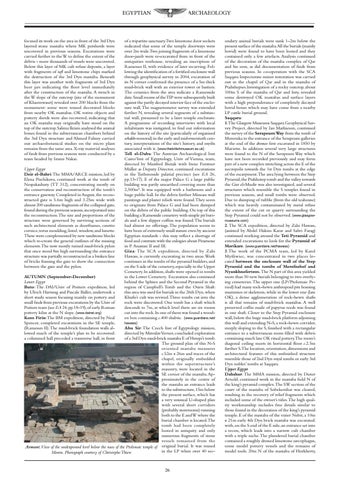
of a tripartite sanctuary.Two limestone door sockets indicated that some of the temple doorways were over 2m wide.Two joining fragments of a limestone door-jamb were re-excavated from in front of the antiquities resthouse, revealing an inscription of Ramesses II, with evidence of later recarving. Following the identification of a fortified enclosure wall through geophysical survey in 2004, excavation of its N corner confirmed the presence of a 5m thick mud-brick wall with an exterior tower or bastion. The ceramics from the area indicate a Ramesside date.Small rooms of theTIP were subsequently built against the partly decayed interior face of the enclosure wall.The magnetometer survey was extended further N, revealing several segments of a substantial wall, presumed to be a later temple enclosure. A programme of recording interviews with local inhabitants was instigated, to find out information on the history of the site (particularly of organised sebakh-removal) in the early and mid-twentieth century, interpretations of the site’s history, and myths associated with it. (www.thebritishmuseum.ac.uk) Tell el-Daba: The Austrian Archaeological Inst Cairo/Inst of Egyptology, Univ of Vienna, team, directed by Manfred Bietak with Irene Forstner Upper Egypt Müller as Deputy Director, continued excavations Deir el-Bahri:The MMA/ARCE mission, led by in the Tuthmoside palatial precinct (see EA 26, Elena Pischikova, continued work at the tomb of pp.13-17). E of the major Palace G a large public Nespakashuty (TT 312), concentrating mostly on building was partly unearthed covering more than the conservation and reconstruction of the tomb’s 2,500m2. It was equipped with a bathroom and a entrance gateway. Completed in August, the reconhuge public hall. In the debris further Minoan wall structed gate is 5.6m high and 3.25m wide with paintings and plaster reliefs were found.They seem almost 200 sandstone fragments of the collapsed gate, to originate from Palace G and had been dumped found during the previous seasons,incorporated into on the debris of the public building. On top of this the reconstruction.The size and proportions of the building a Ramesside cemetery with simple pit buristructure were governed by surviving sections of als and a few slipper coffins was found.The burials such architectural elements as doorframes, cavetto had almost no offerings. The population seems to cornice, torus moulding,lintel, window, and lunette. have been of extremely small stature even by ancient These were complemented by new sandstone blocks Egyptian standards - this may reflect a shortage of which re-create the general outlines of the missing food and contrasts with the eulogies about Piramesse elements.The now mostly ruined mud-brick pylon in P. Anastasi II and III. that once stood 8m high surrounding the entrance Giza: The SCA expedition, directed by Zahi structure was partially reconstructed as a broken line Hawass, is currently excavating in two areas.Work of bricks framing the gate to show the connection continues in the tombs of the pyramid builders, and between the gate and the pylon. on the S side of the cemetery,especially in the Upper Cemetery. In addition, shafts were opened in tombs AUTUMN (September-December) in the Lower Cemetery. Excavation also continued Lower Egypt behind the Sphinx and the Second Pyramid in the Buto: The DAI/Univ of Poitiers expedition, led region of Campbell’s Tomb and the Osiris Shaft: by Ulrich Hartung and Pascale Ballet, undertook a this area was used for burials in the 26th Dyn, when short study season focusing mainly on pottery and Khufu’s cult was revived.Three tombs cut into the small finds from previous excavations by the Univ of rock were discovered. One tomb has a shaft which Poitiers team (see EA 24,pp.18-19),of early Roman descends to 7m, at which level there are six rooms pottery kilns at the N slope. (www.dainst.org) cut into the rock.In one of them was found a woodKom Firin:The BM expedition, directed by Neal en box containing c.400 shabtis. (www.guardians.net/ Spencer, completed excavations in the SE temple, hawass) (Ramesses II).The mud-brick foundation walls alAbu Sir: The Czech Inst of Egyptology mission, lowed much of the temple’s plan to be recovered: directed by Miroslav Verner, concluded exploration a columned hall preceded a transverse hall, in front of a 3rd Dyn mud-brick mastaba E of Hetepi’s tomb. The ground plan of this N-S oriented mastaba measures c.52m x 26m and traces of the chapel, originally embedded within the superstructure’s masonry, were located in the SE corner of the mastaba.Approximately in the centre of the mastaba an entrance leads to the substructure,15m below the present surface, which has a very unusual U-shaped plan with several short corridors (probably storerooms) running both to the E andW where the burial chamber is located.The tomb had been completely looted in antiquity and only numerous fragments of stone vessels remained from the Armant.View of the underground level below the naos of the Ptolemaic temple of original burial. It was reused in the LP when over 40 secMontu. Photograph courtesy of Christophe Thiers
26
ondary animal burials were sunk 1–2m below the present surface of the mastaba.All the burials (mainly bovid) were found to have been looted and they contained only a few artefacts. Analysis continued of the decoration of the mastaba complex of Qar and his sons, as did documentation of finds from previous seasons. In co-operation with the SCA Saqqara Inspectorate minor restoration was carried out in the chapel of Qar and in the mastaba of Ptahshepses.Investigation of a rocky outcrop, about 100m S of the mastaba of Qar and Inty, revealed some destroyed OK mastabas and surface layers with a high preponderance of completely decayed bovid bones which may have come from a nearby LP cattle burial ground. Saqqara: 1.The Glasgow Museums Saqqara Geophysical Survey Project, directed by Ian Mathieson, continued the survey of the Serapeum Way from the tomb of Mereruka to the entrance of the Serapeum galleries at the end of the dromos first excavated in 1850 by Mariette. In addition several very large structures were found to the N of the Serapeum Way which have not been recorded previously and may form part of a new complex stretching across the E of the necropolis towards the 1st Dyn tombs at the edge of the escarpment.The area lying between the Step Pyramid,the Ptahhotep tomb and the valley towards the Gisr el-Mudir was also investigated, and several structures which resemble the S temples found in previous seasons, and small tombs were observed. Due to dumping of rubble (from the old teahouse) which was heavily contaminated by metal refuse the extent of the cut or quarry surrounding the Step Pyramid could not be observed. (www.glasgowmuseums.com) 2. The SCA expedition, directed by Zahi Hawass, (assisted by Abdel Hakim Karar and Sabri Farag) continued working around the Teti Pyramid and extended excavations to look for the Pyramid of Merikare. (www.guardians.net/hawass) 3.The work of the PCMA team, led by Karol My!liwiec, was concentrated in two places located between the enclosure wall of the Step Pyramid and the tombs of Merefnebef and Nyankhnefertem. The N part of this area yielded more than 50 new burials belonging to two overlying cemeteries.The upper one (LP/Ptolemaic Period) had many rock-hewn anthropoid pits housing mummies or skeletons, while in the lower one (late OK), a dense agglomeration of rock-hewn shafts is all that remains of mud-brick mastabas. A well preserved coffin made of papyrus reeds was found in one shaft. Closer to the Step Pyramid enclosure wall, below the huge mud-brick platform adjoining this wall and extending N-S, a rock-hewn corridor, steeply sloping to the S, finished with a rectangular entrance to a subterranean room filled with debris containing much late OK ritual pottery.The room’s diagonal ceiling meets its horizontal floor c.2.5m further S.The location, orientation, dimensions and architectural features of this unfinished structure resemble those of 2nd Dyn royal tombs or early 3rd Dyn nobles’ tombs at Saqqara. Upper Egypt Dahshur: The MMA mission, directed by Dieter Arnold, continued work in the mastaba field N of the king’s pyramid complex.The SW section of the court of the mastaba of Sobekemhat was cleared, resulting in the recovery of relief fragments which included some of the owner’s titles.The high quality workmanship includes fine details similar to those found in the decoration of the king’s pyramid temple. E of the mastaba of the vizier Nebit, a 10m x 21m early 4th Dyn brick mastaba was excavated. with, on the S end of the E side, an entrance set into a recess, which leads into a narrow cult chamber with a triple niche.The plundered burial chamber contained a roughly dressed limestone sarcophagus, some model pottery vessels and the remains of model tools. 20m N of the mastaba of Horkherty,