EGYPTIAN
ARCHAEOLOGY
Left: Faience pectoral (Late Period). (Photograph © Christian Décamps)
Right: Coffin with a gold-plated mask (see detail on p.22) in tomb F17. (Photograph © Christian Décamps)
and highly decorated in colour. They had been buried directly in the sand with very simple funerary equipment, composed essentially of protective amulets and faience jewellery of an intense blue colour.The bodies were not mummified. The tombs most recently excavated also belong to the Late Period.They are cut down into the bedrock of the desert and are reached by shafts which vary in depth from five to 15 metres.Two of the tombs were found to be intact – a rare occurrence in Egypt – with remarkable painted coffins containing mummies in perfect condition. Other chambers, although they had been visited by robbers, still contained exceptional coffins with gold-plated faces. A coherent funerary assemblage can be established: coffin, magnificent statuettes and funerary chests, cartonnage, faience amulets, pottery and mummy bandages inscribed with texts from the Book of the Dead. One of the most interesting facts to emerge from this discovery was that the cemetery can be dated, as one of the coffins mentions Year 2 of King Nectanebo II. After the last season, in April/May 2005, nine of the mummies were X-rayed and a tenth mummy was taken to the Egyptian Museum in Cairo to be scanned. The lowest archaeological level in the Louvre concession is that which contains the mastaba of Akhethotep – the level of the Old Kingdom. It is also one of the most spectacular.The monument from which the Louvre chapel came has now been relocated.The mastaba, which is 32m long and 6m high, is faced with fine white limestone and is one of the most beautiful and best preserved in the area.Among the most important objects discovered are three statues of Akhethotep, a series of offering tables and a papyrus with the name of King Isesi (c.2411-2380 BC). The chamber, accessible by a shaft 21m deep, still contains a monumental stone sarcophagus. The ancient robbers had left enough material for the original richness
Ô Christiane Ziegler (Director of the Department of Egyptian Antiquities at the Louvre Museum) is Director of the archaeological mission of the Louvre at Saqqara.The mission is financed by the Mission Recherche et Technologie du ministère de la Culture and has a team of French and Egyptian specialists, with over 100 Egyptian workmen.The writer is grateful to the SCA Inspector in the 2005 season, Mustafa Hassan Abd el-Rahman, for his help on site.
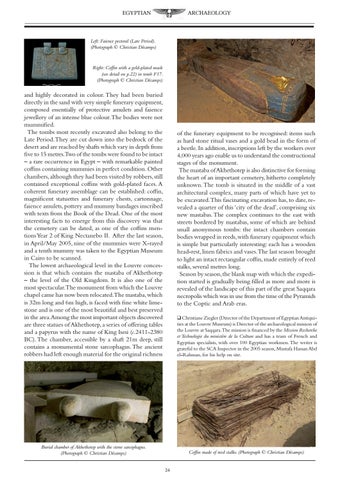
Burial chamber of Akhethotep with the stone sarcophagus. (Photograph © Christian Décamps)
Coffin made of reed stalks. (Photograph © Christian Décamps)
of the funerary equipment to be recognised: items such as hard stone ritual vases and a gold bead in the form of a beetle. In addition, inscriptions left by the workers over 4,000 years ago enable us to understand the constructional stages of the monument. The mastaba of Akhethotep is also distinctive for forming the heart of an important cemetery, hitherto completely unknown. The tomb is situated in the middle of a vast architectural complex, many parts of which have yet to be excavated.This fascinating excavation has, to date, revealed a quarter of this ‘city of the dead’, comprising six new mastabas. The complex continues to the east with streets bordered by mastabas, some of which are behind small anonymous tombs: the intact chambers contain bodies wrapped in reeds, with funerary equipment which is simple but particularly interesting: each has a wooden head-rest, linen fabrics and vases.The last season brought to light an intact rectangular coffin, made entirely of reed stalks, several metres long. Season by season, the blank map with which the expedition started is gradually being filled as more and more is revealed of the landscape of this part of the great Saqqara necropolis which was in use from the time of the Pyramids to the Coptic and Arab eras.
24