EGYPTIAN
ARCHAEOLOGY
The Louvre Museum excavations at Saqqara
In 1903 the Louvre Museum acquired the decorated chapel of Akhethotep, known to come from Saqqara. Inspired by the desire to relocate and identify the tomb itself, the Museum began work at the site in 1991. Christiane Ziegler summarises the results of the most recent excavation seasons. Saqqara,the site of the Step Pyramid of Djoser,was one of Egypt’s most important political, economic and religious centres up to the time of the Arab conquest of Egypt. It was also one of the first sites in Egypt to be excavated and the Louvre Museum has many thousands of objects which come from Saqqara. However, many areas which were excavated rapidly in the past have been forgotten, broken up by uncontrolled excavation, or buried under debris, without being published.The recent excavations of the Archaeological Mission of the Louvre have revealed some of the site’s history in an area where the map was previously blank.These excavations have been undertaken in the tradition of the Louvre Museum, which has always aimed to combine field archaeology with study of the collections. It was in 1903 that the Service des Antiquités (the precursor of the Egyptian Supreme Council for Antiquities) sold to France the mastaba of Akhethotep, though only the decorated chapel was dismantled and transported to Paris.No archival document had recorded the monument nor had its location been planned on any map. All that was known was that it had been removed from a position some hundreds of metres from the south-east corner of the Step Pyramid enclosure. Study of the Louvre mastaba began in 1991 and when archaeologists arrived at Saqqara they had to start by clear-
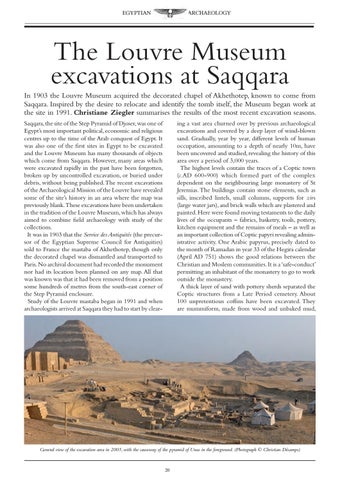
ing a vast area churned over by previous archaeological excavations and covered by a deep layer of wind-blown sand. Gradually, year by year, different levels of human occupation, amounting to a depth of nearly 10m, have been uncovered and studied, revealing the history of this area over a period of 3,000 years. The highest levels contain the traces of a Coptic town (c.AD 600-900) which formed part of the complex dependent on the neighbouring large monastery of St Jeremias. The buildings contain stone elements, such as sills, inscribed lintels, small columns, supports for zirs (large water jars), and brick walls which are plastered and painted. Here were found moving testaments to the daily lives of the occupants – fabrics, basketry, tools, pottery, kitchen equipment and the remains of meals – as well as an important collection of Coptic papyri revealing administrative activity. One Arabic papyrus, precisely dated to the month of Ramadan in year 33 of the Hegira calendar (April AD 751) shows the good relations between the Christian and Moslem communities. It is a ‘safe-conduct’ permitting an inhabitant of the monastery to go to work outside the monastery. A thick layer of sand with pottery sherds separated the Coptic structures from a Late Period cemetery. About 100 unpretentious coffins have been excavated. They are mummiform, made from wood and unbaked mud,
General view of the excavation area in 2005, with the causeway of the pyramid of Unas in the foreground. (Photograph © Christian Décamps)
20