©);26+#0
#4%*#©1.1);
The first British Egyptology Congress, Cambridge 2005 In September 2005, the first British Egyptology Congress was held in Cambridge. Dan Lines gives a personal assessment of the weekend’s activities. It is often said that academia can be a rather lonely business, taking place in isolation or, at best, in small groups of like-minded specialists. Perhaps for this reason, opportunities for Egyptologists to meet and to share the fruits of their labour tend to be greatly anticipated, enthusiastically participated in, and fondly remembered. All of this is certainly true of the First British Egyptology Congress, held in Cambridge on the weekend of 24-25 September, 2005. British Egyptologists have, in recent years, had a number of annual opportunities to congregate, including the British Museum’s themed symposia, Cambridge’s Glanville Memorial Lecture and, for graduate students, the Current Research in Egyptology conferences, hosted in rotation by university Egyptology departments around the country.There had, however, not been a single, wideremit national congress along similar lines to gatherings in other countries or the four-yearly International Congress of Egyptologists.The British Egyptology Congress, organised by Sally-Ann Ashton and Helen Strudwick of the Fitzwilliam Museum in Cambridge, on behalf of the EES and the Museum, filled this gap with an admirably wide-ranging scope, uniting researchers who came from a great variety of institutions and sub-disciplines and are at different stages of their academic careers. The Congress had a pleasingly inclusive feel, with graduate students and ‘non-professional’ Egyptologists sharing podium-time with well-established academics. Several poster presentations were also displayed at the Fitzwilliam Museum, including many with either a technical or ‘fringe’ feel. The quality of presentations was generally high, and there were great rewards available for straying from one’s own area of expertise. Thomas Schneider’s clear and persuasive paper on his interpretation of Libyan personal names in Papyrus Moscow 314 was a personal highlight. A total of more than 50 20-minute papers were divided across three lecture rooms running parallel sessions over one and a half days.The sessions were loosely organised around broad themes such as ‘religion’, ‘fieldwork’ and so on. One of the most frustrating experiences for any congress-goer is when supposedly parallel sessions are not tightly time-controlled and so get out of step.This makes moving between rooms during sessions a hit-and-miss experience for audience-members, and can easily turn
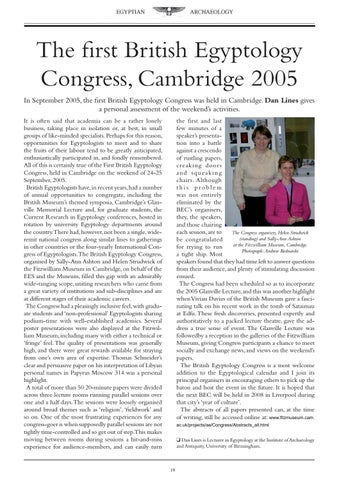
the first and last few minutes of a speaker’s presentation into a battle against a crescendo of rustling papers, creaking door s and squeaking chairs. Although this problem was not entirely eliminated by the BEC’s organisers, they, the speakers, and those chairing each session, are to The Congress organisers, Helen Strudwick (standing) and Sally-Ann Ashton be congratulated at the Fitzwilliam Museum, Cambridge. for trying to run Photograph: Andrew Bednarski a tight ship. Most speakers found that they had time left to answer questions from their audience, and plenty of stimulating discussion ensued. The Congress had been scheduled so as to incorporate the 2005 Glanville Lecture, and this was another highlight when Vivian Davies of the British Museum gave a fascinating talk on his recent work in the tomb of Sataimau at Edfu. These fresh discoveries, presented expertly and authoritatively to a packed lecture theatre, gave the address a true sense of event. The Glanville Lecture was followedby a reception in the galleries of the Fitzwilliam Museum, giving Congress participants a chance to meet socially and exchange news, and views on the weekend’s papers. The British Egyptology Congress is a most welcome addition to the Egyptological calendar and I join its principal organisers in encouraging others to pick up the baton and host the event in the future. It is hoped that the next BEC will be held in 2008 in Liverpool during that city’s ‘year of culture’. The abstracts of all papers presented can, at the time of writing, still be accessed online at: 888!#69075*70!)'0! ')!7."342-*)65"'*"%21+4*55"$(564')65&'//!,60/
! Dan Lines is Lecturer in Egyptology at the Institute of Archaeology and Antiquity, University of Birmingham.
ÿ9