©);26+#0
#4%*#©1.1);
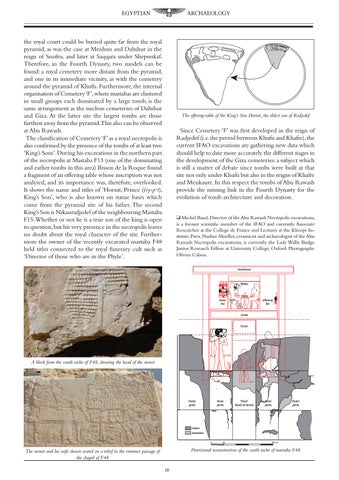
the royal court could be buried quite far from the royal pyramid, as was the case at Meidum and Dahshur in the reign of Snofru, and later at Saqqara under Shepseskaf. Therefore, in the Fourth Dynasty, two models can be found: a royal cemetery more distant from the pyramid, and one in its immediate vicinity, as with the cemetery around the pyramid of Khufu. Furthermore, the internal organisation of Cemetery ‘F’, where mastabas are clustered in small groups each dominated by a large tomb, is the same arrangement as the nucleus cemeteries of Dahshur and Giza. At the latter site the largest tombs are those furthest away from the pyramid.This also can be observed at Abu Rawash. The classification of Cemetery ‘F’ as a royal necropolis is also confirmed by the presence of the tombs of at least two ‘King’s Sons’. During his excavations in the northern part of the necropolis at Mastaba F13 (one of the dominating and earlier tombs in this area) Bisson de la Roque found a fragment of an offering table whose inscription was not analysed, and its importance was, therefore, overlooked. It shows the name and titles of ‘Hornit, Prince (Šry-pút), King’s Son’, who is also known on statue bases which come from the pyramid site of his father. The second King’s Son is Nikauradjedef of the neighbouring Mastaba F15.Whether or not he is a true son of the king is open to question, but his very presence in the necropolis leaves no doubt about the royal character of the site. Furthermore the owner of the recently excavated mastaba F48 held titles connected to the royal funerary cult such as ‘Director of those who are in the Phyle’.
The offering-table of the King’s Son Hornit, the eldest son of Radjedef
Since Cemetery ‘F’ was first developed in the reign of Radjedef (i.e. the period between Khufu and Khafre), the current IFAO excavations are gathering new data which should help to date more accurately the different stages in the development of the Giza cemeteries: a subject which is still a matter of debate since tombs were built at that site not only under Khufu but also in the reigns of Khafre and Menkaure. In this respect the tombs of Abu Rawash provide the missing link in the Fourth Dynasty for the evolution of tomb architecture and decoration. ! Michel Baud, Director of the Abu Rawash Necropolis excavations, is a former scientific member of the IFAO and currently Associate Researcher at the College de France and Lecturer at the Kheops Institute, Paris. Nadine Moeller, ceramicist and archaeologist of the Abu Rawash Necropolis excavations, is currently the Lady Wallis Budge Junior Research Fellow at University College, Oxford. Photographs: Olivier Cabon. ":+12<:)>-
')*5-< ! 527-7 52;<
! 8//-:270 52;<
%27<-5 #:=6
A block from the south niche of F48, showing the head of the owner
&=<-: 3)6*
$77-: 3)6*
(#88:. 9*)+4 8/ 72+1-@
$77-: 3)6*
&=<-: 3)6*
*:84-7 ?-)<1-:-, 0
20
100 cm
Provisional reconstruction of the south niche of mastaba F48
The owner and his wife shown seated on a relief in the entrance passage of the chapel of F48 ÿ8