©);26+#0
#4%*#©1.1);
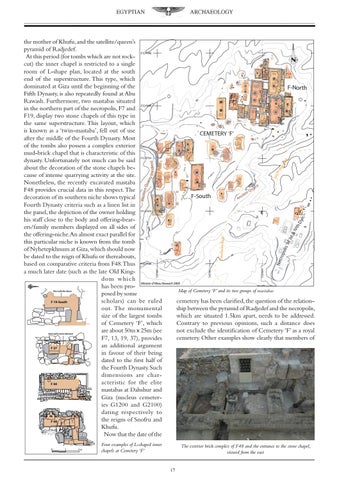
the mother of Khufu, and the satellite/queen’s pyramid of Radjedef. 3'324'900 At this period (for tombs which are not rock0 8 cut) the inner chapel is restricted to a single 6 15 room of L-shape plan, located at the south 28 11 14 end of the superstructure. This type, which 13 2 27 dominated at Giza until the beginning of the (!+?BD: 26 Fifth Dynasty, is also repeatedly found at Abu 4 7 25 3 Rawash. Furthermore, two mastabas situated 3'324'800 1 19 17 in the northern part of the necropolis, F7 and 12 5 9 F19, display two stone chapels of this type in 21 the same superstructure. This layout, which 10 is known as a ‘twin-mastaba’, fell out of use %'*'/'-2 4(9 34 after the middle of the Fourth Dynasty. Most 40 of the tombs also possess a complex exterior 36 32 42 35 mud-brick chapel that is characteristic of this 38 dynasty. Unfortunately not much can be said 41 43 51 about the decoration of the stone chapels be44 cause of intense quarrying activity at the site. 37 45 46 30 Nonetheless, the recently excavated mastaba 31 F 39 5BB F48 provides crucial data in this respect.The ,E D > 6;8 (!.?ED: 33 decoration of its southern niche shows typical $> 47 48 Fourth Dynasty criteria such as a linen list in XV the panel, the depiction of the owner holding XIV his staff close to the body and offering-bearIX 49 ers/family members displayed on all sides of the offering-niche.An almost exact parallel for this particular niche is known from the tomb of Nyhetepkhnum at Giza, which should now 50 40 be dated to the reign of Khufu or thereabouts, based on comparative criteria from F48.Thus 3'324'500 a much later date (such as the late Old Kingdom which &299276 -/$+7; '*<*,1 "!!# has been pro0 Map of Cemetery ‘F’ and its two groups of mastabas posed by some cemetery has been clarified, the question of the relationscholars) can be ruled ) #(!*,.-+ ship between the pyramid of Radjedef and the necropolis, out. The monumental which are situated 1.5km apart, needs to be addressed. size of the largest tombs Contrary to previous opinions, such a distance does of Cemetery ‘F’, which not exclude the identification of Cemetery ‘F’ as a royal are about 50m Z 25m (see cemetery. Other examples show clearly that members of F7, 13, 19, 37), provides an additional argument ) $& in favour of their being dated to the first half of the Fourth Dynasty. Such dimensions are characteristic for the elite ) %" mastabas at Dahshur and Giza (nucleus cemeteries G1200 and G2100) dating respectively to the reigns of Snofru and ) %' Khufu. Now that the date of the #
#
;C 4* 9 )CD
+86 B?A ?<
'315'900
'315'800
.?ED:!85CD 15
7;
3)
0D: &
F>"
18CD8B >
,E5 BB F
@=?78B>G
+?BD :!8 5C D1 57 ;
50
#
(.9: <*44 *0:.8 %29976
(.9: <*44 ) 62,1.9 -.9:87=.-
95*44 +47,39
0
2
4m
Four examples of L-shaped inner chapels at Cemetery ‘F’
The exterior brick complex of F48 and the entrance to the stone chapel, viewed from the east ÿ7