©);26+#0
#4%*#©1.1);
A Fourth Dynasty royal necropolis at Abu Rawash
Excavations carried out at the cemetery ‘F’ at Abu Rawash, an IFAO project which started in 2001, have proved that this site is the royal necropolis of Radjedef, third king of the Fourth Dynasty, as reported by Michel Baud and Nadine Moeller.
'316'500
'316'000
'315'500 0
'314'500
3'326'500
'314'000
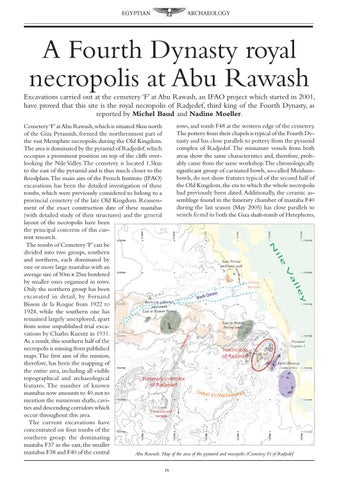
rows, and tomb F48 at the western edge of the cemetery. Cemetery ‘F’ at Abu Rawash, which is situated 8km north The pottery from their chapels is typical of the Fourth Dyof the Giza Pyramids, formed the northernmost part of nasty and has close parallels to pottery from the pyramid the vast Memphite necropolis during the Old Kingdom. complex of Radjedef. The miniature vessels from both The area is dominated by the pyramid of Radjedef, which areas show the same characteristics and, therefore, proboccupies a prominent position on top of the cliffs overably came from the same workshop.The chronologically looking the Nile Valley. The cemetery is located 1.5km significant group of carinated bowls, so-called Meidumto the east of the pyramid and is thus much closer to the bowls, do not show features typical of the second half of floodplain.The main aim of the French Institute (IFAO) the Old Kingdom, the era to which the whole necropolis excavations has been the detailed investigation of these had previously been dated. Additionally, the ceramic astombs, which were previously considered to belong to a semblage found in the funerary chamber of mastaba F40 provincial cemetery of the late Old Kingdom. Reassessduring the last season (May 2005) has close parallels to ment of the exact construction date of these mastabas vessels found in both the Giza shaft-tomb of Hetepheres, (with detailed study of their structures) and the general layout of the necropolis have been the principal concerns of this current research. The tombs of Cemetery ‘F’ can be divided into two groups, southern and northern, each dominated by od od wal all one or more large mastabas with an average size of 50m Z 25m bordered by smaller ones organised in rows. y! le e Only the northern group has been excavated in detail, by Ferna Bisson de la Roque from 1922 1924, while the southern one has remained largely unexplored, apart from some unpublished trial excavations by Charles Kuentz in 1931. As a result, this southern half of ramid psius I necropolis is missing from published p maps. The first aim of the mission, of Radj Rad stic therefore, has been the mapping of s the entire area, including all visible topographical and archaeological Funerary rrar ar complex ex x of R features. The number of known Geb mastabas now amounts to 40, not to el El-Madawarah mention the numerous shafts, cavities and descending corridors which Pyramid ra and d occur throughout this area. temple The current excavations have concentrated on four tombs of the southern group: the dominating mastaba F37 in the east, the smaller mastabas F38 and F40 of the central Abu Rawash. Map of the area of the pyramid and necropolis (Cemetery F) of Radjedef 3'326'500
N
e il
a V
3'326'000
' )
ey ll
& %
( ) '+
3'325'500
3'326'000
3'325'500
*
"" $ !#
3'325'000
3'324'500
3'324'500 324'50
3'324'000
3'324'00 324'000
ÿþ
'316'500
'316'000
'315'500
'315'000
'314'500
3'323'500
'314'000
100
3'325'000
3 323 500 00