EGYPTIAN
ARCHAEOLOGY
Sandstone block with the cartouche of Amasis and the name of the god Thoth
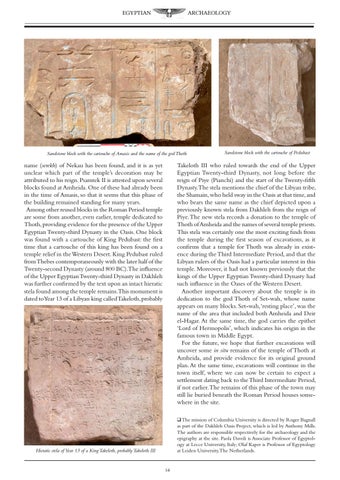
name (serekh) of Nekau has been found, and it is as yet unclear which part of the temple’s decoration may be attributed to his reign. Psamtek II is attested upon several blocks found at Amheida. One of these had already been in the time of Amasis, so that it seems that this phase of the building remained standing for many years. Among other reused blocks in the Roman Period temple are some from another, even earlier, temple dedicated to Thoth, providing evidence for the presence of the Upper Egyptian Twenty-third Dynasty in the Oasis. One block was found with a cartouche of King Pedubast: the first time that a cartouche of this king has been found on a temple relief in the Western Desert. King Pedubast ruled fromThebes contemporaneously with the later half of the Twenty-second Dynasty (around 800 BC).The influence of the Upper Egyptian Twenty-third Dynasty in Dakhleh was further confirmed by the text upon an intact hieratic stela found among the temple remains.This monument is dated toYear 13 of a Libyan king calledTakeloth, probably
Sandstone block with the cartouche of Pedubast
Takeloth III who ruled towards the end of the Upper Egyptian Twenty-third Dynasty, not long before the reign of Piye (Pianchi) and the start of the Twenty-fifth Dynasty.The stela mentions the chief of the Libyan tribe, the Shamain, who held sway in the Oasis at that time, and who bears the same name as the chief depicted upon a previously known stela from Dakhleh from the reign of Piye.The new stela records a donation to the temple of Thoth of Amheida and the names of several temple priests. This stela was certainly one the most exciting finds from the temple during the first season of excavations, as it confirms that a temple for Thoth was already in existence during the Third Intermediate Period, and that the Libyan rulers of the Oasis had a particular interest in this temple. Moreover, it had not known previously that the kings of the Upper Egyptian Twenty-third Dynasty had such influence in the Oases of the Western Desert. Another important discovery about the temple is its dedication to the god Thoth of Set-wah, whose name appears on many blocks. Set-wah,‘resting place’, was the name of the area that included both Amheida and Deir el-Hagar. At the same time, the god carries the epithet ‘Lord of Hermopolis’, which indicates his origin in the famous town in Middle Egypt. For the future, we hope that further excavations will uncover some in situ remains of the temple of Thoth at Amheida, and provide evidence for its original ground plan. At the same time, excavations will continue in the town itself, where we can now be certain to expect a settlement dating back to the Third Intermediate Period, if not earlier.The remains of this phase of the town may still lie buried beneath the Roman Period houses somewhere in the site. Ô The mission of Columbia University is directed by Roger Bagnall as part of the Dakhleh Oasis Project, which is led by Anthony Mills. The authors are responsible respectively for the archaeology and the epigraphy at the site. Paola Davoli is Associate Professor of Egyptology at Lecce University, Italy; Olaf Kaper is Professor of Egyptology at Leiden University,The Netherlands.
Hieratic stela of Year 13 of a King Takeloth, probably Takeloth III
14