EGYPTIAN
ARCHAEOLOGY
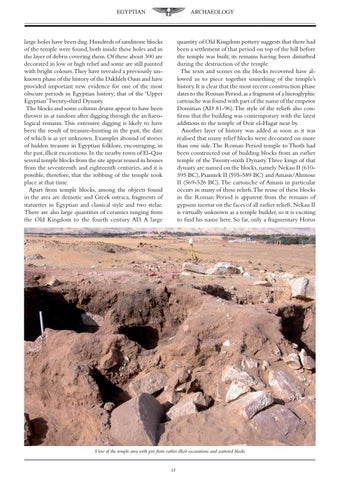
large holes have been dug. Hundreds of sandstone blocks of the temple were found, both inside these holes and in the layer of debris covering them. Of these about 300 are decorated in low or high relief and some are still painted with bright colours.They have revealed a previously unknown phase of the history of the Dakhleh Oasis and have provided important new evidence for one of the most obscure periods in Egyptian history; that of the ‘Upper Egyptian’Twenty-third Dynasty. The blocks and some column drums appear to have been thrown in at random after digging through the archaeological remains. This extensive digging is likely to have been the result of treasure-hunting in the past, the date of which is as yet unknown. Examples abound of stories of hidden treasure in Egyptian folklore, encouraging, in the past, illicit excavations. In the nearby town of El-Qasr several temple blocks from the site appear reused in houses from the seventeenth and eighteenth centuries, and it is possible, therefore, that the robbing of the temple took place at that time. Apart from temple blocks, among the objects found in the area are demotic and Greek ostraca, fragments of statuettes in Egyptian and classical style and two stelae. There are also large quantities of ceramics ranging from the Old Kingdom to the fourth century AD. A large
quantity of Old Kingdom pottery suggests that there had been a settlement of that period on top of the hill before the temple was built; its remains having been disturbed during the destruction of the temple. The texts and scenes on the blocks recovered have allowed us to piece together something of the temple’s history. It is clear that the most recent construction phase dates to the Roman Period,as a fragment of a hieroglyphic cartouche was found with part of the name of the emperor Domitian (AD 81-96).The style of the reliefs also confirms that the building was contemporary with the latest additions to the temple of Deir el-Hagar near by. Another layer of history was added as soon as it was realised that many relief blocks were decorated on more than one side.The Roman Period temple to Thoth had been constructed out of building blocks from an earlier temple of the Twenty-sixth Dynasty.Three kings of that dynasty are named on the blocks, namely Nekau II (610595 BC), Psamtek II (595-589 BC) and Amasis/Ahmose II (569-526 BC).The cartouche of Amasis in particular occurs in many of these reliefs.The reuse of these blocks in the Roman Period is apparent from the remains of gypsum mortar on the faces of all earlier reliefs. Nekau II is virtually unknown as a temple builder, so it is exciting to find his name here. So far, only a fragmentary Horus
View of the temple area with pits from earlier illicit excavations and scattered blocks
13