EGYPTIAN
ARCHAEOLOGY
A new temple for Thoth in the Dakhleh Oasis
As part of the Dakhleh Oasis Project, under the overall direction of Anthony Mills, a team from Columbia University has begun fieldwork at the temple at Amheida. Paola Davoli and Olaf Kaper describe the results of the first seasons of excavation.
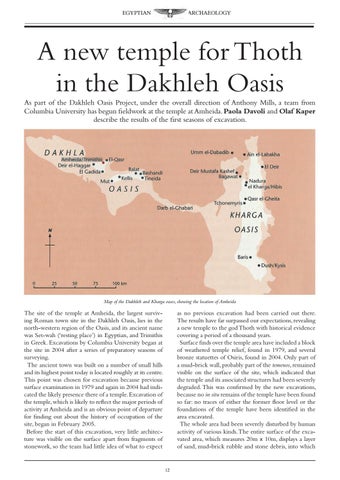
Map of the Dakhleh and Kharga oases, showing the location of Amheida
The site of the temple at Amheida, the largest surviving Roman town site in the Dakhleh Oasis, lies in the north-western region of the Oasis, and its ancient name was Set-wah (‘resting place’) in Egyptian, and Trimithis in Greek. Excavations by Columbia University began at the site in 2004 after a series of preparatory seasons of surveying. The ancient town was built on a number of small hills and its highest point today is located roughly at its centre. This point was chosen for excavation because previous surface examination in 1979 and again in 2004 had indicated the likely presence there of a temple. Excavation of the temple, which is likely to reflect the major periods of activity at Amheida and is an obvious point of departure for finding out about the history of occupation of the site, began in February 2005. Before the start of this excavation, very little architecture was visible on the surface apart from fragments of stonework, so the team had little idea of what to expect
as no previous excavation had been carried out there. The results have far surpassed our expectations, revealing a new temple to the god Thoth with historical evidence covering a period of a thousand years. Surface finds over the temple area have included a block of weathered temple relief, found in 1979, and several bronze statuettes of Osiris, found in 2004. Only part of a mud-brick wall, probably part of the temenos, remained visible on the surface of the site, which indicated that the temple and its associated structures had been severely degraded. This was confirmed by the new excavations, because no in situ remains of the temple have been found so far: no traces of either the former floor level or the foundations of the temple have been identified in the area excavated. The whole area had been severely disturbed by human activity of various kinds.The entire surface of the excavated area, which measures 20m x 10m, displays a layer of sand, mud-brick rubble and stone debris, into which
12