EGYPTIAN
ARCHAEOLOGY
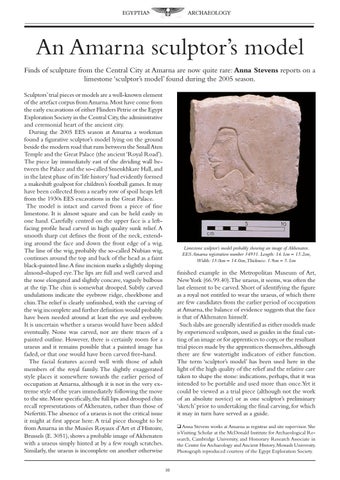
An Amarna sculptor’s model Finds of sculpture from the Central City at Amarna are now quite rare: Anna Stevens reports on a limestone ‘sculptor’s model’ found during the 2005 season. Sculptors’trial pieces or models are a well-known element of the artefact corpus from Amarna.Most have come from the early excavations of either Flinders Petrie or the Egypt Exploration Society in the Central City,the administrative and ceremonial heart of the ancient city. During the 2005 EES season at Amarna a workman found a figurative sculptor’s model lying on the ground beside the modern road that runs between the Small Aten Temple and the Great Palace (the ancient ‘Royal Road’). The piece lay immediately east of the dividing wall between the Palace and the so-called Smenkhkare Hall, and in the latest phase of its ‘life history’ had evidently formed a makeshift goalpost for children’s football games. It may have been collected from a nearby row of spoil heaps left from the 1930s EES excavations in the Great Palace. The model is intact and carved from a piece of fine limestone. It is almost square and can be held easily in one hand. Carefully centred on the upper face is a leftfacing profile head carved in high quality sunk relief. A smooth sharp cut defines the front of the neck, extending around the face and down the front edge of a wig. The line of the wig, probably the so-called Nubian wig, continues around the top and back of the head as a faint black-painted line.A fine incision marks a slightly sloping almond-shaped eye.The lips are full and well carved and the nose elongated and slightly concave, vaguely bulbous at the tip.The chin is somewhat drooped. Subtly carved undulations indicate the eyebrow ridge, cheekbone and chin.The relief is clearly unfinished, with the carving of the wig incomplete and further definition would probably have been needed around at least the eye and eyebrow. It is uncertain whether a uraeus would have been added eventually. None was carved, nor are there traces of a painted outline. However, there is certainly room for a uraeus and it remains possible that a painted image has faded, or that one would have been carved free-hand. The facial features accord well with those of adult members of the royal family. The slightly exaggerated style places it somewhere towards the earlier period of occupation at Amarna, although it is not in the very extreme style of the years immediately following the move to the site.More specifically,the full lips and drooped chin recall representations of Akhenaten, rather than those of Nefertiti.The absence of a uraeus is not the critical issue it might at first appear here. A trial piece thought to be from Amarna in the Musées Royaux d’Art et d’Histoire, Brussels (E. 3051), shows a probable image of Akhenaten with a uraeus simply hinted at by a few rough scratches. Similarly, the uraeus is incomplete on another otherwise
Limestone sculptor’s model probably showing an image of Akhenaten. EES Amarna registration number 34931. Length: 14.1cm – 15.2cm, Width: 13.0cm – 14.0cm,Thickness: 1.9cm – 5.1cm
finished example in the Metropolitan Museum of Art, New York (66.99.40).The uraeus, it seems, was often the last element to be carved. Short of identifying the figure as a royal not entitled to wear the uraeus, of which there are few candidates from the earlier period of occupation at Amarna, the balance of evidence suggests that the face is that of Akhenaten himself. Such slabs are generally identified as either models made by experienced sculptors, used as guides in the final cutting of an image or for apprentices to copy,or the resultant trial pieces made by the apprentices themselves, although there are few watertight indicators of either function. The term ‘sculptor’s model’ has been used here in the light of the high quality of the relief and the relative care taken to shape the stone: indications, perhaps, that it was intended to be portable and used more than once.Yet it could be viewed as a trial piece (although not the work of an absolute novice) or as one sculptor’s preliminary ‘sketch’ prior to undertaking the final carving, for which it may in turn have served as a guide. Ô Anna Stevens works at Amarna as registrar and site supervisor. She is Visiting Scholar at the McDonald Institute for Archaeological Research, Cambridge University, and Honorary Research Associate in the Centre for Archaeology and Ancient History, Monash University. Photograph reproduced courtesy of the Egypt Exploration Society.
10