EGYPTIAN
ARCHAEOLOGY
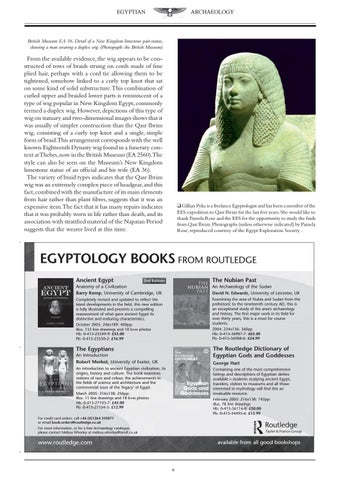
British Museum EA 36. Detail of a New Kingdom limestone pair-statue, showing a man wearing a duplex wig. (Photograph: the British Museum)
From the available evidence, the wig appears to be constructed of rows of braids strung on cords made of fine plied hair, perhaps with a cord tie allowing them to be tightened, somehow linked to a curly top knot that sat on some kind of solid substructure.This combination of curled upper and braided lower parts is reminiscent of a type of wig popular in New Kingdom Egypt, commonly termed a duplex wig. However, depictions of this type of wig on statuary and two-dimensional images shows that it was usually of simpler construction than the Qasr Ibrim wig, consisting of a curly top knot and a single, simple form of braid.This arrangement corresponds with the well known Eighteenth Dynasty wig found in a funerary context atThebes,now in the British Museum (EA 2560).The style can also be seen on the Museum’s New Kingdom limestone statue of an official and his wife (EA 36). The variety of braid types indicates that the Qasr Ibrim wig was an extremely complex piece of headgear, and this fact, combined with the manufacture of its main elements from hair rather than plant fibres, suggests that it was an expensive item.The fact that it has many repairs indicates that it was probably worn in life rather than death, and its association with stratified material of the Napatan Period suggests that the wearer lived at this time.
Ô Gillian Pyke is a freelance Egyptologist and has been a member of the EES expedition to Qasr Ibrim for the last five years. She would like to thank Pamela Rose and the EES for the opportunity to study the finds from Qasr Ibrim. Photographs (unless otherwise indicated) by Pamela Rose, reproduced courtesy of the Egypt Exploration Society. .
EGYPTOLOGY BOOKS FROM ROUTLEDGE Ancient Egypt
The Nubian Past
2nd Edition
An Archaeology of the Sudan
Anatomy of a Civilization Barry Kemp, University of Cambridge, UK
David N. Edwards, University of Leicester, UK
Completely revised and updated to reflect the latest developments in the field, this new edition is fully illustrated and presents a compelling reassessment of what gave ancient Egypt its distinctive and enduring characteristics. October 2005: 246x189: 400pp: illus. 133 line drawings and 10 b+w photos Hb: 0-415-23549-9: £55.00 Pb: 0-415-23550-2: £16.99
Examining the area of Nubia and Sudan from the prehistoric to the nineteenth century AD, this is an exceptional study of the area's archaeology and history. The first major work in its field for over thirty years, this is a must for course students. 2004: 234x156: 360pp Hb: 0-415-36987-7: £65.00 Pb: 0-415-36988-6: £24.99
The Egyptians
The Routledge Dictionary of Egyptian Gods and Goddesses
An Introduction Robert Morkot, University of Exeter, UK
George Hart
An introduction to ancient Egyptian civilization, its origins, history and culture. The book examines notions of race and colour, the achievements in the fields of science and architecture and the controversial issue of the 'legacy' of Egypt. March 2005: 216x138: 256pp: illus. 11 line drawings and 18 b+w photos Hb: 0-415-27103-7: £45.00 Pb: 0-415-27104-5: £12.99
Containing one of the most comprehensive listings and descriptions of Egyptian deities available – students studying ancient Egypt, travelers, visitors to museums and all those interested in mythology will find this an invaluable resource. February 2005: 216x138: 192pp: illus. 78 line drawings Hb: 0-415-36116-8: £50.00 Pb: 0-415-34495-6: £13.99
For credit card orders: call +44 (0)1264 343071 or email book.orders@routledge.co.uk For more information, or for a free Archaeology catalogue, please contact Melissa Whorley at melissa.whorley@tandf.co.uk
www.routledge.com
available from all good bookshops
9