EGYPTIAN
A complete braid
ARCHAEOLOGY
An additional braid
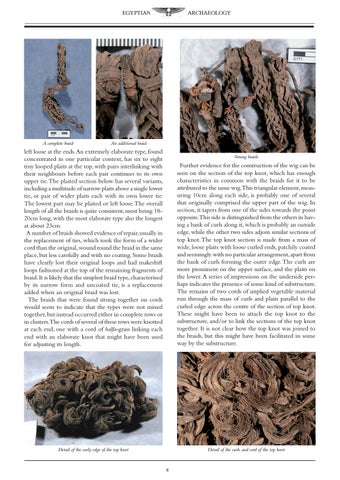
left loose at the ends.An extremely elaborate type, found concentrated in one particular context, has six to eight tiny looped plaits at the top, with pairs interlinking with their neighbours before each pair continues to its own upper tie.The plaited section below has several variants, including a multitude of narrow plaits above a single lower tie, or pair of wider plaits each with its own lower tie. The lowest part may be plaited or left loose.The overall length of all the braids is quite consistent, most being 1820cm long, with the most elaborate type also the longest at about 23cm. A number of braids showed evidence of repair, usually in the replacement of ties, which took the form of a wider cord than the original,wound round the braid in the same place, but less carefully and with no coating. Some braids have clearly lost their original loops and had makeshift loops fashioned at the top of the remaining fragments of braid. It is likely that the simplest braid type, characterised by its narrow form and uncoated tie, is a replacement added when an original braid was lost. The braids that were found strung together on cords would seem to indicate that the types were not mixed together, but instead occurred either in complete rows or in clusters.The cords of several of these rows were knotted at each end, one with a cord of halfa-grass linking each end with an elaborate knot that might have been used for adjusting its length.
Further evidence for the construction of the wig can be seen on the section of the top knot, which has enough characteristics in common with the braids for it to be attributed to the same wig.This triangular element, measuring 10cm along each side, is probably one of several that originally comprised the upper part of the wig. In section, it tapers from one of the sides towards the point opposite.This side is distinguished from the others in having a bank of curls along it, which is probably an outside edge, while the other two sides adjoin similar sections of top knot. The top knot section is made from a mass of wide, loose plaits with loose curled ends, patchily coated and seemingly with no particular arrangement,apart from the bank of curls forming the outer edge.The curls are more prominent on the upper surface, and the plaits on the lower. A series of impressions on the underside perhaps indicates the presence of some kind of substructure. The remains of two cords of unplied vegetable material run through the mass of curls and plaits parallel to the curled edge across the centre of the section of top knot. These might have been to attach the top knot to the substructure, and/or to link the sections of the top knot together. It is not clear how the top knot was joined to the braids, but this might have been facilitated in some way by the substructure.
Detail of the curly edge of the top knot
Detail of the curls and cord of the top knot
Strung braids
8