EGYPTIAN
ARCHAEOLOGY
Notes and News
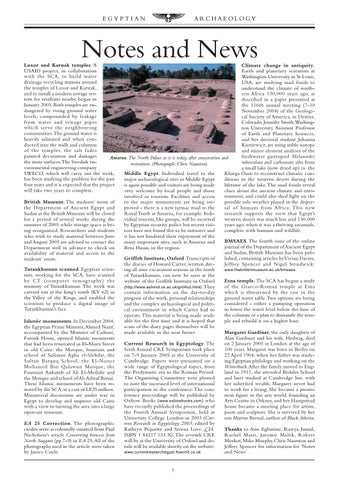
Luxor and Karnak temples. A Climate change in antiquity. USAID project, in collaboration Earth and planetary scientists at with the SCA, to build water Washington University in St Louis, drainage recycling stations around USA, are studying snail fossils to the temples of Luxor and Karnak, understand the climate of northand to install a modern sewage sysern Africa 130,000 years ago, as tem for residents nearby, began in described in a paper presented at January 2005. Both temples are enthe 116th annual meeting (7-10 dangered by rising ground water November 2004) of the Geologilevels, compounded by leakage cal Society of America, in Denver, from water and sewage pipes Colorado. Jennifer Smith,Washingwhich serve the neighbour ing ton University Assistant Professor communities. The ground water is of Earth and Planetary Sciences, heavily salinated and when conand her doctoral student Johanna ducted into the walls and columns Kieniewicz, are using stable isotope of the temples, the salt f ades and minor element analyses of the painted decoration and damages freshwater gastropod Melanoides Amarna. The North Palace as it is today, after conservation and the stone surfaces.The Swedish entuberculata and carbonate silts from restoration. (Photograph: Chris Naunton) vironmental engineering company a small lake (now dried up) in the SWECO, which will carry out the work, Kharga Oasis to reconstruct climatic conMiddle Egypt. Individual travel to the has been studying the problem for the past ditions in the western desert during the major archaeological sites in Middle Egypt four years and it is expected that the project is again possible and visitors are being made lifetime of the lake. The snail fossils reveal will take two years to complete. clues about the ancient climate and envivery welcome by local people and those ronment, and could also shed light on the involved in tourism. Facilities and access to the major monuments are being impossible role weather played in the disperBritish Museum. The students’ room of sal of humans from Afr ica. This new proved - there is a new tarmac road to the the Department of Ancient Egypt and research supports the view that Egypt’s Royal Tomb at Amarna, for example. IndiSudan at the British Museum will be closed vidual tourists, like groups, will be escorted western desert was much less arid 130,000 for a period of several weeks during the years ago, when it was a thriving savannah, by Egyptian security police but recent visisummer of 2005 while storage space is becomplete with humans and wildlife. tors have not found this to be intrusive and ing reorganised. Researchers and students it has not hindered their enjoyment of the who wish to study material between June BMSAES. The fourth issue of the online many important sites, such as Amarna and and August 2005 are advised to contact the journal of the Department of Ancient Egypt Beni Hasan, in the region. Department well in advance to check on and Sudan, British Museum has been pubavailability of material and access to the lished, containing articles by Vivian Davies, Griffith Institute, Oxford. Transcripts of students’ room. Jeffrey Spencer and Nigel Strudwick: the diaries of Howard Carter, written durTutankhamun scanned. Egyptian sciening all nine excavation seasons in the tomb www.thebritishmuseum.ac.uk/bmsaes tists, working for the SCA, have scanned of Tutankhamun, can now be seen at the by CT (computer tomog raphy) the Esna temple. The SCA has begun a study website of the Griffith Institute in Oxford mummy of Tutankhamun. The work was of the Graeco-Roman temple at Esna (http://www.ashmol.ox.ac.uk/gri/4tut.html). They carried out at the king’s tomb (KV 62) in which is threatened by the r ise in the contain information on the day-to-day the Valley of the Kings, and enabled the ground water table. Two options are being progress of the work, personal relationships scientists to produce a digital image of considered - either a pumping operation and the complex archaeological and politiTutankhamun’s face. to lower the water level below the base of cal environment in which Carter had to the columns or a plan to dismantle the temoperate. This material is being made availple and rebuild it on a higher base. able for the first time and it is hoped that Islamic monuments. In December 2004, scans of the diary pages themselves will be the Egyptian Prime Minister, Ahmed Nazif, made available in the near future. Margaret Gardiner, the only daughter of accompanied by the Minister of Culture, Alan Gardiner and his wife, Hedwig, died Farouk Hosni, opened Islamic monments on 2 January 2005 in London at the age of Current Research in Egyptology. The that had been renovated in El-Muez Street 100 years. Margaret was born in Berlin on Sixth Annual CRE Symposium took place in old Cairo: the Mosque, fountain and 22 April 1904, when her father was studyon 7-9 January 2005 at the University of school of Suliman Agha el-Slehdar, the ing Egyptian philology and working on the Cambridge. Papers were presented on a Sultan Barquq School, the El-Nasser Wörterbuch. After the family moved to Engwide range of Egyptological topics, from Mohamed Bin Qalawun Mosque, the land in 1911, she attended Bedales School the Predynastic era to the Roman Period. Fountain Ankuteb of Ali El-Metlahr and and later studied at Cambridge but, with The Organising Committee were pleased the Mosque and school of Al-Ashraf Bersai. her inherited wealth, Margaret never had to note the increased level of international These Islamic monuments have been reto work for a living. She became a promiparticipation in the conference. The constored by the SCA, at a cost of LE25 million. nent figure in the arts world, founding an ference proceedings will be published by Ministerial discussions are under way in Arts Centre in Orkney, and her Hampstead Oxbow Books ( www.oxbowbooks.com) who Egypt to develop and improve old Cairo have recently published the proceedings of home became a meeting place for artists, with a view to turning the area into a large the Fourth Annual Symposium, held at poets and sculptors. She is survived by her open-air museum. University College London in 2003 (Curson Martin Bernal, author of Black Athena. rent Research in Egyptology 2003, edited by EA 25 Correction. The photographic Thanks to Ann Eglintine, Rawya Ismail, Kathryn Piquette and Serena Love. £24. credits were accidentally omitted from Paul Rachel Mairs, Jaromir Malek, Robert ISBN 1 84217 133 X). The seventh CRE Nicholson’s article Conserving bronzes from Morkot, Mike Murphy, Chris Naunton and will be at the University of Oxford and deNorth Saqqara (pp.7-9) in EA 25. All of the Jeffrey Spencer for information for ‘Notes tails will be available shortly on the website: photographs used in the article were taken www.currentresearchegypt.fsworld.co.uk and News’. by Janice Coyle.
7