EGYPTIAN
Priest of Amun, Osorkon of the ‘chronicle’ recorded on the Bubastite Portal at Karnak. Furthermore, later on in the book, Professor Redford writes that from the end of the Twenty-Fifth Dynasty onwards Thebes would be the ‘center of dissent in a reactionary south’, just as it had perhaps been before the beginning of the period. The author’s thoughts on the chronology of the early Twenty-Fifth Dynasty take into consideration the very recently discovered Assyrian evidence from Tang-I Var, and his analysis of Piye’s campaign, particularly as to whether or not his defeat of the rebellious Delta chieftains had any lasting effect, is thoughtful and perceptive. Later, much interesting detail is provided on the nature of the Assyrian invasions which were the blight of the dynasty during its last decade and which would eventually bring it down. Perhaps of greatest value however are the sections on the author’s own work at TwentyFifth Dynasty sites on which he, as their excavator, has a unique perspective and understanding. Details of his excavations at Karnak’s ‘Temple C’ (which he would add to the impressive list of buildings of the reign of Taharqo) and elsewhere at Karnak, are a useful addition to our knowledge, particularly as the detailed publication of these monuments is still awaited. Professor Redford’s point in the epilogue that certain of the more powerful political figures in Egypt ‘embraced Assyrian hostility towards the Napatan regime’ is well made and raises issues that are central to the study of Egypt from the end of the New Kingdom onwards: that of the influx of foreign invaders, settlers, traders and mercenaries, Egyptian attitudes to them, and the effect and extent of their assimilation into and influence on Egyptian culture. The author’s deep knowledge of the various cultures of the Mediterranean and Near East is to the reader’s advantage. Professor Redford also explains how ‘By the close of the seventh century the Egyptians were taking active steps once and for all to neutralize the surviving Twenty-Fifth Dynasty’, raising the question of what the nature of this ‘threat’ actually was. The Egyptian attitude to the Kushite regime is lost to us now but it probably varied throughout the country, with the Thebaid less hostile than the Delta. In terms of art and architecture, at least, far from imposing their own alien traditions on the country, not only were the Twenty-Fifth Dynasty kings thoroughly Egyptianised themselves, they actually seem to have reinvigorated the traditions of Egyptian culture (particularly at Thebes). Events after the end of the Dynasty are dealt with in the three-page epilogue, and the author mentions in the preface that the TwentySixth Dynasty will form the focus of a forthcoming monograph of his – Egyptian/Nubian relations will surely be dealt with in more detail there. However, that volume is unlikely to be a suitable place for expansion on the subject of the later Kushite and Meroitic cultures, on which a little more could have been said here. The Nubian pharaohs of the Twenty-Fifth Dynasty have not previously received the attention accorded to other Egyptian rulers, for
ARCHAEOLOGY
various reasons: their monuments are not as visible today as are those of the New Kingdom, and the names of the Kushite pharaohs have not entered the popular perception of ancient Egypt in the same way as ‘Ramesses’, ‘Tutankhamun’ or ‘Cleopatra’. But this is not to say that theirs is not a story worth telling. While the popular media, and in particular television companies, take no risks when covering ancient Egypt and tend to stick to well-trodden paths, Professor Redford has demonstrated that more obscure material can be presented in a way that is fresh, exciting and accessible. CHRIS NAUNTON
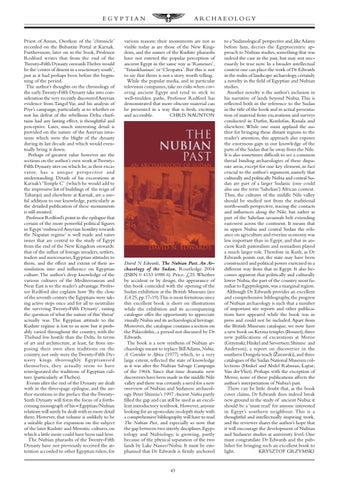
David N Edwards, The Nubian Past. An Archaeology of the Sudan. Routledge 2004 (ISBN 0 4153 6988 6). Price: £25. Whether by accident or by design, the appearance of this book coincided with the opening of the Sudan exhibition at the British Museum (see EA 25, pp.17-19).This is most fortuitous since this excellent book is short on illustrations while the exhibition and its accompanying catalogue offer the opportunity to appreciate visually Nubia and its archaeological heritage. Moreover, the catalogue contains a section on the Palaeolithic, a period not discussed by Dr Edwards. The book is a new synthesis of Nubian archaeology meant to replace Bill Adams, Nubia, A Corridor to Africa (1977) which, to a very large extent, reflected the state of knowledge as it was after the Nubian Salvage Campaign of the 1960s. Since that time dramatic new discoveries have been made in the middle Nile valley and there was certainly a need for a new overview of Nubian and Sudanese archaeology. Peter Shinnie’s 1997 Ancient Nubia partly filled the gap and can still be used as an excellent introductory textbook. However, anyone looking for an up-to-date in-depth study with a comprehensive bibliography will have to read The Nubian Past, and especially so now that the gap between two sisterly disciplines, Egyptology and Nubiology, is growing, partly because of the physical separation of the two lands by Lake Nasser/Nubia. It must be emphasised that Dr Edwards is firmly anchored
43
to a ‘Sudanological’ perspective and, like Adams before him, decries the Egyptocentric approach to Nubian studies, something that was indeed the case in the past, but may not necessarily be true now. In a broader intellectual context one can place the work of Dr Edwards in the realm of landscape archaeology, certainly a novelty in the field of Egyptian and Nubian studies. Another novelty is the author’s inclusion in his narrative of lands beyond Nubia. This is reflected both in the reference to the Sudan in the title of the book and in actual presentation of material from excavations and surveys conducted in Darfur, Kordofan, Kassala and elsewhere. While one must applaud the author for bringing these distant regions to the reader’s attention, this approach also exposes the enormous gaps in our knowledge of the parts of the Sudan that lie away from the Nile. It is also sometimes difficult to see a common thread binding archaeologies of these disparate areas, except for one key element, in fact crucial to the author’s argument, namely that culturally and politically Nubia and central Sudan are part of a larger Sudanic (one could also use the term ‘Sahelian’) African context. Thus, the cultures of the middle Nile valley should be studied not from the traditional north-south perspective, tracing the contacts and influences along the Nile, but rather as part of the Sahelian savannah belt extending east-west across the continent. It means that in upper Nubia and central Sudan the reliance on agriculture and riverine economy was less important than in Egypt, and that in ancient Kush pastoralism and nomadism played a much larger role. Therefore in Kush, as Dr Edwards points out, the state may have been constructed and political power exercised in a different way from that in Egypt. It also becomes apparent that politically and culturally lower Nubia, the part of the country most familiar to Egyptologists, was a marginal region. Although Dr Edwards provides an excellent and comprehensive bibliography, the progress of Nubian archaeology is such that a number of important site reports and other publications have appeared while the book was in press and could not be included. Apart from the British Museum catalogue, we now have a new book on Kerma temples (Bonnet), three new publications of excavations at Meroe (Grzymski; Hinkel and Sievertsen; Shinnie and Anderson), a report on discoveries in the southern Dongola reach (Îurawski), and three catalogues of the Sudan National Museum collections (Hinkel and Abdel Rahman; Lajtar; Van der Vliet). Perhaps with the exception of Meroe, none of these publications affects the author’s interpretation of Nubia’s past. There can be little doubt that, as the book cover claims, Dr Edwards does indeed break new ground in the study of ancient Nubia: it should be a ‘must read’ for anyone interested in Egypt’s southern neighbour. This is a thoughtful and intellectually inspiring work, and the reviewer shares the author’s hope that it will encourage the development of Nubian and Sudanese studies at university level. One must congratulate Dr Edwards and the publisher for bringing such an excellent book to light. KRYSZTOF GRZYMSKI