EGYPTIAN
ARCHAEOLOGY
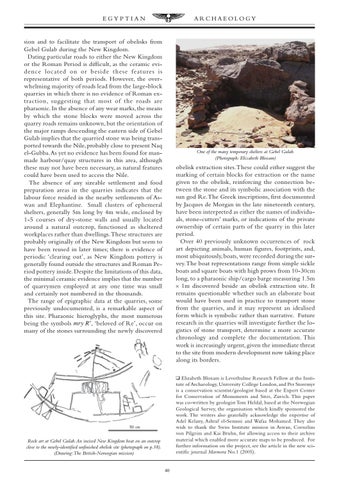
sion and to facilitate the transport of obelisks from Gebel Gulab during the New Kingdom. Dating particular roads to either the New Kingdom or the Roman Period is difficult, as the ceramic evidence located on or beside these features is representative of both periods. However, the overwhelming majority of roads lead from the large-block quarries in which there is no evidence of Roman extraction, suggesting that most of the roads are pharaonic. In the absence of any wear marks, the means by which the stone blocks were moved across the quarry roads remains unknown, but the orientation of the major ramps descending the eastern side of Gebel Gulab implies that the quarried stone was being transported towards the Nile, probably close to present Naq el-Gubba. As yet no evidence has been found for manmade harbour/quay structures in this area, although these may not have been necessary, as natural features could have been used to access the Nile. The absence of any sizeable settlement and food preparation areas in the quarries indicates that the labour force resided in the nearby settlements of Aswan and Elephantine. Small clusters of ephemeral shelters, generally 5m long by 4m wide, enclosed by 1-5 courses of dry-stone walls and usually located around a natural outcrop, functioned as sheltered workplaces rather than dwellings. These structures are probably originally of the New Kingdom but seem to have been reused in later times; there is evidence of periodic ‘clearing out’, as New Kingdom pottery is generally found outside the structures and Roman Period pottery inside. Despite the limitations of this data, the minimal ceramic evidence implies that the number of quarrymen employed at any one time was small and certainly not numbered in the thousands. The range of epigraphic data at the quarries, some previously undocumented, is a remarkable aspect of this site. Pharaonic hieroglyphs, the most numerous being the symbols mry Ra, ‘beloved of Re’, occur on many of the stones surrounding the newly discovered
One of the many temporary shelters at Gebel Gulab. (Photograph: Elizabeth Bloxam)
obelisk extraction sites. These could either suggest the marking of certain blocks for extraction or the name given to the obelisk, reinforcing the connection between the stone and its symbolic association with the sun god Re. The Greek inscriptions, first documented by Jacques de Morgan in the late nineteenth century, have been interpreted as either the names of individuals, stone-cutters’ marks, or indications of the private ownership of certain parts of the quarry in this later period. Over 40 previously unknown occurrences of rock art depicting animals, human figures, footprints, and, most ubiquitously, boats, were recorded during the survey. The boat representations range from simple sickle boats and square boats with high prows from 10-30cm long, to a pharaonic ship/cargo barge measuring 1.5m × 1m discovered beside an obelisk extraction site. It remains questionable whether such an elaborate boat would have been used in practice to transport stone from the quarries, and it may represent an idealised form which is symbolic rather than narrative. Future research in the quarries will investigate further the logistics of stone transport, determine a more accurate chronology and complete the documentation. This work is increasingly urgent, given the immediate threat to the site from modern development now taking place along its borders. ❑ Elizabeth Bloxam is Leverhulme Research Fellow at the Institute of Archaeology, University College London, and Per Storemyr is a conservation scientist/geologist based at the Expert Center for Conservation of Monuments and Sites, Zurich. This paper was co-written by geologist Tom Heldal, based at the Norwegian Geological Survey, the organisation which kindly sponsored the work. The writers also gratefully acknowledge the expertise of Adel Kelany, Ashraf el-Senussi and Wafaa Mohamed. They also wish to thank the Swiss Institute mission in Aswan, Cornelius von Pilgrim and Kai Bruhn, for allowing access to their archive material which enabled more accurate maps to be produced. For further information on the project, see the article in the new scientific journal Marmora No.1 (2005).
Rock art at Gebel Gulab. An incised New Kingdom boat on an outcrop close to the newly-identified unfinished obelisk site (photograph on p.38). (Drawing: The British-Norwegian mission) 40