EGYPTIAN
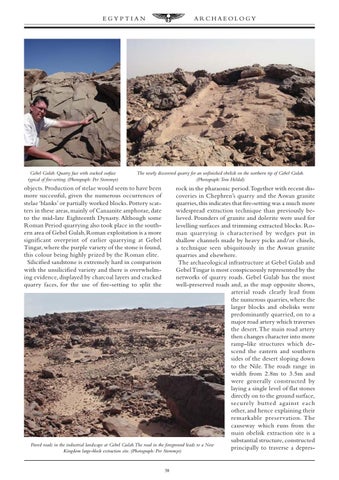
Gebel Gulab. Quarry face with cracked surface typical of fire-setting. (Photograph: Per Storemyr)
ARCHAEOLOGY
The newly discovered quarry for an unfinished obelisk on the northern tip of Gebel Gulab. (Photograph: Tom Heldal)
objects. Production of stelae would seem to have been more successful, given the numerous occurrences of stelae ‘blanks’ or partially worked blocks. Pottery scatters in these areas, mainly of Canaanite amphorae, date to the mid-late Eighteenth Dynasty. Although some Roman Period quarrying also took place in the southern area of Gebel Gulab, Roman exploitation is a more significant overprint of earlier quarrying at Gebel Tingar, where the purple variety of the stone is found, this colour being highly prized by the Roman elite. Silicified sandstone is extremely hard in comparison with the unsilicified variety and there is overwhelming evidence, displayed by charcoal layers and cracked quarry faces, for the use of fire-setting to split the
rock in the pharaonic period.Together with recent discoveries in Chephren’s quarry and the Aswan granite quarries, this indicates that fire-setting was a much more widespread extraction technique than previously believed. Pounders of granite and dolerite were used for levelling surfaces and trimming extracted blocks. Roman quarrying is characterised by wedges put in shallow channels made by heavy picks and/or chisels, a technique seen ubiquitously in the Aswan granite quarries and elsewhere. The archaeological infrastructure at Gebel Gulab and Gebel Tingar is most conspicuously represented by the networks of quarry roads. Gebel Gulab has the most well-preserved roads and, as the map opposite shows, arterial roads clearly lead from the numerous quarries, where the larger blocks and obelisks were predominantly quarried, on to a major road artery which traverses the desert. The main road artery then changes character into more ramp-like structures which descend the eastern and southern sides of the desert sloping down to the Nile. The roads range in width from 2.8m to 3.5m and were generally constructed by laying a single level of flat stones directly on to the ground surface, securely butted against each other, and hence explaining their remarkable preservation. The causeway which runs from the main obelisk extraction site is a substantial structure, constructed Paved roads in the industrial landscape at Gebel Gulab. The road in the foreground leads to a New principally to traverse a depresKingdom large-block extraction site. (Photograph: Per Storemyr) 38