EGYPTIAN
ARCHAEOLOGY
Answering archaeological questions ancient harbour, this time on the Red Sea, which was probably the Ptolemaic port of Nechesia. From the Delta, there are reports on work at three of the major cities: Donald Redford assesses the history and monuments of Mendes, Penny Wilson reveals some previously unsuspected aspects of the Twenty-Sixth Dynasty capital at Sais, and Neal Spencer has been studying the remains of a monumental shrine of Nekhthorheb from Bubastis. From the other end of Egypt, Elizabeth Bloxam and Per Storemyr report on the quartzite quarries at Aswan, finding evidence for their exploitation in both the New Kingdom and the Roman Period. Finally, Miroslav Bárta and Vladimír BrÛna demonstrate how satellite images, such as the stunning view used on the front cover, can increase our knowledge of even such well-known sites as the Memphite pyramid fields. PATRICIA SPENCER
The title of Janine Bourriau’s article in this issue ‘All this pottery, what about it?’demonstrates the curiosity of non-specialists about archaeological investigations. In this case the question was posed by a visitor to the EES excavations at Memphis, baffled by the attention being paid to seemingly insignificant pot-sherds. Such painstaking recording of information and its subsequent study, whether it happens in the field or later in research facilities, is an essential part of all archaeology in Egypt today. The articles in this issue of EA illustrate the varied nature of current Egyptological research and show how detailed study of the available evidence can help archaeologists to answer questions. Manfred Bietak assesses the evidence for locating the ancient Egyptian harbour of Perunefer in the Nile Delta, rather than at Memphis, while John Seeger and Steven Sidebotham have been investigating another
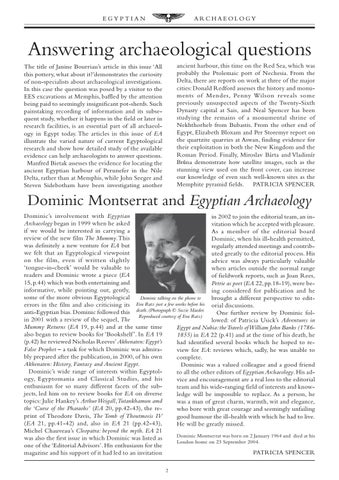
Dominic Montserrat and Egyptian Archaeology Dominic’s involvement with Egyptian in 2002 to join the editorial team, an inArchaeology began in 1999 when he asked vitation which he accepted with pleasure. if we would be interested in carrying a As a member of the editor ial board review of the new film The Mummy. This Dominic, when his ill-health permitted, was definitely a new venture for EA but regularly attended meetings and contribwe felt that an Egyptological viewpoint uted greatly to the editorial process. His on the film, even if wr itten slightly advice was always particularly valuable ‘tongue-in-cheek’ would be valuable to when articles outside the normal range readers and Dominic wrote a piece (EA of fieldwork reports, such as Joan Rees, 15, p.44) which was both entertaining and Petrie as poet (EA 22, pp.18-19), were beinformative, while pointing out, gently, ing considered for publication and he some of the more obvious Egyptological Dominic talking on the phone to brought a different perspective to editerrors in the film and also criticising its Eva Ratz just a few weeks before his orial discussions. anti-Egyptian bias. Dominic followed this death. (Photograph © Suzie Maeder. One further review by Dominic folReproduced courtesy of Eva Ratz) in 2001 with a review of the sequel, The lowed: of Patricia Usick’s Adventures in Mummy Returns (EA 19, p.44) and at the same time Egypt and Nubia: the Travels of William John Banks (1786also began to review books for ‘Bookshelf ’. In EA 19 1855) in EA 22 (p.41) and at the time of his death, he (p.42) he reviewed Nicholas Reeves’ Akhenaten: Egypt’s had identified several books which he hoped to reFalse Prophet – a task for which Dominic was admiraview for EA: reviews which, sadly, he was unable to bly prepared after the publication, in 2000, of his own complete. Akhenaten: History, Fantasy and Ancient Egypt. Dominic was a valued colleague and a good friend Dominic’s wide range of interests within Egyptolto all the other editors of Egyptian Archaeology. His adogy, Egyptomania and Classical Studies, and his vice and encouragement are a real loss to the editorial enthusiasm for so many different facets of the subteam and his wide-ranging field of interests and knowjects, led him on to review books for EA on diverse ledge will be impossible to replace. As a person, he topics: Julie Hankey’s Arthur Weigall, Tutankhamun amd was a man of great charm, warmth, wit and elegance, the ‘Curse of the Pharaohs’ (EA 20, pp.42-43), the rewho bore with great courage and seemingly unfailing print of Theodore Davis, The Tomb of Thoutmosis IV good humour the ill-health with which he had to live. (EA 21, pp.41-42) and, also in EA 21 (pp.42-43), He will be greatly missed. Michel Chauveau’s Cleopatra: beyond the myth. EA 21 Dominic Montserrat was born on 2 January 1964 and died at his was also the first issue in which Dominic was listed as London home on 23 September 2004. one of the ‘Editorial Advisors’. His enthusiasm for the PATRICIA SPENCER magazine and his support of it had led to an invitation 2