EGYPTIAN
ARCHAEOLOGY
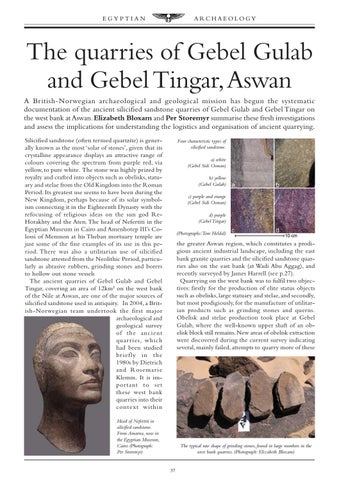
The quarries of Gebel Gulab and Gebel Tingar, Aswan A British-Norwegian archaeological and geological mission has begun the systematic documentation of the ancient silicified sandstone quarries of Gebel Gulab and Gebel Tingar on the west bank at Aswan. Elizabeth Bloxam and Per Storemyr summarise these fresh investigations and assess the implications for understanding the logistics and organisation of ancient quarrying. Silicified sandstone (often termed quartzite) is generally known as the most ‘solar of stones’, given that its crystalline appearance displays an attractive range of colours covering the spectrum from purple red, via yellow, to pure white. The stone was highly prized by royalty and crafted into objects such as obelisks, statuary and stelae from the Old Kingdom into the Roman Period. Its greatest use seems to have been during the New Kingdom, perhaps because of its solar symbolism connecting it in the Eighteenth Dynasty with the refocusing of religious ideas on the sun god ReHorakhty and the Aten. The head of Nefertiti in the Egyptian Museum in Cairo and Amenhotep III’s Colossi of Memnon at his Theban mortuary temple are just some of the fine examples of its use in this period. There was also a utilitarian use of silicified sandstone attested from the Neolithic Period, particularly as abrasive rubbers, grinding stones and borers to hollow out stone vessels The ancient quarries of Gebel Gulab and Gebel Tingar, covering an area of 12km2 on the west bank of the Nile at Aswan, are one of the major sources of silicified sandstone used in antiquity. In 2004, a British-Norwegian team undertook the first major archaeological and geological survey of the ancient quar r ies, which had been studied br iefly in the 1980s by Dietrich and Rosemar ie Klemm. It is impor tant to set these west bank quarries into their context within
Four characteristic types of silicified sandstone. a) white (Gebel Sidi Osman) b) yellow (Gebel Gulab) c) purple and orange (Gebel Sidi Osman) d) purple (Gebel Tingar) (Photographs:Tom Heldal)
the greater Aswan region, which constitutes a prodigious ancient industrial landscape, including the east bank granite quarries and the silicified sandstone quarries also on the east bank (at Wadi Abu Aggag), and recently surveyed by James Harrell (see p.27). Quarrying on the west bank was to fulfil two objectives: firstly for the production of elite status objects such as obelisks, large statuary and stelae, and secondly, but most prodigiously, for the manufacture of utilitarian products such as grinding stones and querns. Obelisk and stelae production took place at Gebel Gulab, where the well-known upper shaft of an obelisk block still remains. New areas of obelisk extraction were discovered during the current survey indicating several, mainly failed, attempts to quarry more of these
Head of Nefertiti in silicified sandstone. From Amarna, now in the Egyptian Museum, Cairo. (Photograph: Per Storemyr)
The typical raw shape of grinding stones, found in large numbers in the west bank quarries. (Photograph: Elizabeth Bloxam)
37