EGYPTIAN
ARCHAEOLOGY
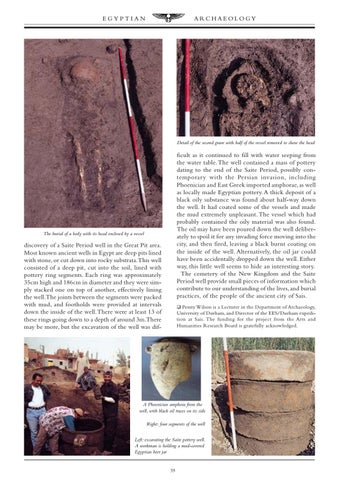
Detail of the second grave with half of the vessel removed to show the head
ficult as it continued to fill with water seeping from the water table. The well contained a mass of pottery dating to the end of the Saite Period, possibly contemporary with the Persian invasion, including Phoenician and East Greek imported amphorae, as well as locally made Egyptian pottery. A thick deposit of a black oily substance was found about half-way down the well. It had coated some of the vessels and made the mud extremely unpleasant. The vessel which had probably contained the oily material was also found. The oil may have been poured down the well deliberately to spoil it for any invading force moving into the city, and then fired, leaving a black burnt coating on the inside of the well. Alternatively, the oil jar could have been accidentally dropped down the well. Either way, this little well seems to hide an interesting story. The cemetery of the New Kingdom and the Saite Period well provide small pieces of information which contribute to our understanding of the lives, and burial practices, of the people of the ancient city of Sais.
The burial of a body with its head enclosed by a vessel
discovery of a Saite Period well in the Great Pit area. Most known ancient wells in Egypt are deep pits lined with stone, or cut down into rocky substrata. This well consisted of a deep pit, cut into the soil, lined with pottery ring segments. Each ring was approximately 35cm high and 186cm in diameter and they were simply stacked one on top of another, effectively lining the well.The joints between the segments were packed with mud, and footholds were provided at intervals down the inside of the well. There were at least 13 of these rings going down to a depth of around 3m.There may be more, but the excavation of the well was dif-
â?‘ Penny Wilson is a Lecturer in the Department of Archaeology, University of Durham, and Director of the EES/Durham expedition at Sais. The funding for the project from the Arts and Humanities Research Board is gratefully acknowledged.
A Phoenician amphora from the well, with black oil traces on its side Right: four segments of the well Left: excavating the Saite pottery well. A workman is holding a mud-covered Egyptian beer jar
35