EGYPTIAN
ARCHAEOLOGY
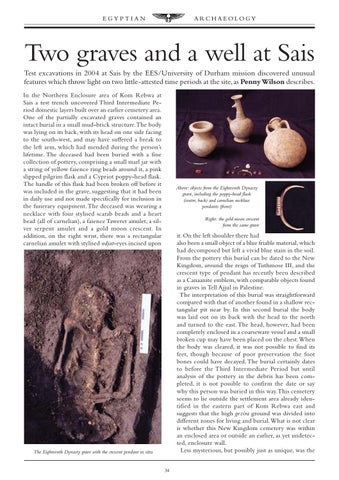
Two graves and a well at Sais Test excavations in 2004 at Sais by the EES/University of Durham mission discovered unusual features which throw light on two little-attested time periods at the site, as Penny Wilson describes. In the Northern Enclosure area of Kom Rebwa at Sais a test trench uncovered Third Intermediate Period domestic layers built over an earlier cemetery area. One of the partially excavated graves contained an intact burial in a small mud-brick structure. The body was lying on its back, with its head on one side facing to the south-west, and may have suffered a break to the left arm, which had mended during the person’s lifetime. The deceased had been buried with a fine collection of pottery, comprising a small marl jar with a string of yellow faience ring beads around it, a pink slipped pilgrim flask and a Cypriot poppy-head flask. The handle of this flask had been broken off before it was included in the grave, suggesting that it had been in daily use and not made specifically for inclusion in the funerary equipment. The deceased was wearing a necklace with four stylised scarab beads and a heart bead (all of carnelian), a faience Taweret amulet, a silver serpent amulet and a gold moon crescent. In addition, on the right wrist, there was a rectangular carnelian amulet with stylised udjat-eyes incised upon
Above: objects from the Eighteenth Dynasty grave, including the poppy-head flask (centre, back) and carnelian necklace pendants (front) Right: the gold moon crescent from the same grave
it. On the left shoulder there had also been a small object of a blue friable material, which had decomposed but left a vivid blue stain in the soil. From the pottery this burial can be dated to the New Kingdom, around the reign of Tuthmose III, and the crescent type of pendant has recently been described as a Canaanite emblem, with comparable objects found in graves in Tell Ajjul in Palestine. The interpretation of this burial was straightforward compared with that of another found in a shallow rectangular pit near by. In this second burial the body was laid out on its back with the head to the north and turned to the east. The head, however, had been completely enclosed in a coarseware vessel and a small broken cup may have been placed on the chest. When the body was cleared, it was not possible to find its feet, though because of poor preservation the foot bones could have decayed. The burial certainly dates to before the Third Intermediate Period but until analysis of the pottery in the debris has been completed, it is not possible to confirm the date or say why this person was buried in this way. This cemetery seems to lie outside the settlement area already identified in the eastern part of Kom Rebwa east and suggests that the high gezira ground was divided into different zones for living and burial. What is not clear is whether this New Kingdom cemetery was within an enclosed area or outside an earlier, as yet undetected, enclosure wall. Less mysterious, but possibly just as unique, was the
The Eighteenth Dynasty grave with the crescent pendant in situ
34