EGYPTIAN
ARCHAEOLOGY
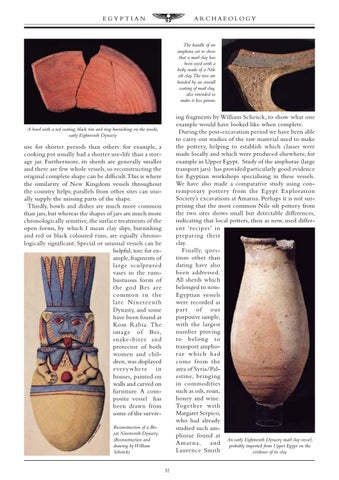
The handle of an amphora cut to show that a marl clay has been used with a body made of a Nile silt clay. The two are bonded by an overall coating of marl clay, also intended to make it less porous
ing fragments by William Schenck, to show what one example would have looked like when complete. During the post-excavation period we have been able to carry out studies of the raw material used to make the pottery, helping to establish which classes were made locally and which were produced elsewhere, for example in Upper Egypt. Study of the amphorae (large transport jars) has provided particularly good evidence for Egyptian workshops specialising in these vessels. We have also made a comparative study using contemporar y pottery from the Egypt Exploration Society’s excavations at Amarna. Perhaps it is not surprising that the most common Nile silt pottery from the two sites shows small but detectable differences, indicating that local potters, then as now, used different ‘recipes’ in prepar ing their clay. Finally, questions other than dating have also been addressed. All sherds which belonged to nonEgyptian vessels were recorded as par t of our purposive sample, with the largest number proving to belong to transport amphorae which had come from the area of Syria/Palestine, bringing in commodities such as oils, resin, honey and wine. Together with Margaret Serpico, who had already studied such amphorae found at An early Eighteenth Dynasty marl clay vessel, Amar na, and probably imported from Upper Egypt on the Laurence Smith evidence of its clay
A bowl with a red coating, black rim and ring burnishing on the inside, early Eighteenth Dynasty
use for shorter periods than others: for example, a cooking pot usually had a shorter use-life than a storage jar. Furthermore, its sherds are generally smaller and there are few whole vessels, so reconstructing the original complete shape can be difficult.This is where the similarity of New Kingdom vessels throughout the country helps; parallels from other sites can usually supply the missing parts of the shape. Thirdly, bowls and dishes are much more common than jars, but whereas the shapes of jars are much more chronologically sensitive, the surface treatments of the open forms, by which I mean clay slips, burnishing and red or black coloured rims, are equally chronologically significant. Special or unusual vessels can be helpful, too: for example, fragments of large sculptured vases in the rumbustuous form of the god Bes are common in the late Nineteenth Dynasty, and some have been found at Kom Rabia. The image of Bes, snake-biter and protector of both women and children, was displayed ever ywhere in houses, painted on walls and carved on furniture. A composite vessel has been drawn from some of the survivReconstruction of a Bes jar, Nineteenth Dynasty. (Reconstruction and drawing by William Schenck)
32