EGYPTIAN
ARCHAEOLOGY
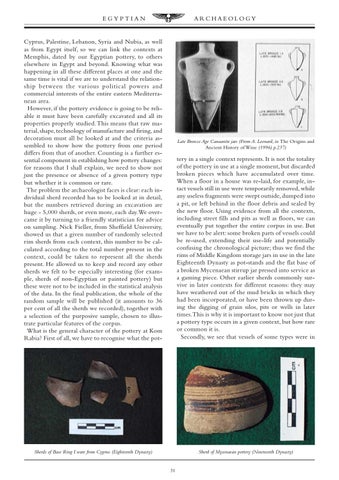
Cyprus, Palestine, Lebanon, Syria and Nubia, as well as from Egypt itself, so we can link the contexts at Memphis, dated by our Egyptian pottery, to others elsewhere in Egypt and beyond. Knowing what was happening in all these different places at one and the same time is vital if we are to understand the relationship between the var ious political powers and commercial interests of the entire eastern Mediterranean area. However, if the pottery evidence is going to be reliable it must have been carefully excavated and all its properties properly studied. This means that raw material, shape, technology of manufacture and firing, and decoration must all be looked at and the criteria assembled to show how the pottery from one period differs from that of another. Counting is a further essential component in establishing how pottery changes: for reasons that I shall explain, we need to show not just the presence or absence of a given pottery type but whether it is common or rare. The problem the archaeologist faces is clear: each individual sherd recorded has to be looked at in detail, but the numbers retrieved during an excavation are huge - 5,000 sherds, or even more, each day. We overcame it by turning to a friendly statistician for advice on sampling. Nick Fieller, from Sheffield University, showed us that a given number of randomly selected rim sherds from each context, this number to be calculated according to the total number present in the context, could be taken to represent all the sherds present. He allowed us to keep and record any other sherds we felt to be especially interesting (for example, sherds of non-Egyptian or painted pottery) but these were not to be included in the statistical analysis of the data. In the final publication, the whole of the random sample will be published (it amounts to 36 per cent of all the sherds we recorded), together with a selection of the purposive sample, chosen to illustrate particular features of the corpus. What is the general character of the pottery at Kom Rabia? First of all, we have to recognise what the pot-
tery in a single context represents. It is not the totality of the pottery in use at a single moment, but discarded broken pieces which have accumulated over time. When a floor in a house was re-laid, for example, intact vessels still in use were temporarily removed, while any useless fragments were swept outside, dumped into a pit, or left behind in the floor debris and sealed by the new floor. Using evidence from all the contexts, including street fills and pits as well as floors, we can eventually put together the entire corpus in use. But we have to be alert: some broken parts of vessels could be re-used, extending their use-life and potentially confusing the chronological picture; thus we find the rims of Middle Kingdom storage jars in use in the late Eighteenth Dynasty as pot-stands and the flat base of a broken Mycenaean stirrup jar pressed into service as a gaming piece. Other earlier sherds commonly survive in later contexts for different reasons: they may have weathered out of the mud bricks in which they had been incorporated, or have been thrown up during the digging of grain silos, pits or wells in later times.This is why it is important to know not just that a pottery type occurs in a given context, but how rare or common it is. Secondly, we see that vessels of some types were in
Sherds of Base Ring I ware from Cyprus (Eighteenth Dynasty)
Sherd of Mycenaean pottery (Nineteenth Dynasty)
Late Bronze Age Canaanite jars (From A. Leonard, in The Origins and Ancient History of Wine (1996) p.237)
31