EGYPTIAN
ARCHAEOLOGY
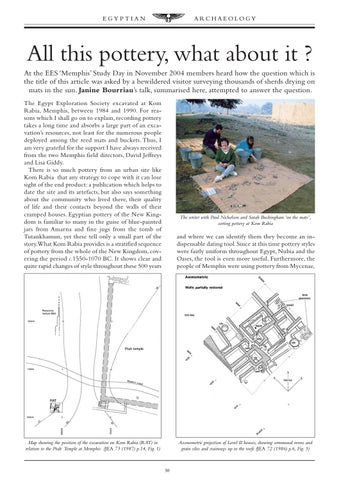
All this pottery, what about it ? At the EES ‘Memphis’ Study Day in November 2004 members heard how the question which is the title of this article was asked by a bewildered visitor surveying thousands of sherds drying on mats in the sun. Janine Bourriau’s talk, summarised here, attempted to answer the question. The Egypt Exploration Society excavated at Kom Rabia, Memphis, between 1984 and 1990. For reasons which I shall go on to explain, recording pottery takes a long time and absorbs a large part of an excavation’s resources, not least for the numerous people deployed among the reed mats and buckets. Thus, I am very grateful for the support I have always received from the two Memphis field directors, David Jeffreys and Lisa Giddy. There is so much pottery from an urban site like Kom Rabia that any strategy to cope with it can lose sight of the end product: a publication which helps to date the site and its artefacts, but also says something about the community who lived there, their quality of life and their contacts beyond the walls of their cramped houses. Egyptian pottery of the New Kingdom is familiar to many in the guise of blue-painted jars from Amarna and fine jugs from the tomb of Tutankhamun, yet these tell only a small part of the story.What Kom Rabia provides is a stratified sequence of pottery from the whole of the New Kingdom, covering the period c.1550-1070 BC. It shows clear and quite rapid changes of style throughout these 500 years
and where we can identify them they become an indispensable dating tool. Since at this time pottery styles were fairly uniform throughout Egypt, Nubia and the Oases, the tool is even more useful. Furthermore, the people of Memphis were using pottery from Mycenae,
Map showing the position of the excavation on Kom Rabia (RAT) in relation to the Ptah Temple at Memphis (JEA 73 (1987) p.14, Fig. 1)
Axonometric projection of Level II houses, showing communal ovens and grain silos and stairways up to the roofs (JEA 72 (1986) p.6, Fig. 3)
The writer with Paul Nicholson and Sarah Buckingham ‘on the mats’, sorting pottery at Kom Rabia
30