EGYPTIAN
1st pylon were moved close to their original position ready to be replaced (www.mom.fr/egypto). Luxor: Conservator Hiroko Kariy for the Chicago House OI Epigraphic Survey resumed conservation and monitoring. of inscribed sandstone wall fragments. Selected fragment groups were documented by Yarko Kobylecky and Ellie Smith, who also began documentation of the badly decaying socle inscription of Amenhotep III which runs around the lower exterior of the rear sanctuary. Dany Roy and his workmen started the stabilisation of the E wall of the Colonnade Hall with a brick and sandstone buttress. Into this will be restored 42 wall fragments which complete a representation of the divine barque of Khonsu and its towboats on the Nile during the Opet festival. Conservation and restoration work at Luxor temple are supported by a Robert W Wilson Challenge for Conserving Our Heritage grant and the World Monuments Fund. Western Thebes: 1. An ARCE EAP Project, funded by USAID, has been working since August in theValley of the Kings removing a previous concrete flood protection prototype around the entrances of KV16 (Ramesses I) and KV17 (Seti I), constructing a new set of protective walls around each entrance and lowering the tourist path in front of the tombs. Edwin Brock (ARCE) directed the archaeological part of the work, including the removal down to the bedrock of debris around the two tombs and excavation of the pathway. Numerous pottery sherds and small artefacts were located, including fragments of the alabaster sarcophagus lid of Seti I. 2. At Dra Abu el-Naga, the DAI team directed by Daniel Polz discovered a small rock chamber (tomb no.KO3.4) at the bottom of a shaft, with a large (2.7m long, 1m wide and 1m high) wooden sarcophagus containing a wooden inner coffin. The chamber is only slightly larger than the sarcophagus, so robbers had to break through the foot panel to remove the mummy, and any other objects. The sarcophagus is decorated on the exterior with a horizontal line of text, with the title, ‘Sab’, and the name, Imeny, of its owner, in an offering formula. The internal decoration of the sarcophagus is extremely well preserved with religious texts and polychrome representations of ideal burial equipment. The inner coffin, also box-shaped, has only a band of text on its outer sides with the title and name of Imeny’s wife, the ‘mistress of the household’, Geheset. A vertical column of text, added to the foot panel of the outer coffin at a later stage also refers to Geheset. Probably the chamber and the large sarcophagus were being prepared during Imeny’s lifetime when his wife died unexpectedly early and was buried in the smaller coffin and then placed inside the larger sarcophagus of her husband. The shaft tomb, which had originally been planned for Imenybecame, therefore, the burial place of his wife. Preliminary analysis of the pottery with the burial shows it dates to the first half of the 13th Dyn, rarely attested in Upper Egypt. (www.dainst.org) 3. The Italian Mission of the Univ of Pisa at Dra Abu el-Naga, directed by Marilina Betrò, continued work in TT 14. The first room was decorated by Huy, a Ramesside wab-priest of Amenhotep I ‘the Image of Amun’ , but all the structure was later reused as shown by traces of funerary reoccupation in the almost square room E of the niche room. In the same period the overground chambers of a yet unknown tomb located W of TT 14 were probably connected through a stepped passage to the underground funerary passages and rooms of TT 14. The new tomb, now under excavation, has a long vaulted room with scant traces of painted decoration, and another sloping passage opening in the floor and going to the W.Among the finds were wooden, pottery and faience shabtis, fragments of wall decoration showing Ahmose-Nefertari and probably Ahhotep, a few funerary cones and fragments of votive beds. (www.egittologia.unipi.it)
ARCHAEOLOGY
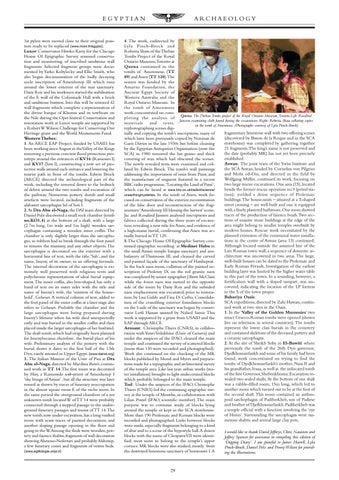
4. The work, codirected by Lyla Pinch-Brock and Roberta Shaw, of the Theban Tombs Project of the Royal Ontario Museum,Toronto at Qurna continued in the tombs of Amenmose, (TT 89) and Anen (TT 120).The season was funded by the Amarna Foundation, the Ancient Egypt Society of Western Australia and the Royal Ontario Museum. In the tomb of Amenmose work concentrated on completing the analysis of Qurna. The Theban Tombs project of the Royal Ontario Museum, Toronto.Left: Rosalind Janssen examining cloth found during the excavations. Right: Roberta Shaw collating copies mater ials and texts, in the tomb of Amenmose. (Photographs courtesy of Lyla Pinch-Brock) rephotographing scenes digfragmentary limestone wall with two offering scenes itally and copying the tomb’s inscriptions, many of (discovered by Bisson de la Roque and in the SCA which have been previously copied by Norman de storehouse) was completed by gathering together Garis Davies in the late 1930s but before cleaning 21 fragments.The king’s name is not preserved and by the Egyptian Antiquities Organisation (now the the date (probably MK) has not yet been precisely SCA) in 1980 removed the bat guano and thick established. covering of wax which had obscured the scenes. Aswan: The joint team of the Swiss Institute and The newly revealed texts were examined and colthe SCA Aswan, headed by Cornelius von Pilgrim lated by Edwin Brock. The tomb’s wall paintings and Mohi ed-Din, and directed in the field by addressing the importation of resin from Punt, and Wolfgang Müller, continued its work, focusing on the manufacture of unguent featured in a recent two large rescue excavations. One area (15), located BBC radio programme, ‘Locating the Land of Punt’, beside the former rescue operation no.9 (petrol stawhich can be heard at www.bbc.co.uk/radio4/science/ tion), yielded a dense sequence of Ptolemaic unearthingmysteries. In the tomb of Anen, work fobuildings. The house-units – situated at a T-shaped cused on conservation of the exterior, reconstitution street crossing – are well built and one is equipped of the false door and reconstruction of the fragwith a finely plastered bathroom. One room showed mentary ‘Amenhotep III blessing the harvest’ scene. traces of the production of faience beads. Two secJac and Rosalind Janssen analysed inscriptions and tions of massive stone buildings at the edge of the fabrics collected during the three years of excavaarea might belong to smaller temples overbuilt by tion, revealing a new title for Anen, and evidence of modern houses. Rescue work necessitated by the a high-status burial, confirming that Anen was acplanned extension of the communal water installatually buried in TT 120. tions in the centre of Aswan (area 13) continued. 5.The Chicago House OI Epigraphic Survey conAlthough located outside the assumed line of the tinued epigraphic recording at Medinet Habu in Late Roman town wall, a sequence of domestic arthe small Amun temple barque sanctuary and amchitecture was uncovered in two areas. The large, bulatory of Thutmosis III, and cleaned the carved well-built houses can be dated to the Ptolemaic and and painted façade of the sanctuary of Hatshepsut. Early Roman Periods. Investigation of the earliest In the back naos room, collation of the painted inbuilding layer was limited by the higher water table scription of Ptolemy IX on the red granite naos in this part of the town. In a sounding, however, a was completed by senior epigrapher J Brett McClain fortification wall with a sloped rampart, was unwhile the 4-ton naos was moved to the opposite covered, indicating the location of the LP fortress side of the room by Dany Roy and the subsided to the S of the town proper. naos emplacement was excavated, prior to restoraBahariya Oasis: tion, by Lisa Giddy and Tina Di Cerbo. ConsolidaSCA expeditions, directed by Zahi Hawass, contintion of the crumbling exterior foundation blocks ued work at two sites in the Oasis. on the S side of the sanctuary was begun by conser1. In the ‘Valley of the Golden Mummies’ two vator Lotfi Hassan assisted by Nahed Samir. This intact Graeco-Roman tombs were opened (shown work is supported by a grant from USAID and the live on television in several countries). The tombs EAP through ARCE. represent the lower class burials in the cemetery Armant: Christophe Thiers (CNRS), in collaboand contained skeletons of the deceased, pottery and ration with Youri Volokhine (Univ of Geneva) and a ceramic sarcophagus. under the auspices of the IFAO, cleaned the main 2. At the site of Sheikh Soby in El-Bawiti where temple and continued the survey of scattered blocks previously the tomb of the 26th Dyn governor, (more than 130 were recorded and photographed). Djedkhonsuefankh and some of his family had been Work also continued on the checking of the MK found, work concentrated on trying to find the blocks published by Mond and Myers and preparatombs of Djedkhonsuefankh’s mother, Nasa II and tions made for a topographic and architectural survey his grandfather, Iruaa, as well as the unlocated tomb of the temple area. Like last year, urban works (waof the first Governor, Shebenkhonsu. Excavation reter installation) brought to light undecorated blocks vealed two sealed shafts. At the bottom of one shaft which probably belonged to the main temple. was a rubble-filled room, 15m long, which led to Tod: Under the auspices of the IFAO, Christophe another room which turned out to be at the foot of Thiers (CNRS) led the continuing epigraphic surthe second shaft. This room contained an anthrovey at the temple of Monthu, in collaboration with poid sarchophagus of Padiherkheb, son of Padiese Lilian Postel (IFAO, scientific member). The main and brother of Djefkhonsuefankh. Padiherkheb was purpose was to continue study of blocks lying a temple official with a function involving the ‘eye around the temple or kept in the SCA storehouse. of Horus’. Surrounding the sarcophagus were nuMore than 190 Ptolemaic and Roman blocks were merous shabtis and several large clay pots. recorded and photographed. Links between blocks were made, especially fragments belonging to a kind of altar and to a scene of the hypostyle hall. A dozen I would like to thank David Jeffreys, Chris Naunton and blocks with the name of Cleopatra VII were identiJeffrey Spencer for assistance in compiling this edition of fied; most seem to belong to the temple’s upper ‘Digging Diary’. I am grateful to James Harrell, Lyla cornice. MK blocks were also studied, mostly from Pinch-Brock, Daniel Polz and Penny Wilson for providthe destroyed limestone sanctuary of Senwosret I. A ing the illustrations.
29