EGYPTIAN
Harry Tzalas, continued its underwater archaeological surveys focusing on the site Chatby 1, in the vicinity of Cape Silsileh (ancient Akra Lochias).The weather conditions and the visibility were good and this resulted in tracing over 100 large architectural elements and other artefacts.These included a red granite slab with the torso of a pharaonic official, carved in low relief, and, found near by, a hieroglyphic text inscribed on a quartzite slab. The inscription contains two cartouches but is covered with marine concretion and has not yet been cleaned and studied. Other finds were two monumental granite bases, a stone anchor, catapult balls, a metallic cannon ball and numerous pottery sherds. Buto: The DAI/Univ of Poitiers expedition, led by Ulrich Hartung and Pascale Ballet, concentrated on survey and study.Tomasz Herbich investigated a further 8.5 ha by geophysical measurements in the NW and N part of the site.The magnetic map shows the continuation of casemate-like building structures arranged along a main street (see EA 24, pp.16-17) most probably of the Saite Period.These houses are partly covered by Ptolemaic/Roman building remains, cemeteries and industrial features such as kilns and slag heaps.The core drillings undertaken in the same area confirmed this picture and cast additional light on the extension of TIP and ED settlement layers below the Saite buildings. Pottery studies were mainly dedicated to research on material from the spring campaign (see EA 25, p.29) and from the EES excavations in the 1960s, the latter being almost finished. (www.dainst.org) Mendes (Tell el-Ruba): The Pennsylvania State Univ expedition, directed by Donald Redford, continued excavation (see further pp.8-12). Kom Firin:The BM expedition, led by Neal Spencer, underook further excavation in the SE temple, which clarified further elements of its plan, and the dating of this ruined structure to the Ramesside Period. A domestic installation (late NK/earlyTIP) built into the NW corner of the temple was cleared: large in situ cooking vessels, a pot-stand, a small number of fired clay animal figurines, a flint knife and an amulet were recovered. The magnetometry survey was extended to areas adjacent to the temple, revealing a 220×200m enclosure, with walls 5m thick and with fortifying bastions at the corners. Smaller structures were arranged around the small temple. An imposing two-tower gateway was identified in the N stretch of the enclosure wall. Excavations yielded a mass of limestone chippings, some with worked surfaces: the gate may have been clad with decorated limestone.The enclosure is built with the same type of bricks and construction method, and follows the same alignment, as the temple within, suggesting a Ramesside date. Further fired clay cobra figurines were discovered in a variety of contexts.(www.thebritishmuseum.ac.uk) Tell el-Mashala: Sabrina Rampersad (Univ of Toronto), continued excavation of the Late Predynastic and ED remains along the W edge of the tell. Sev-
ARCHAEOLOGY
eral contracted burials were uncovered, one of which contained two whole vessels and half a large oyster shell.The presence of goods, albeit meagre, in association with this individual is the first indication of social stratification within the site’s ancient population. Upper Egyptian artefacts were also uncovered, most notably a fragment of a small breccia ointment jar from one of the habitation contexts. The flaked tool industry (the bladelet) continues to dominate the artifactual assemblage, but other finds are bladelet cores, small round clay discs (perhaps used as pot lids), upper and lower grinding stones, hammerstones, faunal remains and shell fragments. Abu Sir:The Czech Institute of Egyptology expedition, led by Miroslav Verner, investigated a large 5th Dyn mastaba in South Abu Sir. The mastaba, devastated by robbers and unfortunately so far anonymous, has a unique architectural plan. In addition, restoration and reconstruction of the relief decoration in the tomb of Inti and the copying of scenes and inscriptions in the tomb of Qar was undertaken and the archaeological and geodetical survey of South Abu Sir continued (see pp.3-6).Anthropological materials from the pyramid Lepsius no.25 were examined. Cairo, Ain Shams. The SCA has established a law requiring an Inspector of Antiquities to be present whenever building construction is being conducted in areas known to contain archaeological remains. As a result, an expedition, directed by Zahi Hawass, has been excavating beneath one of the houses in Ain Shams and found a late 26th Dyn tomb, containing a large black granite anthropoid sarcophagus with the name and title of the deceased, Khonsuankh, ‘Treasurer of the King's Palace’ and ‘Chief of the Royal Palace’. Surrounding the sarcophagus were more than 400 shabtis and four intact alabaster canopic jars with lids in the forms of the sons of Horus.Within the sarcophagus were the remains of the mummy and several gold amulets.The tomb has now been relocated next to the tomb of Panehsi in the Ain Shams Open Air Museum.
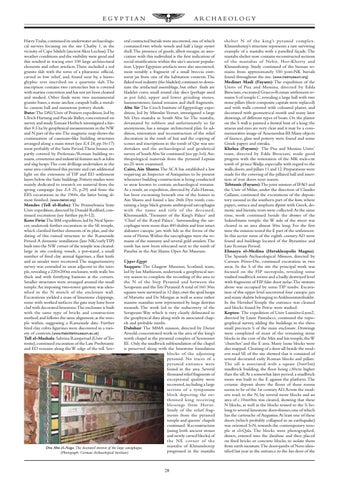
Upper Egypt Saqqara: The Glasgow Museum, Scotland, team, led by Ian Mathieson, undertook a geophysical survey season to complete the recording of the area to the N of the Step Pyramid and between the Serapeum and the Teti Pyramid. A total of 160 30m squares were surveyed in 12 days, over the spoil heaps of Mariette and De Morgan as well as some rather massive mastabas now represented by huge detritus mounds. The work led to the rediscovery of the Serapeum Way which is very clearly delineated in the geophysical data along with its associated chapels and probable tombs. Dahshur: The MMA mission, directed by Dieter Arnold, concentrated work in the area of the king’s north chapel at the pyramid complex of Senwosret III. Only the mudbrick subfoundation of the chapel is preserved along with the limestone foundation blocks of the adjoining pyramid. No traces of a pyramid entrance were found in the area. Several thousand relief fragments of exceptional quality were recovered, including a large section of a tympanum block depicting the enthroned king receiving blessings from Hor us. Study of the relief fragments from the pyramid temple and queens’ chapels continued. Reconstruction (using both ancient stones and newly carved blocks) of the NE cor ner of the mastaba of Khnumhotep Dra Abu el-Naga. The decorated interior of the large sarcophagus. progressed in the mastaba (Photograph: German Archaeological Institute)
28
shelter N of the king’s pyramid complex. Khnumhotep’s structure represents a rare surviving example of a mastaba with a panelled façade. The mastaba shelter now contains reconstructed sections of the mastabas of Nebit, Hor-Kherty and Khnumhotep. Study continued of the human remains from approximately 550 post-NK burials found throughout the site. (www.metmuseum.org) Medinet Madi (Fayum): The expedition of the Univs of Pisa and Messina, directed by Edda Bresciani, excavated Graeco-Roman settlement remains S of temple C, revealing a large hall with two stone pillars (their composite capitals were replaced) and with walls covered with coloured plaster, and decorated with geometrical motifs and many later drawings, of different types of boats. On the plaster on the S wall is painted a frontal bust of a king: the uraeus and eyes are very clear and it may be a commemorative image of Amenemhat III. Many objects of faience, glass and pottery were found and some Greek papyri and ostraka. Khelua (Fayum): The Pisa and Messina Univs’ team, directed by Edda Bresciani, made good progress with the restoration of the MK rock-cut tomb of prince Wadje, especially with regard to the walls, doors, and pillars 11 and 12. Preparations were made for the covering of the pillared hall and insertion of iron doors next season. Tebtunis (Fayum):The joint mission of IFAO and the Univ of Milan, under the direction of Claudio Gallazzi, continued the excavations of the depository mound in the southern part of the kom, where papyri, ostraca and amphora dipinti with Greek, demotic and hieratic texts were collected. At the same time, work continued beside the dromos of the Soknebtunis temple: the W side of the street was cleared in an area almost 50m long. For the first time the mission tested the E part of the settlement. In this sector ruins of the eighth century AD were found and buildings located of the Byzantine and Late Roman Period. Ehnasya el-Medina (Herakleopolis Magna). The Spanish Archaeological Mission, directed by Carmen Pérez-Die, continued excavation in two areas. In the S of the site the principal work was focused on the FIP necropolis, revealing some vaulted mudbrick rooms and a badly destroyed level with fragments of FIP false door stelae.The stratum above was occupied by some TIP tombs. Excavation of this upper level uncovered four canopic jars and many shabtis belonging to Ankhsomtutefnakht. In the Herishef Temple the entrance was cleaned and blocks found by Petrie were studied. Koptos: The expedition of Univ Lumière-Lyon2, directed by Laure Pantalacci, continued the topographical survey, adding the buildings in the three small precincts S of the main enclosure. Drawings were completed of most of the remaining stone blocks in the core of the Min and Isis temple, the W ‘churches’ and the E area. Many loose blocks were also mapped. Cleaning of a door sill beside the modern road SE of the site showed that it consisted of several decorated early Roman blocks and pillars. The sill is associated with a square (5m×5m) mudbrick building, the floor being c.80cm higher than the sill.At a somewhat later period, a mudbrick room was built to the E against the platform. The ceramic deposit above the floors of these rooms seems to be of the 1st century AD. Across the modern road, to the N, lay several more blocks and an area of c.10m×8m was cleared, showing that these N blocks, as well as the blocks reused to the S, belong to several limestone door-frames, one of which has the cartouche of Augustus. At least one of these doors (which probably collapsed in an earthquake) was oriented S-N, towards the contemporary temple at el-Qala. The blocks were photographed, drawn, entered into the database and then placed on fired bricks or concrete blocks, to isolate them from earth moisture.The door-jambs of Nero identified last year in the entrance to the Isis door of the