EGYPTIAN
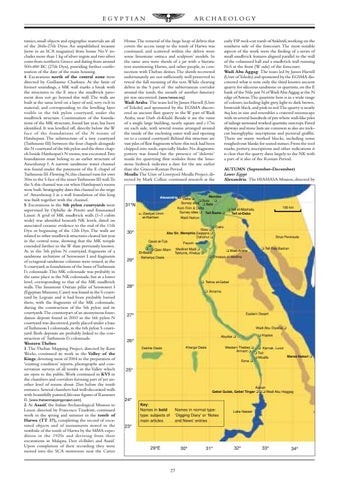
ramics, small objects and epigraphic materials are all of the 26th-27th Dyns. An unpublished treasure (now in an SCA magazine) from house No.V includes more than 1 kg of silver ingots and two silver coins from northern Greece and dating from around 500-480 BC (27th Dyn), providing further confirmation of the date of the main housing. 4. Excavations north of the central zone were directed by Guillaume Charloux. At the limit of former soundings, a MK wall marks a break with the structures to the E since the mudbrick pavement does not go beyond this wall. The walls are built at the same level on a layer of soil, very rich in material, and corresponding to the levelling layer visible in the 6th pylon courtyard, under the mudbrick structure. Continuation of the foundations of the MK structure, found last year, has been identified. It was levelled off, directly below the W face of the foundations of the N rooms of Hatshepsut. The substructure of a tiny courtyard (Tuthmosis III) between the four chapels alongside the N courtyard of the 6th pylon and the three chapels beside Hatshesput’s N rooms, was excavated.Two foundations must belong to an earlier structure of Amenhotep I. A narrow sandstone water channel was found under the pavement of the E chapel of Tuthmosis III. Flowing N, this channel runs for over 30m to the S face of the inner Tuthmosis III wall.To the S, this channel was cut when Hatshepsut’s rooms were built. Stratigraphy dates this channel to the reign of Amenhotep I as a wall foundation of this king was built together with the channel. 5. Excavations in the 5th pylon courtyards were supervised by Ophélie de Peretti and Emmanuel Lanoë. A grid of MK mudbrick walls (1-3 cubits wide) was identifed beneath NK levels, dated on associated ceramic evidence to the end of the 11th Dyn or beginning of the 12th Dyn. The walls are related to other mudbrick structures cleared last year in the central zone, showing that the MK temple extended further to the W than previously known. As in the 5th pylon N courtyard, fragments of a sandstone architrave of Senwosret I and fragments of octagonal sandstone columns were reused, in the S courtyard, as foundations of the bases of Tuthmosis I’s colonnade. This MK colonnade was probably in the same place as the NK colonnade, but at a lower level, corresponding to that of the MK mudbrick walls. The limestone Osirian pillar of Senwosret I (Egyptian Museum, Cairo) was found in the S courtyard by Legrain and it had been probably buried there, with the fragments of the MK colonnade, during the construction of the 5th pylon and its courtyards.The counterpart of an anonymous foundation deposit found in 2003 in the 6th pylon N courtyard was discovered, partly placed under a base of Tuthmosis I colonnade, in the 6th pylon S courtyard. Both deposits are probably linked to the construction of Tuthmosis I’s colonnade. Western Thebes: 1. The Theban Mapping Project, directed by Kent Weeks, continued its work in the Valley of the Kings, devoting most of 2004 to the preparation of ‘existing condition’ reports, photographs and conservation surveys of all tombs in the Valley which are open to the public. Work continued in KV5 in the chambers and corridors forming part of yet another level of rooms about 25m below the tomb entrance. Several chambers had well-decorated walls with beautifully painted, life-size figures of Ramesses II. (www.thebanmappingproject.com) 2. At Asasif, the Italian Archaeological Mission to Luxor, directed by Francesco Tiradritti, continued work in the spring and summer in the tomb of Harwa (TT 37), completing the record of excavated objects and of monuments stored in the vestibule of the tomb of Harwa by the MMA expedition in the 1920s and deriving from their excavations in Malqata, Deir el-Bahri and Asasif. Upon completion of their recording they were moved into the SCA storeroom near the Carter
ARCHAEOLOGY
House.The removal of the huge heap of debris that covers the access ramp to the tomb of Harwa was continued, and scattered within the debris were some limestone ostraca and sculptors’ models. In the same area were sherds of a jar with a hieratic text mentioning Harwa, and other people, in connection with Theban deities. The sherds recovered unfortunately are not sufficiently well preserved to reveal the full meaning of the text. While clearing debris in the S part of the subterranean corridor around the tomb, the mouth of another funerary pit was uncovered. (www.harwa.org) Wadi Araba: The team led by James Harrell (Univ of Toledo) and sponsored by the EGSMA discovered an ancient flint quarry in the W part of Wadi Araba, near Darb el-Khalil. Beside it are the ruins of a single large building, nearly square and c.17m on each side, with several rooms arranged around the inside of the enclosing outer wall and opening on to a central courtyard. Behind this structure are vast piles of flint fragments where this rock had been chipped into tools, especially blades. No diagnostic pottery was found but the presence of ‘dolerite’ mauls for quarrying flint nodules from the limestone bedrock indicates a date for the site earlier than the Graeco-Roman Period. Moalla:The Univ of Liverpool Moalla Project, directed by Mark Collier, continued research at the
31°N
30°
29°
early FIP rock-cut tomb of Ankhtifi,working on the southern side of the forecourt. The most notable aspects of the work were the finding of a series of small mudbrick features aligned parallel to the wall of the columned hall and a mudbrick wall running N-S at the front (W side) of the forecourt. Wadi Abu Aggag: The team led by James Harrell (Univ of Toledo) and sponsored by the EGSMA discovered what is now only the third known ancient quarry for siliceous sandstone or quartzite, on the E bank of the Nile just N of Wadi Abu Aggag at the N edge of Aswan.The quartzite here is in a wide range of colours, including light grey, light to dark brown, brownish black, and pink to red.The quarry is nearly 4sq km in size and resembles a cratered moonscape with its several hundreds of pits where wall-like piles of tailings surround worked quartzite outcrops. Paved slipways and stone huts are common as also are rockcut hieroglyphic inscriptions and pictorial graffiti. There are many worked blocks, including some roughed-out blanks for seated statues. From the tool marks, pottery, inscriptions and other indications it is clear that the quarry dates largely to the NK with a part of it also of the Roman Period. AUTUMN (September-December) Lower Egypt Alexandria: The HIAMASA Mission, directed by
Mendes Alexandria ❑ Delta ❑ ❑ Buto ❑ Survey sites ❑ Sais Kom Firin & Delta ❑ Tell el-Mashala, Survey sites ❑ Tell Basta ❑ Tell el-Daba ⇐ Zawiyet Umm el-Rakham Wadi Natrun ❑ Cairo Giza ❑ Abu Sir, Memphis,Saqqara ❑ Dahshur ❑ Qaret el-Tub Fayum ❑ ❑ ❑ Qasr Allam Medinet Madi ❑ ❑ Wadi Araba El-Bawiti Tebtunis, Khelua ❑ ❑ Ehnasya el-Medina Bahariya Oasis
100 km
Sinai Peninsula ❑ Tell Ras Badran
❑ Tehne el-Gebel
28° ❑ Amarna
Eastern Desert
27°
Wadi Abu Diyeiba ❑ ❑ Koptos
Abydos ❑
26° Western Thebes ❑ Armant ❑
Kharga Oasis
Dakhla Oasis
Esna ❑
❑ Karnak, Luxor ❑ Tod Marsa Nakari ❑ ❑ Moalla
25°
Aswan Gebel Gulab, Gebel Tingar ❑ ❑ ❑ Wadi Abu Haggag
24° Key: Names in bold type: subjects of main articles
Names in normal type: ‘Digging Diary’ or ‘Notes and News’ entries
Lake Nasser
23° A
29°E
30°
27
31°
32°
33°
34°