EGYPTIAN
ARCHAEOLOGY
Digging Diary 2004 Summaries of some of the archaeological work undertaken in Egypt during the Summer and Autumn of 2004 appear below together with some previously unreported work carried out in Spring 2004 (see also EA 25, pp.25-29). The sites are arranged geographically from north to south, ending with the Western Oases.Where possible, website addresses, which contain more detailed reports, have been given. Field Directors who would like reports to appear in future issues of EA are asked to send a short summary, with a website address if available, as soon as possible after the end of each season to Egyptian Archaeology, 3 Doughty Mews, London WC1N 2PG. E-mail: patricia.spencer@ees.ac.uk PATRICIA SPENCER Abbreviations: EDP Early Dynastic Period: OK Old Kingdom; FIP First Intermediate Period; MK Middle Kingdom; SIP Second Intermediate Period; NK New Kingdom;TIP Third Intermediate Period; LP Late Period. Institutes and Research Centres: ARCE American Research Center in Egypt; BM British Museum; CNRS French National Research Centre; CTEEFK Franco-Egyptian Centre, Karnak; DAI German Institute, Cairo; EAP Egyptian Antiquities Project; EGSMA Egyptian Geological Survey and Mining Authority; HIAMASA The Hellenic Institute of Ancient and Mediaeval Alexandrian Studies, Athens; IFAO French Institute, Cairo; MMA The Metropolitan Museum of Art, New York; OI Oriental Institute, University of Chicago. SCA Supreme Council for Antiquities
SUMMER/AUTUMN
SPRING (February-May) Upper Egypt Karnak: The CTEEFKcontinued work under the overall direction of François Larché and Nicolas Grimal. 1. Jean Winand and Stéphanie Polis recorded, photographed and registered about 150 scattered blocks which were already on platforms east of the Amun temple. The blocks, of the reigns of Tuthmosis III and Ramesses II, come from either the precinct wall or the Eastern Temple. One room of the Taharqo monument (in which blocks of the wall were once stored) was partially cleaned and blocks coming from several monuments were identified.Around 80 fragments of a diorite royal statue were moved from this room to the ‘Sheikh Labib’ storeroom. 2. Work between the 7th and 8th pylons, financed by the Latvian Ministry of Culture, and supervised by Bruno Deslandes (Unesco architectural expert) undertook the scanning survey of the 8th pylon and of the walls linking it to the 7th pylon. Millions of points were scanned to reconstruct the pylon and its environment. 3. Excavation continued, directed by Charles van Siclen, between the 8th and 9th pylons. A small area c.15m E of the W stone enclosure wall and S of the presumed line of the southern MK enclosure wall was re-cleared and recorded, revealing a small stairway from the start of the 18th Dyn. The stairs led W down from an artificial raised platform (temp. Ahmose?) to the original MK level of the small forecourt. Constructional details of the Horemheb wall were studied. On the exterior of the wall, the foundations, made up of Amarna talatat, had been replaced
(probably c. reign of Ptolemy I when the court itself was repaired) with large blocks of sandstone which seem to have come from an unknown, dismantled pylon (?) of post-Ramesside date. After that repair, a mudbrick pavement three courses thick was laid alongside the wall. This pavement extends at least 3m to the west of the wall, but its western edge has not been reached. A group of three cubes of sandstone which formed parts of a small standing statue holding a naos with a rounded top were found in a sub-surface rubbish pit located west of the 8th pylon. The statue has the name of the vizier Huy (c.years 30-40 of Ramesses II). 4. A new project, directed by Emmanuel Laroze, to study and publish the architecture of the Opet Temple began with the cleaning of the monument. About 100 blocks previously ranged on the ground along the southern façade of the temple have been moved and stored on the platforms built against the Euergetes storeroom. Topographers plotted several millions of points on the temple while the outside faces, the roof and the hypostyle hall were surveyed and photographed, using a 3D scan. Western Thebes: A new mission, headed by Guy Lecuyot (UMR 8546 CNRS-ENS) and Catherine Thirard (Univ of Lyon II) and supported by the IFAO, initiated a study of Coptic remains in the S part of the Theban Mountain, with archaeological investigation in the three most N wadis of the area: ‘the First Valley’, ‘the Second Valley’ (also known as ‘Vallée des Pèlerins d’Espagne’), and the ‘Third Valley’. GPS coordinates were taken so the sites can be accurately mapped. Many Coptic remains were identified and recorded, including pottery, unpublished
Egypt Exploration Society Expeditions
Sais: The EES/Univ of Durham team, led by Penny Wilson, excavated three test trenches in the N Enclosure area. Two of the trenches contained TIP domestic areas with ovens and mudbrick buildings. These structures seemed to have been constructed over an earlier cemetery (see further pp.34-35). Evidence of a Saite monumental structure was found at the S entrance to the enclosure area, confirming that there had been Saite material here, but it has been completely removed by nineteenth century sebbakhin. Further drilling work in the Saite region confirmed the settlement to the S, a substantial sand gezira under Qodaba to the S and a sand ridge to the E with the Saite river channel alongside it. Delta Survey: 1.During the Sais season, Penny Wilson and the EES/Durham team visited and recorded basic information on 37 sites in Beheira governorate, concentrating on sites around the north part of the Canopic Branch of the Nile. These included the large spectacular mounds at Kom el-Ahmar (EES no.286) and Kom Debaa (EES no.612/613); the rocky outcrops on the W with ancient sites such as Kom el-Hag (EES no.358); once-extensive, now much reduced, sites like Abu Guduur (EES no.406) and Tell Trughi (EES no.303); the finished sites of Tell Bisintawy (EES no.333) and Kom Farag (EES no.400), and the sandy mound with material dating from the NK to the Medieval Period at Rosetta (Abu Mandour). In addition survey plans were made at Kom Sidi Selim (EES no.282), Kom el-Misk (EES no.600) and Kom Khawalid (EES no.272) in Kafr el-Sheikh province. Pottery was recorded at all sites for further
(www.ees.ac.uk)
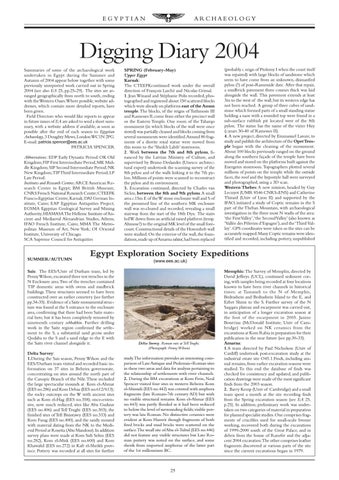
Delta Survey. Roman vats at Tell Trughi. (Photograph: Penny Wilson)
study.The information provides an interesting comparison of Late Antique and Ptolemaic-Roman sites in these two areas and data for analysis pertaining to the relationship of settlements with river channels. 2. During the BM excavations at Kom Firin, Neal Spencer visited four sites in western Beheira. Kom el-Shimuli (EES no.442) was covered with amphora fragments (late Roman-7th century AD) but with no visible structural remains. Kom el-Ahmar (EES no.443) was partly flooded as it had been reduced to below the level of surrounding fields; visible pottery was late Roman. No distinctive ceramics were evident at Kom Hamrit though fragments of both fired bricks and mud bricks were scattered on the surface.The small site of Abu el-Tubul (EES no.446) did not feature any visible structures but Late Roman pottery was noted on the surface, and some sherds from imported amphorae of the latter part of the 1st millennium BC.
25
Memphis: The Survey of Memphis, directed by David Jeffreys (UCL), continued sediment coring, with samples being recorded at four locations known to have been river channels in historical times: at Tammuh to the N of Memphis, Bedrashein and Bedrashein Island to the E, and Ezbet Shimi to the S. Further survey of the N Saqqara plateau and escarpment was carried out, in anticipation of a longer excavation season at the foot of the escarpment in 2005. Janine Bourriau (McDonald Institute, Univ of Cambridge) worked on NK ceramics from the excavations at Kom Rabia in preparation for their publication in the near future (see pp.30-33). Amarna: 1.A team directed by Paul Nicholson (Univ of Cardiff) undertook post-excavation study at the industrial estate site O45.1.Finds, including animal remains, from earlier excavation seasons were studied. To this end the database of finds was checked for consistency and updated, and publication drawings were made of the most significant finds from the 2003 season. 2. Barry Kemp (Univ of Cambridge) and a small team spent a month at the site recording finds from the Spring excavation season (see EA 25, p.25). In addition, preliminary work was undertaken on two categories of material in preparation for planned specialist studies. One comprises fragments of crucibles used for small-scale bronze working, recovered both during the excavations of 1999-2000 south of the Great Palace, and in debris from the house of Ranefer and the adjacent 2004 excavation.The other comprises leather fragments discovered at various parts of the site since the current excavations began in 1979.