EGYPTIAN
ARCHAEOLOGY
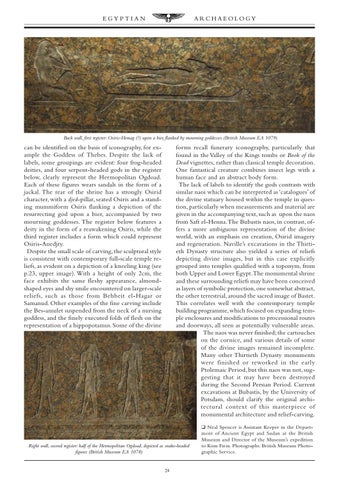
Back wall, first register: Osiris-Hemag (?) upon a bier, flanked by mourning goddesses (British Museum EA 1079)
can be identified on the basis of iconography, for example the Goddess of Thebes. Despite the lack of labels, some groupings are evident: four frog-headed deities, and four serpent-headed gods in the register below, clearly represent the Hermopolitan Ogdoad. Each of these figures wears sandals in the form of a jackal. The rear of the shrine has a strongly Osirid character, with a djed-pillar, seated Osiris and a standing mummiform Osiris flanking a depiction of the resurrecting god upon a bier, accompanied by two mourning goddesses. The register below features a deity in the form of a reawakening Osiris, while the third register includes a form which could represent Osiris-Anedjty. Despite the small scale of carving, the sculptural style is consistent with contemporary full-scale temple reliefs, as evident on a depiction of a kneeling king (see p.23, upper image). With a height of only 2cm, the face exhibits the same fleshy appearance, almondshaped eyes and shy smile encountered on larger-scale reliefs, such as those from Behbeit el-Hagar or Samanud. Other examples of the fine carving include the Bes-amulet suspended from the neck of a nursing goddess, and the finely executed folds of flesh on the representation of a hippopotamus. Some of the divine
forms recall funerary iconography, particularly that found in the Valley of the Kings tombs or Book of the Dead vignettes, rather than classical temple decoration. One fantastical creature combines insect legs with a human face and an abstract body form. The lack of labels to identify the gods contrasts with similar naoi which can be interpreted as ‘catalogues’ of the divine statuary housed within the temple in question, particularly when measurements and material are given in the accompanying text, such as upon the naos from Saft el-Henna. The Bubastis naos, in contrast, offers a more ambiguous representation of the divine world, with an emphasis on creation, Osirid imagery and regeneration. Naville’s excavations in the Thirtieth Dynasty structure also yielded a series of reliefs depicting divine images, but in this case explicitly grouped into temples qualified with a toponym, from both Upper and Lower Egypt. The monumental shrine and these surrounding reliefs may have been conceived as layers of symbolic protection, one somewhat abstract, the other terrestrial, around the sacred image of Bastet. This correlates well with the contemporary temple building programme, which focused on expanding temple enclosures and modifications to processional routes and doorways, all seen as potentially vulnerable areas. The naos was never finished; the cartouches on the cornice, and various details of some of the divine images remained incomplete. Many other Thirtieth Dynasty monuments were finished or reworked in the early Ptolemaic Period, but this naos was not, suggesting that it may have been destroyed during the Second Persian Period. Current excavations at Bubastis, by the University of Potsdam, should clarify the original architectural context of this master piece of monumental architecture and relief-carving.
Right wall, second register: half of the Hermopolitan Ogdoad, depicted as snake-headed figures (British Museum EA 1078)
24
❑ Neal Spencer is Assistant Keeper in the Department of Ancient Egypt and Sudan at the British Museum and Director of the Museum’s expedition to Kom Firin. Photographs: British Museum Photographic Service.