EGYPTIAN
ARCHAEOLOGY
The great naos of Nekhthorheb from Bubastis The work of a British Museum project to record fully the fragments of a great Thirtieth Dynasty naos from Bubastis is described by Neal Spencer. Part of the façade of the naos (British Museum EA 1080)
Between 1887 and 1889, Edouard Naville directed the Egypt Exploration Fund’s excavations at Bubastis (Tell Basta) in the north-eastern Nile Delta. (see photograph, p.1). A columned hall of Osorkon II was discovered, fronted by a gateway adorned with scenes of the sed-festival, while the western end of the temple site yielded a significant amount of architecture inscribed for the Thirtieth Dynasty king Nekhthorheb (Nectanebo II), including reliefs, lintels and fragments of several monolithic shrines. It is still unclear if the Nekhthorheb structure represented an addition to, or modification of, the Twenty Second Dynasty temple, or was a separate entity. During this king’s reign, at least eight monolithic naoi were set up in the Bubastis temple, dedicated to forms of Bastet, Heryshef, Horhekenu, Sekhmet, Seshmetet and Khonsu-Horus. Fragments of the largest of these shrines, presumably the central naos in the temple, are now in the British Museum, the Egyptian Museum in Cairo, and various
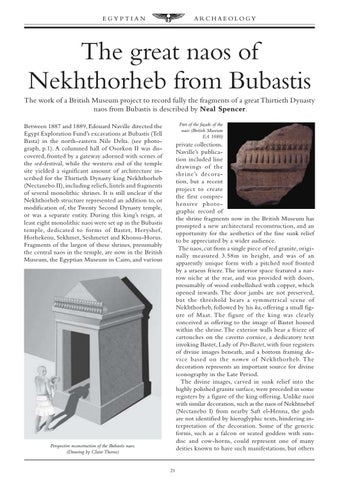
private collections. Naville’s publication included line drawings of the shr ine’s decoration, but a recent project to create the first comprehensive photographic record of the shrine fragments now in the British Museum has prompted a new architectural reconstruction, and an opportunity for the aesthetics of the fine sunk relief to be appreciated by a wider audience. The naos, cut from a single piece of red granite, originally measured 3.58m in height, and was of an apparently unique form with a pitched roof fronted by a uraeus frieze. The interior space featured a narrow niche at the rear, and was provided with doors, presumably of wood embellished with copper, which opened inwards. The door jambs are not preserved, but the threshold bears a symmetr ical scene of Nekhthorheb, followed by his ka, offering a small figure of Maat. The figure of the king was clearly conceived as offering to the image of Bastet housed within the shrine. The exterior walls bear a frieze of cartouches on the cavetto cornice, a dedicatory text invoking Bastet, Lady of Per-Bastet, with four registers of divine images beneath, and a bottom framing device based on the nomen of Nekhthorheb. The decoration represents an important source for divine iconography in the Late Period. The divine images, carved in sunk relief into the highly polished granite surface, were preceded in some registers by a figure of the king offering. Unlike naoi with similar decoration, such as the naos of Nekhtnebef (Nectanebo I) from nearby Saft el-Henna, the gods are not identified by hieroglyphic texts, hindering interpretation of the decoration. Some of the generic forms, such as a falcon or seated goddess with sundisc and cow-horns, could represent one of many deities known to have such manifestations, but others
Perspective reconstruction of the Bubastis naos. (Drawing by Claire Thorne)
21