EGYPTIAN
ARCHAEOLOGY
Anhydrite walls of an early Roman structure looking south-east. (Photograph: Steven Sidebotham)
View of the anhydrite quarry in Wadi el-Amboot looking north-west. (Photograph: Steven Sidebotham)
but excavations have also documented commercial activities conducted at the ancient port, suggesting exports of wine and glassware, and imports of beads, some of the latter likely to have come from India and Sri Lanka. Additional excavation should eventually provide evidence that allows identification of other exports and imports and their provenances. Recovery of beryls and anhydrite architectural elements reflects interaction with mines and quarries in the Eastern Desert. Other artefacts documented from the excava-
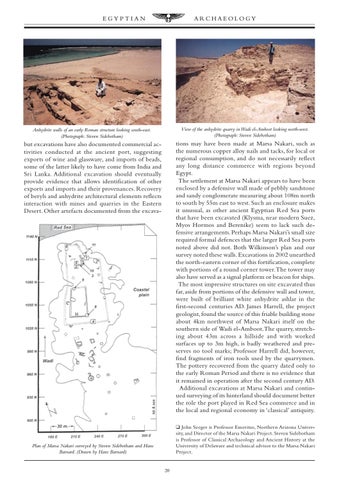
tions may have been made at Marsa Nakari, such as the numerous copper alloy nails and tacks, for local or regional consumption, and do not necessarily reflect any long distance commerce with regions beyond Egypt. The settlement at Marsa Nakari appears to have been enclosed by a defensive wall made of pebbly sandstone and sandy conglomerate measuring about 108m north to south by 55m east to west. Such an enclosure makes it unusual, as other ancient Egyptian Red Sea ports that have been excavated (Klysma, near modern Suez, Myos Hormos and Berenike) seem to lack such defensive arrangements. Perhaps Marsa Nakari’s small size required formal defences that the larger Red Sea ports noted above did not. Both Wilkinson’s plan and our survey noted these walls. Excavations in 2002 unearthed the north-eastern corner of this fortification, complete with portions of a round corner tower. The tower may also have served as a signal platform or beacon for ships. The most impressive structures on site excavated thus far, aside from portions of the defensive wall and tower, were built of brilliant white anhydrite ashlar in the first-second centuries AD. James Harrell, the project geologist, found the source of this friable building stone about 4km northwest of Marsa Nakari itself on the southern side of Wadi el-Amboot.The quarry, stretching about 43m across a hillside and with worked surfaces up to 3m high, is badly weathered and preserves no tool marks; Professor Harrell did, however, find fragments of iron tools used by the quarrymen. The pottery recovered from the quarry dated only to the early Roman Period and there is no evidence that it remained in operation after the second century AD. Additional excavations at Marsa Nakari and continued surveying of its hinterland should document better the role the port played in Red Sea commerce and in the local and regional economy in ‘classical’ antiquity. ❑ John Seeger is Professor Emeritus, Northern Arizona University, and Director of the Marsa Nakari Project. Steven Sidebotham is Professor of Classical Archaeology and Ancient History at the University of Delaware and technical advisor to the Marsa Nakari Project.
Plan of Marsa Nakari surveyed by Steven Sidebotham and Hans Barnard. (Drawn by Hans Barnard)
20