EGYPTIAN
ARCHAEOLOGY
Marsa Nakari: an ancient port on the Red Sea The ruins at Marsa Nakari on the Red Sea have long been known and it has been suggested that they might be associated with the ancient port of Nechesia, noted by the geographer Ptolemy. John Seeger and Steven Sidebotham describe their investigation of the site.
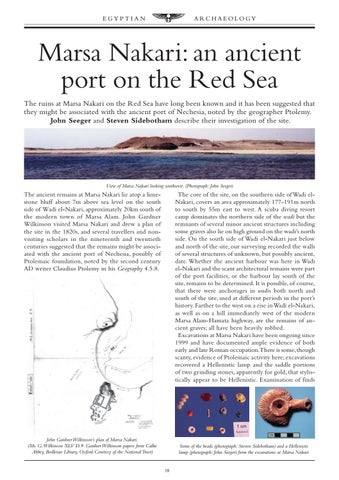
View of Marsa Nakari looking southwest. (Photograph: John Seeger)
The ancient remains at Marsa Nakari lie atop a limestone bluff about 7m above sea level on the south side of Wadi el-Nakari, approximately 20km south of the modern town of Marsa Alam. John Gardner Wilkinson visited Marsa Nakari and drew a plan of the site in the 1820s, and several travellers and nonvisiting scholars in the nineteenth and twentieth centuries suggested that the remains might be associated with the ancient port of Nechesia, possibly of Ptolemaic foundation, noted by the second century AD writer Claudius Ptolemy in his Geography 4.5.8.
The core of the site, on the southern side of Wadi elNakari, covers an area approximately 177-191m north to south by 55m east to west. A scuba diving resort camp dominates the northern side of the wadi but the remnants of several minor ancient structures including some graves also lie on high ground on the wadi’s north side. On the south side of Wadi el-Nakari just below and north of the site, our surveying recorded the walls of several structures of unknown, but possibly ancient, date. Whether the ancient harbour was here in Wadi el-Nakari and the scant architectural remains were part of the port facilities, or the harbour lay south of the site, remains to be determined. It is possible, of course, that there were anchorages in wadis both north and south of the site, used at different periods in the port’s history. Farther to the west on a rise in Wadi el-Nakari, as well as on a hill immediately west of the modern Marsa Alam-Hamata highway, are the remains of ancient graves; all have been heavily robbed. Excavations at Marsa Nakari have been ongoing since 1999 and have documented ample evidence of both early and late Roman occupation.There is some, though scanty, evidence of Ptolemaic activity here; excavations recovered a Hellenistic lamp and the saddle portions of two grinding stones, apparently for gold, that stylistically appear to be Hellenistic. Examination of finds
John Gardner Wilkinson’s plan of Marsa Nakari. (Ms. G. Wilkinson XLV D.9. Gardner Wilkinson papers from Calke Abbey, Bodleian Library, Oxford.Courtesy of the National Trust)
Some of the beads (photograph: Steven Sidebotham) and a Hellenistic lamp (photograph: John Seeger) from the excavations at Marsa Nakari
18