EGYPTIAN
ARCHAEOLOGY
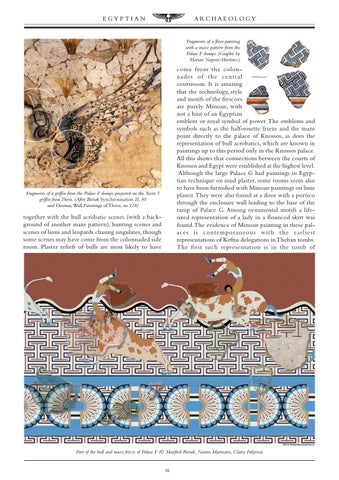
Fragments of a floor painting with a maze pattern from the Palace F dumps. (Graphic by Marian Negrete-Martinez)
come from the colonnades of the central courtroom. It is amazing that the technology, style and motifs of the frescoes are purely Minoan, with not a hint of an Egyptian emblem or royal symbol of power. The emblems and symbols such as the half-rosette frieze and the maze point directly to the palace of Knossos, as does the representation of bull acrobatics, which are known in paintings up to this period only in the Knossos palace. All this shows that connections between the courts of Knossos and Egypt were established at the highest level. Although the large Palace G had paintings in Egyptian technique on mud plaster, some rooms seem also to have been furnished with Minoan paintings on lime plaster. They were also found at a door with a portico through the enclosure wall leading to the base of the ramp of Palace G. Among ornamental motifs a lifesized representation of a lady in a flounced skirt was found. The evidence of Minoan painting in these palaces is contemporaneous with the earliest representations of Keftiu delegations in Theban tombs. The first such representation is in the tomb of
Fragments of a griffin from the Palace F dumps projected on the Xeste 3 griffin from Thera. (After Bietak Synchronisation II, 30 and Doumas, Wall Paintings of Thera, no.128)
together with the bull acrobatic scenes (with a background of another maze pattern), hunting scenes and scenes of lions and leopards chasing ungulates, though some scenes may have come from the colonnaded side room. Plaster reliefs of bulls are most likely to have
Part of the bull and maze frieze of Palace F (Š Manfred Bietak, Nanno Marinatos, Clairy Palyvou)
16