EGYPTIAN
ARCHAEOLOGY
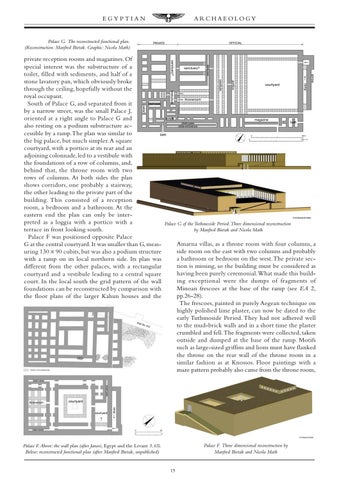
Palace G. The reconstructed functional plan. (Reconstruction: Manfred Bietak. Graphic: Nicola Math)
private reception rooms and magazines. Of special interest was the substructure of a toilet, filled with sediments, and half of a stone lavatory pan, which obviously broke courtyard through the ceiling, hopefully without the royal occupant. South of Palace G, and separated from it by a narrow street, was the small Palace J, oriented at a right angle to Palace G and also resting on a podium substructure accessible by a ramp. The plan was similar to the big palace, but much simpler. A square courtyard, with a portico at its rear and an adjoining colonnade, led to a vestibule with the foundations of a row of columns, and, behind that, the throne room with two rows of columns. At both sides the plan shows corridors, one probably a stairway, the other leading to the private part of the building. This consisted of a reception room, a bedroom and a bathroom. At the eastern end the plan can only be interpreted as a loggia with a portico with a Palace G of the Tuthmoside Period. Three dimensional reconstruction by Manfred Bietak and Nicola Math terrace in front looking south. Palace F was positioned opposite Palace Amarna villas, as a throne room with four columns, a G at the central courtyard. It was smaller than G, measside room on the east with two columns and probably uring 130 Ă— 90 cubits, but was also a podium structure a bathroom or bedroom on the west. The private secwith a ramp on its local northern side. Its plan was tion is missing, so the building must be considered as different from the other palaces, with a rectangular having been purely ceremonial. What made this buildcourtyard and a vestibule leading to a central square ing exceptional were the dumps of fragments of court. In the local south the grid pattern of the wall Minoan frescoes at the base of the ramp (see EA 2, foundations can be reconstructed by comparison with pp.26-28). the floor plans of the larger Kahun houses and the The frescoes, painted in purely Aegean technique on highly polished lime plaster, can now be dated to the early Tuthmoside Period. They had not adhered well to the mud-brick walls and in a short time the plaster crumbled and fell. The fragments were collected, taken outside and dumped at the base of the ramp. Motifs such as large-sized griffins and lions must have flanked the throne on the rear wall of the throne room in a similar fashion as at Knossos. Floor paintings with a maze pattern probably also came from the throne room,
courtyard
courtyard
Palace F. Three dimensional reconstruction by Manfred Bietak and Nicola Math
Palace F. Above: the wall plan (after Janosi, Egypt and the Levant 5, 65). Below: reconstructed functional plan (after Manfred Bietak, unpublished)
15