EGYPTIAN
ARCHAEOLOGY
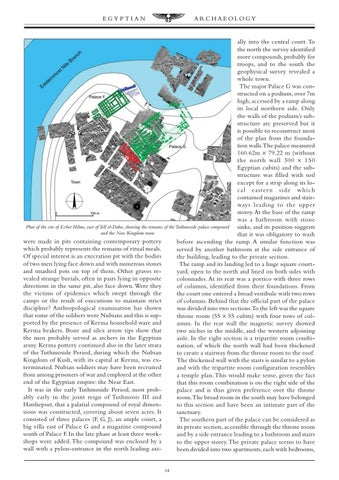
ally into the central court. To the north the survey identified more compounds, probably for troops, and to the south the geophysical survey revealed a whole town. The major Palace G was constructed on a podium, over 7m high, accessed by a ramp along its local northern side. Only the walls of the podium’s substructure are preserved but it is possible to reconstruct most of the plan from the foundation walls.The palace measured 160.62m × 79.22 m (without the nor th wall 300 × 150 Egyptian cubits) and the substructure was filled with soil except for a strip along its local easter n side which contained magazines and stairways leading to the upper storey. At the base of the ramp was a bathroom with stone Plan of the site of Ezbet Hilme, east of Tell el-Daba, showing the remains of the Tuthmoside palace compound sinks, and its position suggests and the New Kingdom town that it was obligatory to wash were made in pits containing contemporary pottery before ascending the ramp. A similar function was which probably represents the remains of ritual meals. served by another bathroom at the side entrance of Of special interest is an execration pit with the bodies the building, leading to the private section. of two men lying face down and with numerous stones The ramp and its landing led to a huge square courtand smashed pots on top of them. Other graves reyard, open to the north and lined on both sides with vealed strange burials, often in pairs lying in opposite colonnades. At its rear was a portico with three rows directions in the same pit, also face down. Were they of columns, identified from their foundations. From the victims of epidemics which swept through the the court one entered a broad vestibule with two rows camps or the result of executions to maintain strict of columns. Behind that the official part of the palace discipline? Anthropological examination has shown was divided into two sections.To the left was the square that some of the soldiers were Nubians and this is supthrone room (55 × 55 cubits) with four rows of colported by the presence of Kerma household ware and umns. In the rear wall the magnetic survey showed Kerma beakers. Bone and silex arrow tips show that two niches in the middle, and the western adjoining the men probably served as archers in the Egyptian aisle. In the right section is a tripartite room combiarmy. Kerma pottery continued also in the later strata nation, of which the north wall had been thickened of the Tuthmoside Period, during which the Nubian to create a stairway from the throne room to the roof. Kingdom of Kush, with its capital at Kerma, was exThe thickened wall with the stairs is similar to a pylon terminated. Nubian soldiers may have been recruited and with the tripartite room configuration resembles from among prisoners of war and employed at the other a temple plan. This would make sense, given the fact end of the Egyptian empire: the Near East. that this room combination is on the right side of the It was in the early Tuthmoside Period, most probpalace and is thus given preference over the throne ably early in the joint reign of Tuthmosis III and room.The broad room in the south may have belonged Hatshepsut, that a palatial compound of royal dimento this section and have been an intimate part of the sions was constructed, covering about seven acres. It sanctuary. consisted of three palaces (F, G, J), an ample court, a The southern part of the palace can be considered as big villa east of Palace G and a magazine compound its private section, accessible through the throne room south of Palace F. In the late phase at least three workand by a side entrance leading to a bathroom and stairs shops were added. The compound was enclosed by a to the upper storey. The private palace seems to have wall with a pylon-entrance in the north leading axibeen divided into two apartments, each with bedrooms,
14