EGYPTIAN
ARCHAEOLOGY
The Tuthmoside stronghold of Perunefer In the early Eighteenth Dynasty the Tuthmoside kings had a naval and military stronghold at ‘Perunefer’, originally thought to have been at Memphis. Manfred Bietak reconsiders its location in the light of evidence from the Austrian excavations at Tell el-Daba. It was George Daressy who first proposed in the late 1920s that the location of Perunefer, the major Egyptian military and naval stronghold of the Eighteenth Dynasty, should not be sought at Memphis but in the Delta, at the same site as the later town of Piramesse. Labib Habachi agreed that Perunefer was in the Delta but he thought it was at the site of Khatana/Qantir which he identified as Avaris/Piramesse.Their reasoning was based on the Karnak and Memphis stelae of Amenhotep II, who describes proceeding to Memphis, after his arrival at Perunefer. This would have been unnecessary if Perunefer had been situated at the Memphite residence. A Delta identification would also make sense in respect to the Canaanite cults attested for Perunefer in Pap. Petersburg 1116A: they could be considered as a continuum of Avaris. Ancient Avaris can now be safely identified, after nearly four decades of excavations by the Austrian Institute, with the site of Tell el-Daba and its environs, and together with nearby Qantir (being excavated by
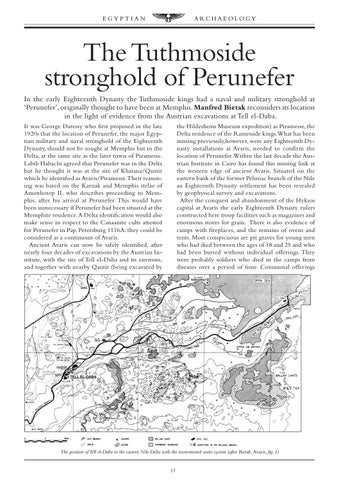
the Hildesheim Museum expedition) as Piramesse, the Delta residence of the Ramesside kings.What has been missing previously,however, were any Eighteenth Dynasty installations at Avaris, needed to confirm the location of Perunefer. Within the last decade the Austrian Institute in Cairo has found this missing link at the western edge of ancient Avaris. Situated on the eastern bank of the former Pelusiac branch of the Nile an Eighteenth Dynasty settlement has been revealed by geophysical survey and excavations. After the conquest and abandonment of the Hyksos capital at Avaris the early Eighteenth Dynasty rulers constructed here troop facilities such as magazines and enormous stores for grain. There is also evidence of camps with fireplaces, and the remains of ovens and tents. Most conspicuous are pit graves for young men who had died between the ages of 18 and 25 and who had been buried without individual offerings. They were probably soldiers who died in the camps from diseases over a period of time. Communal offerings
The position of Tell el-Daba in the eastern Nile Delta with the reconstructed water system (after Bietak, Avaris, fig. 1)
13