EGYPTIAN
ARCHAEOLOGY
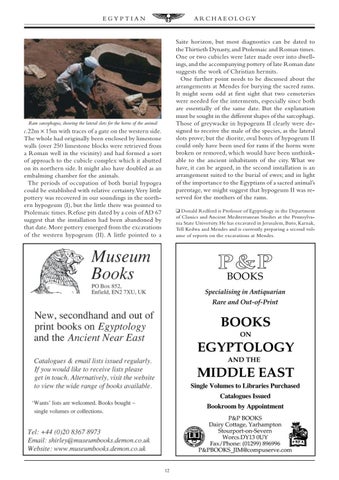
Saite horizon, but most diagnostics can be dated to the Thirtieth Dynasty, and Ptolemaic and Roman times. One or two cubicles were later made over into dwellings, and the accompanying pottery of late Roman date suggests the work of Christian hermits. One further point needs to be discussed about the arrangements at Mendes for burying the sacred rams. It might seem odd at first sight that two cemeteries were needed for the interments, especially since both are essentially of the same date. But the explanation must be sought in the different shapes of the sarcophagi. Those of greywacke in hypogeum II clearly were designed to receive the male of the species, as the lateral slots prove; but the diorite, oval boxes of hypogeum II could only have been used for rams if the horns were broken or removed, which would have been unthinkable to the ancient inhabitants of the city. What we have, it can be argued, in the second installation is an arrangement suited to the burial of ewes; and in light of the importance to the Egyptians of a sacred animal’s parentage, we might suggest that hypogeum II was reserved for the mothers of the rams.
Ram sarcophagus, showing the lateral slots for the horns of the animal
c.22m Ă— 15m with traces of a gate on the western side. The whole had originally been enclosed by limestone walls (over 250 limestone blocks were retrieved from a Roman well in the vicinity) and had formed a sort of approach to the cubicle complex which it abutted on its northern side. It might also have doubled as an embalming chamber for the animals. The periods of occupation of both burial hypogea could be established with relative certainty.Very little pottery was recovered in our soundings in the northern hypogeum (I), but the little there was pointed to Ptolemaic times. Refuse pits dated by a coin of AD 67 suggest that the installation had been abandoned by that date. More pottery emerged from the excavations of the western hypogeum (II). A little pointed to a
â?‘ Donald Redford is Professor of Egyptology in the Department of Classics and Ancient Mediterranean Studies at the Pennsylvania State University. He has excavated in Jerusalem, Buto, Karnak, Tell Kedwa and Mendes and is currently preparing a second volume of reports on the excavations at Mendes.
12