EGYPTIAN
ARCHAEOLOGY
The Late Period redevelopment of the temple the Ramesside court, although we are not sure whether this work was begun by Amasis. Here a foundation box, c.65m × 40m, had been excavated down to the level of the Old Kingdom podium (thus removing the remains of the temples of the Middle and New Kingdoms) and back-filled with fine building sand to a depth of 2m. Above, a new configuration of rooms and corridors was constructed, with walls of quartzite and columns of basalt. This part of the complex was so horribly destroyed in the Middle Ages that we despaired of ever being able to reconstruct the ground plan. The present surface layer consists of masses of shattered quartzite, some few fragments approaching 1m in length, but most reduced to mere slivers of stone. But then, as we proceeded to excavate in incremental ‘peel-backs’, we found a series of regularly-positioned ‘slots’ which were appearing beneath the rubble, sunk into the foundation sand; and it was realised that here we had the foundations of a wallingsystem, robbed out to be sure, but accidentally back-filled by detritus. Once these had been plotted, both in top-plan and section, there emerged a meaningful and symmetrical plan, not so very different from the layout of typical temples of the Late Period. A barque shrine had occupied the central portion of the rear of the temple, and had been surrounded by an ambulatory and side chambers on south, east and west.What lay in front has not yet been fully investigated, but it is conceivable that a hypostyle hall had once stood behind the second Ramesside pylon. Decoration of these new chambers dated from the Twenty-Ninth and Thirtieth Dynasties: a dado of upright cartouches gives the prenomen and nomen of Akoris of the Twenty-Ninth Dynasty, while a horizontal band of text (of unknown import) was added by King Nekhtnebef (Nektanebo I) in his first year (380-79 BC). The walls were carved with the usual scenes in panels, showing the king offering Dado of cartouches of king Akoris, from an ambulatory(?) within the temple to the Ram.
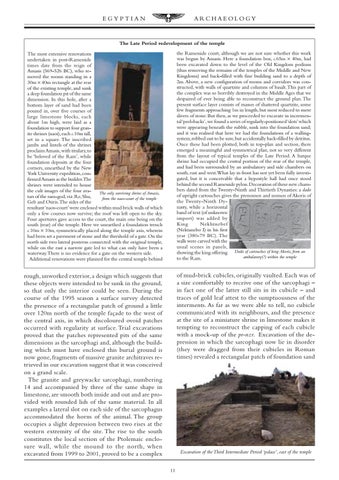
The most extensive renovations undertaken in post-Ramesside times date from the reign of Amasis (569-526 BC), who removed the rooms standing in a 30m × 40m rectangle at the rear of the existing temple, and sunk a deep foundation pit of the same dimension. In this hole, after a bottom layer of sand had been poured in, over five courses of large limestone blocks, each about 1m high, were laid as a foundation to support four granite shrines (naoi), each c.10m tall, set in a square. The inscribed jambs and lintels of the shrines proclaim Amasis, with titulary, to be ‘beloved of the Ram’, while foundation deposits at the four corners, unearthed by the New York University expedition, confirmed Amasis as the builder.The shrines were intended to house the cult images of the four avaThe only surviving shrine of Amasis, tars of the ram-god, viz. Re, Shu, from the naos-court of the temple Geb and Osiris. The sides of the resultant ‘naos-court’ were enclosed within mud brick walls of which only a few courses now survive; the roof was left open to the sky. Four apertures gave access to the court, the main one being on the south (rear) of the temple. Here we unearthed a foundation trench c.10m × 10m, symmetrically placed along the temple axis, wherein had been set a pavement of stone and the threshold of a gate. On the north side two lateral posterns connected with the original temple, while on the east a narrow gate led to what can only have been a waterway. There is no evidence for a gate on the western side. Additional renovations were planned for the central temple behind
of mud-brick cubicles, originally vaulted. Each was of a size comfortably to receive one of the sarcophagi – in fact one of the latter still sits in its cubicle – and traces of gold leaf attest to the sumptuousness of the interments. As far as we were able to tell, no cubicle communicated with its neighbours, and the presence at the site of a miniature shrine in limestone makes it tempting to reconstruct the capping of each cubicle with a mock-up of the pr-nzr. Excavation of the depression in which the sarcophagi now lie in disorder (they were dragged from their cubicles in Roman times) revealed a rectangular patch of foundation sand
rough, unworked exterior, a design which suggests that these objects were intended to be sunk in the ground, so that only the interior could be seen. During the course of the 1995 season a surface survey detected the presence of a rectangular patch of ground a little over 120m north of the temple façade to the west of the central axis, in which discoloured ovoid patches occurred with regularity at surface. Trial excavations proved that the patches represented pits of the same dimensions as the sarcophagi and, although the building which must have enclosed this burial ground is now gone, fragments of massive granite architraves retrieved in our excavation suggest that it was conceived on a grand scale. The granite and greywacke sarcophagi, numbering 14 and accompanied by three of the same shape in limestone, are smooth both inside and out and are provided with rounded lids of the same material. In all examples a lateral slot on each side of the sarcophagus accommodated the horns of the animal. The group occupies a slight depression between two rises at the western extremity of the site. The rise to the south constitutes the local section of the Ptolemaic enclosure wall, while the mound to the north, when excavated from 1999 to 2001, proved to be a complex
Excavation of the Third Intermediate Period ‘palace’, east of the temple
11