EGYPTIAN
ARCHAEOLOGY
Faience haunch with the cartouche of Merenptah from the foundation deposit of the second pylon
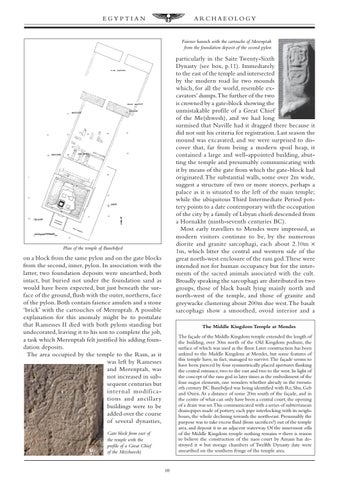
particularly in the Saite Twenty-Sixth Dynasty (see box, p.11). Immediately to the east of the temple and intersected by the modern road lie two mounds which, for all the world, resemble excavators’ dumps.The further of the two is crowned by a gate-block showing the unmistakable profile of a Great Chief of the Me(shwesh), and we had long surmised that Naville had it dragged there because it did not suit his criteria for registration. Last season the mound was excavated, and we were surprised to discover that, far from being a modern spoil heap, it contained a large and well-appointed building, abutting the temple and presumably communicating with it by means of the gate from which the gate-block had originated. The substantial walls, some over 2m wide, suggest a structure of two or more storeys, perhaps a palace as it is situated to the left of the main temple; while the ubiquitous Third Intermediate Period pottery points to a date contemporary with the occupation of the city by a family of Libyan chiefs descended from a Hornakht (ninth-seventh centuries BC). Most early travellers to Mendes were impressed, as modern visitors continue to be, by the numerous diorite and granite sarcophagi, each about 2.10m × 1m, which litter the central and western side of the great north-west enclosure of the ram god. These were intended not for human occupancy but for the interments of the sacred animals associated with the cult. Broadly speaking the sarcophagi are distributed in two groups, those of black basalt lying mainly north and north-west of the temple, and those of granite and greywacke clustering about 200m due west. The basalt sarcophagi show a smoothed, ovoid interior and a
Plan of the temple of Banebdjed
on a block from the same pylon and on the gate blocks from the second, inner, pylon. In association with the latter, two foundation deposits were unearthed, both intact, but buried not under the foundation sand as would have been expected, but just beneath the surface of the ground, flush with the outer, northern, face of the pylon. Both contain faience amulets and a stone ‘brick’ with the cartouches of Merenptah. A possible explanation for this anomaly might be to postulate that Ramesses II died with both pylons standing but undecorated, leaving it to his son to complete the job, a task which Merenptah felt justified his adding foundation deposits. The area occupied by the temple to the Ram, as it was left by Ramesses and Merenptah, was not increased in subsequent centuries but inter nal modifications and ancillar y buildings were to be added over the course of several dynasties,
The Middle Kingdom Temple at Mendes The façade of the Middle Kingdom temple extended the length of the building, over 30m north of the Old Kingdom podium, the surface of which was used as the floor. Later construction has been unkind to the Middle Kingdom at Mendes, but some features of this temple have, in fact, managed to survive. The façade seems to have been pierced by four symmetrically placed apertures flanking the central entrance, two to the east and two to the west. In light of the concept of the ram god in later times as the embodiment of the four major elements, one wonders whether already in the twentieth century BC Banebdjed was being identified with Re, Shu, Geb and Osiris. At a distance of some 20m south of the façade, and in the centre of what can only have been a central court, the opening of a drain was set.This communicated with a series of subterranean drain-pipes made of pottery, each pipe interlocking with its neighbours, the whole declining towards the north-east. Presumably the purpose was to take excess fluid (from sacrifices?) out of the temple area, and deposit it in an adjacent waterway. Of the innermost cella of the Middle Kingdom temple nothing remains – there is reason to believe the construction of the naos court by Amasis has destroyed it – but storage chambers of Twelfth Dynasty date were unearthed on the southern fringe of the temple area.
Gate block from east of the temple with the profile of a Great Chief of the Me(shwesh)
10