public. In addition, a group of junior architects joined a three-day seminar to study Mamluk geometry and apply this knowledge in their projects. Finally, the Egyptian Heritage Rescue Foundation (EHRF ) par tnered with 13 designers and craftsmen working in different fields from khiyamiyya (quilting) to tile making, interior design, jewellery and fashion. Each participant created a contemporary design inspired by the geometry and ornamentation of the Mamluk minbars.
Photos: EHRF
Right: cement tiles with a geometrical design inspired by the Mamluk minbars.
28 May 2008. All its side panels had been removed as well as the entrance portal, leaving only the structure of both flanks, the staircase and the dome (image p. 28, bottom). Some of the stolen parts could be repatriated when, in 2014, Danish police intercepted a parcel destined for the USA that contained wooden pieces with inlaid panels taken from the Ganim al-Bahlawan minbar. Its restoration involved salvaging the structure still in situ and reuniting the repatriated pieces with it. However, the process made us aware of the tragic loss of know-how in traditional woodwork. Only a single master craftsman was available with the necessary skills to join the restoration team. The database created by project is, we believe, the first of its kind in Egypt. It is not exclusive to the minbars and can be developed to accommodate mater ial from other architectural elements, such as doors,
We hope that the legacy of the project will be to create sustained interest and appreciation both in Egypt and abroad. The EHRF will continue to care for the minbars alongside the Ministry of Tourism and Antiquities. Our aim is to share the knowledge we have acquired through the project with wider circles of professionals as the best way to raise awareness and we hope that this can play a role in the protection of Egypt’s heritage.
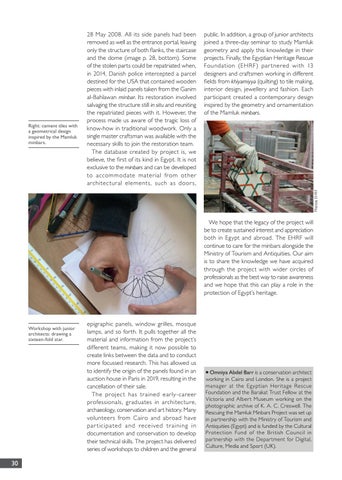
Workshop with junior architects: drawing a sixteen-fold star.
30
epigraphic panels, window grilles, mosque lamps, and so forth. It pulls together all the material and information from the project’s different teams, making it now possible to create links between the data and to conduct more focussed research. This has allowed us to identify the origin of the panels found in an auction house in Paris in 2019, resulting in the cancellation of their sale. The project has trained early-career professionals, graduates in architecture, archaeology, conservation and art history. Many volunteers from Cairo and abroad have par ticipated and r eceived tr aining in documentation and conservation to develop their technical skills. The project has delivered series of workshops to children and the general
• Omniya Abdel Barr is a conservation architect working in Cairo and London. She is a project manager at the Egyptian Heritage Rescue Foundation and the Barakat Trust Fellow at the Victoria and Albert Museum working on the photographic archive of K. A. C. Creswell. The Rescuing the Mamluk Minbars Project was set up in partnership with the Ministry of Tourism and Antiquities (Egypt) and is funded by the Cultural Protection Fund of the British Council in partnership with the Department for Digital, Culture, Media and Sport (UK).