Photos: EHRF
RESCUING THE MAMLUK MINBARS OF CAIRO
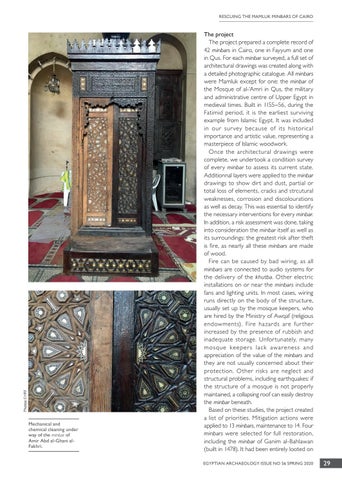
Mechanical and chemical cleaning under way of the minbar of Amir Abd al-Ghani alFakhri.
The project The project prepared a complete record of 42 minbars in Cairo, one in Fayyum and one in Qus. For each minbar surveyed, a full set of architectural drawings was created along with a detailed photographic catalogue. All minbars were Mamluk except for one: the minbar of the Mosque of al-‘Amri in Qus, the military and administrative centre of Upper Egypt in medieval times. Built in 1155–56, during the Fatimid period, it is the earliest surviving example from Islamic Egypt. It was included in our sur vey because of its historical importance and artistic value, representing a masterpiece of Islamic woodwork. Once the architectural drawings were complete, we undertook a condition survey of every minbar to assess its current state. Additionnal layers were applied to the minbar drawings to show dirt and dust, partial or total loss of elements, cracks and strcutural weaknesses, corrosion and discolourations as well as decay. This was essential to identify the necessary interventions for every minbar. In addition, a risk assessment was done, taking into consideration the minbar itself as well as its surroundings: the greatest risk after theft is fire, as nearly all these minbars are made of wood. Fire can be caused by bad wiring, as all minbars are connected to audio systems for the delivery of the khutba. Other electric installations on or near the minbars include fans and lighting units. In most cases, wiring runs directly on the body of the structure, usually set up by the mosque keepers, who are hired by the Ministry of Awqaf (religious endowments). Fire hazards are fur ther increased by the presence of rubbish and inadequate storage. Unfor tunately, many mosque keeper s lack awar eness and appreciation of the value of the minbars and they are not usually concerned about their protection. Other risks are neglect and structural problems, including earthquakes: if the structure of a mosque is not properly maintained, a collapsing roof can easily destroy the minbar beneath. Based on these studies, the project created a list of priorities. Mitigation actions were applied to 13 minbars, maintenance to 14. Four minbars were selected for full restoration, including the minbar of Ganim al-Bahlawan (built in 1478). It had been entirely looted on EGYPTIAN ARCHAEOLOGY ISSUE NO 56 SPRING 2020
29