listed and systematically restored. The minbars were given great care and attention and only the best carpenters were hired to replace the missing parts. No further looting took place until recent decades. As the latest thefts caused concern, we started checking catalogues and sales records of auction houses, focusing on the three prominent London auction houses of Sotheby’s, Christie’s and Bonhams that have dedicated departments of Islamic art. After assessing sales from 2000 to 2017, we found that a total of 52 carved wooden panels, possibly dating to the Mamluk period, had been sold. A noticeable surge in the sales appeared in 2008, with 15 lots, and in 2011, with seven. In every year except for 2006 at least one lot containing Mamluk wooden panels was offered.
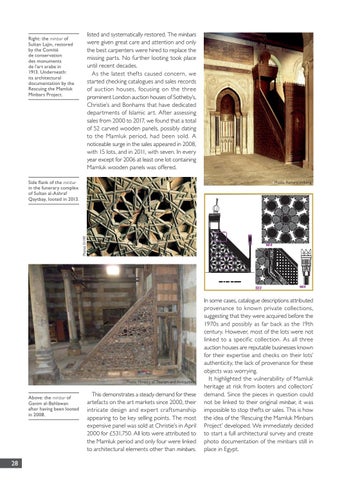
Right: the minbar of Sultan Lajin, restored by the Comité de conservation des monuments de l’art arabe in 1913. Underneath: its architectural documentation by the Rescuing the Mamluk Minbars Project.
Side flank of the minbar in the funerary complex of Sultan al-Ashraf Qaytbay, looted in 2013.
Photo: Richard Wilding
KEY PLAN
RESCUING THE MAMLUK MINBARS OF CAIRO
Photo: EHRF
Documentation and Conservation Project
Owner:
MINISTRY OF ANTIQUITIES Funded by the :
CULTURAL PROTECTION FUND
Supervised by :
Historic Cairo Department Implemented by :
Egyptian Heritage Rescue Foundation ARCHITECTURAL DOCUMENTATION MINBAR OF LAJIN AT IBN TULUN MOSQUE (index no. 220) Reviewed by:
Drawn by: Maryam alTouny Ahmed Sayed Mostafa Sedky Noha Badr Nourhan Ahmed Walaa Hassan Hajar muhammad
Maryam Abd el-Aziz Hana el-Masry Mona el-Shahed
Dr. Omniya Abdel Barr Eng. Ibrahim Bahaa
DETAILED BLOW-UP FOR ELEVATION-RIGHT OF IMAM IT_220_ARCH_007 Scale : 1:5
Photo: Ministry of Tourism and Antiquities
Above: the minbar of Ganim al-Bahlawan after having been looted in 2008.
28
This demonstrates a steady demand for these artefacts on the art markets since 2000, their intricate design and exper t craftsmanship appearing to be key selling points. The most expensive panel was sold at Christie’s in April 2000 for £531,750. All lots were attributed to the Mamluk period and only four were linked to architectural elements other than minbars.
In some cases, catalogue descriptions attributed provenance to known private collections, suggesting that they were acquired before the 1970s and possibly as far back as the 19th century. However, most of the lots were not linked to a specific collection. As all three auction houses are reputable businesses known for their expertise and checks on their lots’ authenticity, the lack of provenance for these objects was worrying. It highlighted the vulnerability of Mamluk heritage at risk from looters and collectors’ demand. Since the pieces in question could not be linked to their original minbar, it was impossible to stop thefts or sales. This is how the idea of the ‘Rescuing the Mamluk Minbars Project’ developed. We immediately decided to start a full architectural survey and create photo documentation of the minbars still in place in Egypt.