editor@yourmonthlypaper.com
Your Personal Nutritionist
Hidden Sugars Lurking in Our Food By Linda Michaelis RD,MS
In my practice I have seen many knowledgable clients who do not realize how much sugar they consume each day. My client, Charles (name changed), was referred to me by his doctor for prediabetes. Every morning for breakfast Charles enjoyed his favorite Raisin Bran cereal along with a glass of freshly squeezed orange juice. He thought this was a healthy choice for him. After our meeting he realized that he was eating two servings of cereal with almost two cups of milk each morning and was consuming almost 40 grams of sugar from the cereal plus 20 grams of sugar from milk with its naturally occurring lactose (milk sugar). His total sugar intake from his bowl of cereal was 60 grams. His glass of orange juice accounted for another 30 grams of sugar. I taught Charles that one teaspoon of sugar is equal to 4 grams. Charles was consuming 90 grams of sugar each morning, or about 20 teaspoons of sugar. Charles almost fell out of his chair from surprise. Now, of course, that was only breakfast. Charles learned from his employees that Greek yogurt is good for you, and thus he purchased all the berry flavors for the office to snack on. Unfortunately, his nonfat blueberry Chobani brand Greek yogurt has 20 grams or 5 teaspoons of sugar. I informed him that many companies now offer Greek yogurt with about 10 grams of sugar or less which is more acceptable. Once in a while Charles frequents Starbucks and orders a non-fat vanilla soy latte. I reminded him about the natural sugar in the milk along with the sugar in the vanilla flavoring. I told him that fewer “pumps” of flavoring was a good way to reduce the amount of sugar in the drink. Charles mentioned that for lunch he often has a turkey sandwich with chips and a Coke to drink. Did you realize that an average size Coke, has 30 grams, or about 6 teaspoons, of sugar? To wean Charles off of the Coke I recommended drinking just a half serving over a lot of ice or diluting it. I introduced Charles to “no sugar added” Snapple and Sparkling Ice that is also carbonated. He has now weaned himself off of Coke and is enjoying Raspberry Sparkling Ice.
Squamous Cell Carcinoma Skin and Retinoids By Christine Chung, MD
I recently met a vibrant, athletic, well-dressed woman who had just turned 60 years old. Six months earlier, she had developed a red bump on her left forehead, just above her eyebrow, which was squamous cell carcinoma (SCC), a type of skin cancer. She was treated with Mohs surgery, a procedure in which a dermatologist shaves off layers of skin to remove the cancer. Unfortunately, my patient’s skin cancer kept recurring in that same area. After her third Mohs surgery, we treated her with radiation therapy to decrease the risk of cancer recurrence. After her last treatment, she wanted to know if she had done anything that had led to her skin cancer. “Dr. Chung, did I get my skin cancer because of all the Retin-A that I’ve used for my wrinkles?” she asked. SCC of the skin is one of the most common malignancies diagnosed in the US, with over 700,000 new cases each year. It occurs most frequently on sun-exposed skin in fair-skinned individuals, though it may also develop in people with darker skin. SCC of the skin is associated with exposure to ultraviolet light from the sun, and it occurs more often in older people. Patients who have undergone organ transplantation and require chronic immunosuppression are also at greater risk of developing skin cancer. This type of cancer can take many forms, including flat red spots, painless bumps, or scaly patches on the skin. A doctor needs to biopsy the skin to confirm the diagnosis of cancer. Over 90% of skin SCC are cured with local therapy alone, usually surgical excision like Mohs. An advantage of Mohs microsurgery is that the surgeon can look at the cells as they are being removed, to ensure that all of the cancer has been fully excised. Low-risk SCC may also be treated with freezing (cryotherapy), radiation therapy, or a topical cream. Some patients may need radiation after surgical excision, if the cancer cells have aggressive features, such as invasion into the local nerves, or if the cancer continues to
Danville Today News ~ May 2015 - Page 25 Food products have many ingredients that contain sugar. Various names for them include white and brown sugar, confectioner’s sugar, corn syrup, dextrin, honey, invert sugar, maple syrup, raw and beet sugar, cane sugar, evaporated cane juice, high fructose corn syrup, malt, molasses, and turbinado sugar. Please realize that when fruit juice is listed on bakery goods it is also referring to a sugar.
Hidden Sugars in Foods
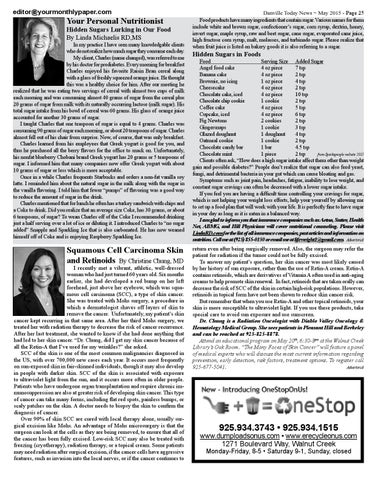
Food Serving Size Added Sugar Angel food cake 4 oz piece 7 tsp Banana cake 4 oz piece 2 tsp Brownie, no icing 1 oz piece 4 tsp Cheesecake 4 oz piece 2 tsp Chocolate cake, iced 4 oz piece 10 tsp Chocolate chip cookie 1 cookie 2 tsp Coffee cake 4 oz piece 5 tsp Cupcake, iced 4 oz piece 6 tsp Fig Newtons 2 cookies 2 tsp Gingersnaps 1 cookie 3 tsp Glazed doughnut 1 doughnut 4 tsp Oatmeal cookie 1 cookie 2 tsp Chocolate candy bar 1 bar 4.5 tsp Chocolate mint 1 piece 2 tsp from Sparkspeople website 2015 Clients often ask, “How does a high sugar intake affect them other than weight gain and possible diabetes?” People don’t realize that sugar can also feed yeast, fungi, and detrimental bacteria in your gut which can cause bloating and gas. Symptoms such as joint pain, headaches, fatigue, inability to lose weight, and constant sugar cravings can often be decreased with a lower sugar intake. If you feel you are having a difficult time controlling your cravings for sugar, which is not helping your weight loss efforts, help your yourself by allowing me to set up a food plan that will work with your life. It is perfectly fine to have sugar in your day as long as it is eaten in a balanced way. I am glad to inform you that insurance companies such as Aetna, Sutter, Health Net, ABMG, and Hill Physicians will cover nutritional counseling. Please visit LindaRD.com for the list of all insurance companies, past articles and information on nutrition. Call me at (925) 855-0150 or email me at lifeweight1@gmail.com. Advertorial return even after being surgically removed. Also, the surgeon may refer the patient for radiation if the tumor could not be fully excised. To answer my patient’s question, her skin cancer was most likely caused by her history of sun exposure, rather than the use of Retin-A cream. Retin-A contains retinoids, which are derivatives of Vitamin A often used in anti-aging creams to help promote skin renewal. In fact, retinoids that are taken orally can decrease the risk of SCC of the skin in certain high-risk populations. However, retinoids in topical form have not been shown to reduce skin cancer risk. But remember that when you use Retin-A and other topical retinoids, your skin is more susceptible to ultraviolet light. If you use these products, take special care to avoid sun exposure and use sunscreen. Dr. Chung is a Radiation Oncologist with Diablo Valley Oncology & Hematology Medical Group. She sees patients in Pleasant Hill and Berkeley and can be reached at 925-825-8878. Attend an educational program on May 20th, 6:30-8pm at the Walnut Creek Library’s Oak Room. “The Many Faces of Skin Cancer” will feature a panel of medical experts who will discuss the most current information regarding prevention, early detection, risk factors, treatment options. To register call 925-677-5041. Advertorial
925.934.3743 • 925.934.1515
www.dumploadsonus.com • www.erecycleonus.com 1271 Boulevard Way, Walnut Creek Monday-Friday, 8-5 • Saturday 9-1, Sunday, closed