THURSDAY, DECEMBER 4, 2008 | NEWS | THE DIAMONDBACK
3
Sachs: Goals for spring ‘realistic’ ADDRESS, from Page 1 for the future and motivate his colleagues to continue to work hard throughout the second semester. “I am not a big believer in looking to the past, and that was the hardest part of the speech for me to write,” Sachs explained after the address. “But we know what’s happened, it’s all about where we are going and what we can do with what we have left.” Sachs harped on the need for
the SGA members to continue to reach out to members of the university community, and the need for a larger, more comprehensive advocacy plan. He backed the idea up by promising to contribute $15,000 toward the creation of a new program that, according to Sachs, will help to mobilize students toward making a difference. He pointed to high textbook prices as an issue that can only be solved with a strong student voice. “The opportunity to build this
force is perfect,” Sachs stressed. “It’s crucial that we find ways for students to help.” The plan to mobilize students focused on reaching out to the university’s new voters and having an increased presence in Annapolis and Washington. Sachs said he would provide grants to student groups looking to lobby in Annapolis. He also proposed a “Spring Fling,” which would bring Art Attack, Maryland Day and other campus-wide events into a single
week. Sachs said a community service component could also be built into the week-long celebration that calls on students to harness their skills in ways that benefit the community — for example, education majors could tutor at local schools. While past SGA presidents have pushed state legislators to make pro-student decisions, such as agreeing to fund a tuition freeze, a $1 billion state deficit could make officials more hesitant to approve such a costly
measure this year. Sachs acknowledged all of his ideas would require hard work from the SGA and cooperation with other student groups. Working together, he said, is “100% crucial to the success of the programs.” His goals for next semester are not insurmountable, he added. “It’s completely realistic; I have been working toward this; there is nothing in there that we won’t accomplish,” Sachs said after the speech. “The Spring Fling is already being worked on, the advocacy efforts are going good. This is all here; this is all happening.” The only success from this semester Sachs mentioned was reg-
istering voters and getting them to the poll for the presidential election. “We challenged you all to get out the vote,” Sachs said. “We moved thousands of students to the polls — we did it.” After applauding the members of the legislature for their work thus far, Sachs urged them to step up and fulfill their obligations as members of the SGA. “It’s time for us to be leaders,” Sachs said during the meeting. “It’s time for us to do what we promised to do in the beginning. We all need to make sacrifices, but I believe in you.” lemairedbk@gmail.com
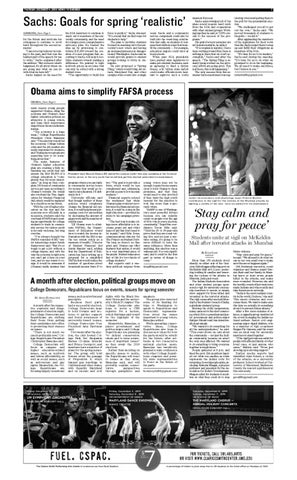
Obama aims to simplify FAFSA process OBAMA, from Page 1 main reason young people supported Obama, citing the economy and Obama’s clear higher education policies as attractive to young voters, and hope their importance rings true in his new administration. “The economy is a huge issue,” College Republicans President Chris Banerjee said. “This election was about the economy. College tuition costs and the job market are really important for students, and Obama knows people are expecting him to do something about that.” The main features of Obama’s higher education plan are creating a fully refundable tax credit that will ensure the first $4,000 of a college education is “completely free for most Americans,” as long as they complete 100 hours of community service per year, according to Obama’s website. He would also overhaul the Free Application for Student Financial Aid, which would be replaced by a checkbox on tax forms. With the cost of higher education on the rise and the economy now officially in a recession, students said the overhaul of FAFSA and creating an opportunity for college students to trade in community service for tuition credit is not only welcome, but long overdue. “I’ve always thought the FAFSA was kind of BS,” senior kinesiology major Sarah Easterwood said. “But it’s so tough to get a job without a college degree, and with the way the economy is right now, you can’t get a loan on your own, and no one wants to cosign. It would be awesome if [Obama] really instates that
President-elect Barack Obama (D) visited the campus earlier this year, speaking at the Comcast Center, above, to the very youth that would help get him elected. ADAM FRIED/THE DIAMONDBACK
program where you can trade in community service hours for money that would go toward your education. I’d definitely do it.” University officials said that though neither of these policies would completely change the financial aid system, it would help lessen processing costs for universities by decreasing the amount of paperwork and the number of middle-men. “[If Obama were to eliminate FAFSA], the Department of Education would have to match the income information with the IRS or use the tax return solely as a measure of wealth,” Director of Student Financial Aid Sarah Bauder said, adding that the Department of Education has been writing up a proposal for a simplified FAFSA that would reduce the number of questions about household income from 37 to
two. “The goal is to provide a form, which would be less complicated and, ultimately, provide access to low-income students.” Financial experts echoed the sentiment that while Obama’s plan would not revolutionize the financial aid system, it would be a step in the right direction — provided he sticks to his campaign promises. “The best way to make college more affordable is to increase grant aid and other types of aid that don’t need to be repaid,” said Edie Irons, communications director for The Project on Student Debt. “As long as there’s no fine print and Obama can offer students that option, it would be a very important piece of the puzzle. Student loans are a fact of life for two-thirds of college students.” But experts said a onetime political outpour from
young voters may not be enough to gain the necessary clout to hold Obama to these promises, and that they would need to stay involved if they want the high youth turnout for the election to look like more than a sporadic whim. “AARP is one of Washington’s most powerful lobbies because you can reliably count on people over the age of 60 to vote in every election, consistently,” TerpsVote coordinator Devin Ellis said. “Until the 18- to 29-year-olds prove that they are a real voting bloc and not just a onetime outing, it’s going to be more difficult to have the same influence. More than anything, this election was a wakeup call. It is very significant, and it could be the first part in terms of things to come.” langdbk@gmail.com
A month after election, political groups move on College Democrats, Republicans focus on events, issues for spring semester BY ANNA KOWALCZYK Staff writer
A month after the respective euphoria and disappointment of election night, the College Democrats and Republicans are shifting their focus from getting their candidates into office to promoting their stances on issues. “There is not much we can do politically now,” College Republicans President Christopher Banerjee said. College Democrats will focus on campus- and higher education-related issues, such as textbook and tuition affordability, as well as social issues, such as anti-racism and gay rights. Meanwhile, the College Republicans are focusing largely on national
issues, such as abortion and gun rights. Because their party had a successful election, College Democrats hope to hold forums and lectures to gather support and foster awareness of university-based issues, College Democrats Vice President Amy Hartman said. Two weeks after the election, the club hosted College Park Del. Benjamin Barnes (D-Anne Arundel and Prince George’s), and members have a number of plans for the spring semester. The group will hold forums about the passage of Proposition 8, which banned gay marriage in California and other states, with Equality Maryland and on racism and civil
rights with the Black Student Union and the university’s NAACP chapter. The College Democrats also hope to invite a CNN reporter for a lecture, which Hartman said would be the highlight of the semester. Meanwhile, Banerjee, a junior government and politics major, said College Republicans are planning “to defend conservative ideals and to raise awareness of important issues” as they await the 2010 elections. Rather than deciding on specific issues to tackle, the Republicans will react to issues as they arise, Banerjee said, and will probably explain conservative perspectives through pamphlets and
speakers. The group also reserved some of its funding for trips to Washington to speak to Republican and Democratic representatives about the issues important to young voters, Banerjee added. While spreading conservative ideas, College Republicans also hope to discuss new ideas for how the party should be rebuilt for the future, after setbacks in two consecutive national election years. Banerjee has tentatively planned a state conference with other College Republican chapters and possibly state representatives to focus on the future of the party. kowalczykdbk@gmail.com
Junior neuroscience and physiology major Francis Bustos contributes to the vigil for the victims of the Mumbai attacks by lighting a candle of his own. VINCE SALAMONE/FOR THE DIAMONDBACK
‘Stay calm and pray for peace’ Students unite at vigil on McKeldin Mall after terrorist attacks in Mumbai BY KYLE GOON Staff writer
More than 150 students stood silently on either side of the Omicron Delta Kappa reflecting pool on McKeldin Mall at 8:12 p.m. yesterday, holding lit candles and honoring the victims of the attacks in Mumbai, India, last week. The Indian Students Association and other student groups sponsored a vigil for university community members to mourn or simply show support for those killed and wounded in the terrorist attacks. The vigil comes after one held Monday by the Student Council of India, a graduate students’ group. Braving the chilly temperature, many came out to the short ceremony, which ISA co-president and junior government and politics major Rahguv Murali said was intentionally kept simple. “We wanted to do something for all the undergraduates,” he said. “This event shows we care about the community — not just the Indian community, because we aren’t the only ones affected. We wanted to do something to bring everyone together in tough times.” People gathered at 8 p.m. and lined the pool. ISA members handed out white tea candles, as white represents the Indian color for mourning. Several people spoke, including Satindar Bhagat, a physics professor and president for the Association for India’s Development. Bhagat called for students to meditate on what they could do to stop
future violence. “Stay calm and pray for peace,” he said. “We all need to do what we can in our own small way to make sure this never happens again.” ISA freshman executive, event organizer and finance major Simran Shah said her family in Mumbai knew at least seven people killed in the attacks, and many more wounded. However, she said the horrific events of last week have made Indians and others unify and take threats more seriously. “India is the most resilient country in the world, I believe,” she said. “She meets obstacles and overcomes them. We want to make sure this time we actually do something about it to prevent future attacks.” After a few more minutes of silence, a cappella group Anokha led the crowd in singing the Indian national anthem. Senior civil engineering major Anjuli Bakhru, who is a member of vigil co-sponsor Kappa Phi Gamma, said the event was an ideal way for university members to stand together. “[The vigil] provides an outlet for people with affected family or other loved ones, or just anyone who cares,” Bakhru said. “Even just showing up is showing support.” Earlier media reports had identified Alan Scherr, a victim of the attacks, as a university professor. Scherr worked at University of Maryland, Baltimore County. He was not a professor at this university. goondbk@gmail.com