4
Opinion
THE DIAMONDBACK | TUESDAY, FEBRUARY 19, 2013
EDITORIAL BOARD
YASMEEN ABUTALEB Editor in Chief
Mike King
Managing Editor
Tyler Weyant
Managing Editor
maria romas Opinion Editor
nadav karasov Opinion Editor
CONTACT US 3150 South Campus Dining Hall | College Park, MD 20742 | newsumdbk@gmail.com OR opinionumdbk@gmail.com PHONE (301) 314-8200
Profits over values
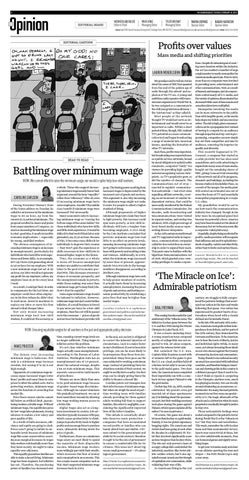
EDITORIAL CARTOON
Mass media and shifting priorities LAUREN MENDELSOHN
JAKE STEINER/the diamondback
HEAD TO HEAD
Battling over minimum wage VIEW: We cannot afford to raise the minimum wage, nor would a spike help low-skill workers.
CAROLINE CARLSON During President Obama’s State of the Union address on Tuesday, he called for an increase in the minimum wage to $9 an hour, up from the current $7.25 national minimum. The proposal resulted in cheers and praise from many members of Congress. As much as increasing the minimum wage is a feel-good idea, it results in terrible economic implications — especially for young, unskilled workers. The obvious consequence of increasing minimum wage is an increase in unemployment, particularly for individuals who have little work experience and fewer skills. As an example, let’s say I have a job generating about $7.50 an hour for my employer. With a new minimum wage law set at $9 an hour, my labor would not generate any profit for my employer; rather, my employer loses $1.50 for every hour I work. As a result, I could get fired. In order to compensate for the lost labor, my employer could force other employees in his firm (whom he didn’t fire) to work more, invest in machines to replace my labor or move his firm abroad to find cheaper labor. No t o n ly wo u l d i n c rea s i n g m i n i m u m wa ge h u r t l ow- s k i l l workers, it could hurt the economy as
a whole. Those who support increasing minimum wage usually frame their argument around the term “equality” rather than “efficiency.” After all, even if increasing minimum wage hurts some employees, wouldn’t the middle class benefit if minimum wage were increased? Not necessarily. Many economists refer to increasing minimum wage as “erasing the bottom rungs of the career ladder.” For those individuals who have few skills and little work experience, it would be difficult to find work if their labor only generated, say, $7.50 an hour. Because of this, it becomes more difficult for individuals to improve their resume — they won’t gain the experience or skills necessary in low-skill jobs to demand higher wages in the future. Thus, the economy as a whole is worse off because unemployed workers are unable to contribute their labor to the pool of economic productivity. This decreases everyone’s chance at economic prosperity, and the unemployed remain in poverty, while those making way more than minimum wage get to keep their jobs. How’s that for equality? Some argue minimum wage should be indexed to inflation. However, minimum wage laws just create further inflation. If a small business is forced to pay more per hour for a low-skill employee, then the cost will be passed on to the consumer — prices of goods and services the business provides will
go up. The buying power resulting from increased wages is depreciated by the increased cost of goods and services. This argument is also why increasing the minimum wage might not make it easier for people to afford a higher standard of living. Although proponents of higher minimum wage laws claim they want to fight poverty, this increase could spur more poverty, as low-skill individuals will have a tougher time becoming employed. A 2012 study by the Cato Institute concluded that previous minimum wage laws had little to no effect on poverty levels, meaning increasing minimum wage isn’t going to solve issues our country faces with poverty and resulting crime and violence. Additionally, in 2009, when the minimum wage increased by more than 10 percent, approximately 600,000 jobs in the teenage workforce disappeared, according to Breitbart.com. Although minimum wage laws seek to help poorer members of society, it actually hurts them by increasing unemployment, increasing the prices of goods and services and hurting economic productivity by establishing a price floor that may be higher than market wages. Caroline Carlson is a sophomore government and politics and information systems major. She can be reached at caroline.crlsn@gmail.com.
VIEW: Ensuring equitable wages for all workers is the just and appropriate policy decision.
MARC PRIESTER T h e d e b a te o ve r i n c re a s i n g minimum wage is ludicrous. Not only is a minimum wage increase overdue, but raising it to $9 is not high enough. Opponents of a minimum wage increase argue increased wages lower firms’ profits and cause them to raise prices to offset the added costs. But in protecting workers, minimum wage serves the function of correcting free market ills. Price floors ensure salaries cannot fall below an artificial limit, guaranteeing workers a livable wage. Without minimum wage, the equilibrium price for low-wage labor plummets, forcing laborers to endure a low salary and poor quality of life. In a world of finite resources, efficiency and equity are going to clash. Prices aren’t going to inflate to unbearable levels because of minimum wage like some conservatives assert. Because marginal increases in wages help workers substantially more than they harm society, we ought to value equality over efficiency. This equality guarantees families are able to make a decent living. Minimum wage has been stagnant, but inflation has not. Therefore, the purchasing power of families has decreased over
time, meaning current wage levels are no longer sufficient. Tying wages to inflation solves this problem. It’s not clear whether minimum wages actually cause unemployment. According to the Bureau of Labor Statistics, Washington state has an unemployment rate of 7.6 percent, about the national average, despite a $9.19 state minimum wage. This unravels conservative indictments of price floors. Women are more likely than men to be paid minimum wage because of gender-based wage discrimination. Although we cannot eliminate this prejudicial treatment, we can at least mend these wounds by allowing low-wage working women access to a better life. Higher wages also act as a longterm investment in society. Job satisfaction typically increases with pay, which causes productivity to climb. Jumps in productivity leads to higher profits and encourage firms to produce more, ultimately driving down the price of goods. Furthermore, those on a minimum wage salary are most likely to spend the majority of their disposable income. Minimum wage workers more willingly part with their wealth, which increases the flow of money and consumption in an economy. This was a major reason companies such as Wal-Mart supported minimum wage increases back in 2009.
In the end, our society is obligated to correct the inherent injustice of circumstance. Luck is a major factor in one’s livelihood. If you’re born into privilege, you are far more likely to be prosperous than those born impoverished. Many born poor are the ones subjected to working a minimum wage. Instead of punishing them for situations outside of their control, we ought to rectify fate’s cruelty. Our first step can be simply giving them the ability to finance a decent life. Caroline points out teenagers lose their jobs because of minimum wage. But when we weigh the need of parttime working teens with families already providing for them against adults working full time to support families, this effect is negligible, considering the significantly improved lives of the latter’s families. This debate is essentially about who deserves more protection — companies that have accumulated record profits or families who can barely afford food and shelter. Citizens submit to the government and abide by its social contract; therefore it ought to be the role of government to ensure a comfortable life for its citizens. This issue isn’t about big versus small government — it’s about logical government. Marc Priester is a sophomore economics and government and politics major. He can reached at marcpriester@gmail.com.
My grandpa used to tell me stories about his career at NBC that spanned from the end of the golden age of radio through the advent and explosion of the TV era. A young and ambitious radio operator with transmissions experience in World War II, he was assigned as a cameraman to the still young television division — the “picture box,” as they called it. Most people at the network thought TV would just serve as entertainment and would never be as important as radio. Within a short period of time, though, NBC realized TV’s potential as a mass communication tool and began broadcasting a range of material into American homes, sparking the formation of other TV networks. Back then, profits were important, but broadcasting was respected more as a public service; networks, bound by moral obligation to uphold noble standards, competed “fairly” for viewers by providing high-quality material recognizing various viewpoints. As TV’s popularity grew, so did the number of channels. The Communications Act of 1934 — enacted to regulate communication nationwide — had strict rules regarding affiliate networks, creating an environment of smaller independent stations, that could be more easily monitored by the Federal Communications Commission. For decades, radio broadcasting and telecommunications were viewed in separate realms, and overlap was minimal, with a high percentage of local-based media sources representing diverse viewpoints. As the 20th century moved forward and TV supplanted radio in importance, communications companies called for less restriction on ownership in order to expand their reach. This push came to fruition with the bipartisan Telecommunications Act of 1996, which granted cross-ownership privileges to media corpora-
tions. Despite its intended goal of creating more freedom within the industry, the act has enabled a handful of large conglomerates to nearly monopolize the American media spectrum. Prior to 1996, more than 50 companies were involved in providing news, entertainment and other communications. Now, as a result of buyouts and mergers, just six corporations control nearly all U.S. media, and the variety of opinions disseminated has decreased while cases of inaccuracies and sensationalism have multiplied. Monopolies involving the media can be more subversive to the public than with tangible goods, as the media help shape our beliefs and unconscious selves. The risk is high, given communication can be a propaganda tool. Instead of having to compete for an audience through impartial and top-notch programming, companies can now simply buy out their competitor and take its audience, removing the impetus for quality and diversity. This recently happened in TV: Comcast, a company that started as a cable provider but has since used acquisitions and costly advertising to expand into many areas of mass media, bought out the remaining shares of NBC, giving Comcast total ownership of the network and all of its programs, channels and buildings, including the famous studios in Rockefeller Plaza. As a result of the merger, the media giant will control an estimated one out of every five hours of TV and essentially monopolize programming in 11 major U.S. cities. My grandfather would be sad to see how much the communications industry has changed, though in his later years he recognized greed had become too powerful a force. America may have been founded on the ideals of democracy, but we’ve become more like a corporate-ruled plutocracy. Hopefully, despite being motivated by profits, media providers will recognize their influence and use it to uphold standards of quality, variety and objectivity, rather than to foster and nurture biases. L a u re n Me n d e l so h n i s a se n i o r psychology major. She can be reached at lmendel1@terpmail.umd.edu.
‘The Miracle on Ice’: Admirable patriotism NEAL FREYMAN This coming Sunday marks the 33rd anniversary of the “Miracle on Ice,” the fabled ice hockey game between the U.S. and the USSR during the Winter Olympics in Lake Placid, N.Y. It was a classic underdog story: A young American team composed mostly of college kids was not expected to win, let alone compete, against the veteran Soviet side. But somehow the U.S. won. Captain Mike Eruzione scored with 10 minutes left in the game to give the U.S. a 4-3 lead, and they held off a furious Soviet rally to secure a trip to the gold medal game. Two days later, the American team completed their improbable run with a comeback victory against Finland to win the gold medal. On that day, Feb. 24, 1980, a nation celebrated. My parents even got married out of sheer spontaneous joy. (I’m kidding about the spontaneous part, but their wedding ceremony took place during the game against Finland, which I guess explains all the radios I’ve seen in pictures.) Of course, this game was about a lot more than hockey or a gold medal. Frankly, it was for global supremacy bragging rights. The Americans and Soviets had been going at each other for decades in a diplomatic tit-fortat that involved significantly more serious weapons than hockey sticks. The win not only proved a team of scrappy college kids could defeat the industrial, machine-like Soviet athlete-soldier-robots, but it also signaled to many Americans the triumph of capitalism over communism, while validating their way of life. As Americans living in the 21st
century, we struggle to fully comprehend the patriotic feelings that enveloped our nation in the days and weeks following that game. Our nation has experienced its greatest bursts of nationalism when faced with a clearly defined and formidable threat. In the late 18th and early 19th centuries, Americans took pride in their independence from Britain, and for parts of the 20th century, they demonized the Germans and Russians. To be American was to bear the torch of liberty, justice and individual rights (while, in many cases, not always honoring those ideals on our own shores) against the tyranny of monarchy, fascism and communism. Today, threats to our national security are much less associated with individual countries, and therefore being an American and showing pride in this country is a different prospect than it used to be. I don’t think al-Qaeda is competing in the Olympics anytime soon, much less playing ice hockey. Nor can we rally around eliminating an anonymous cyberterrorist. For many, the most patriotic moments in our lives were encapsulated by 9/11: the tragic aftermath of the attacks and a celebration when its main perpetrator was finally brought to justice in May 2011. Those nationalistic feelings were muted compared to the patriotic fervor during World War II or the “Miracle on Ice.” But they were real nonetheless. This week, remember the 1980 hockey team and their monumental victory. Sports may seem trivial at times, but for a few unbelievable moments, they can transcend games and signify something larger. So get your vuvuzelas ready and cheer on our athletes sporting the stars and stripes — the FIFA World Cup is only a year away. Neal Freyman is a senior history major. He can be reached at nfreyman3@gmail.com.