Opinion How are you preparing for finals? “I’m going to watch YouTube videos of people studying and use that as motivation.” Garrett Hines @garretth_tdr
“By coming up with the perfect way to ask for a curve.” Garrett Marcel @Gret419
“I’ll spend most of my designated study time doing calculations on the projected grade scale to see how bad I’ll do if I don’t actually study.”
Clarke Perkins
page 8
YOUNG MONEY
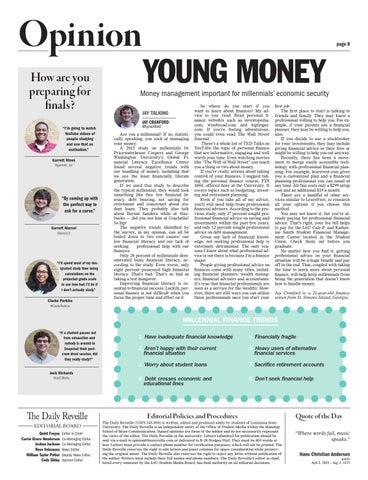
Money management important for millennials’ economic security JAY TALKING JAY CRANFORD @hjcranford Are you a millennial? If so, statistically speaking, you suck at managing your money. A 2015 study on millennials by Pricewaterhouse Coopers and George Washington University’s Global Financial Literacy Excellence Center found several negative trends with our handling of money, including that we are the least financially literate generation. If we used this study to describe the typical millennial, they would look something like this: low financial literacy, debt bearing, not saving for retirement and concerned about student loans. They probably also talk about Bernie Sanders while at Starbucks — did you see him at Coachella? So hip! The negative trends identified by the survey, in my opinion, can all be boiled down to two root causes: our low financial literacy and our lack of seeking professional help with our finances. Only 24 percent of millennials demonstrated basic financial literacy, according to the study. Even worse, only eight percent possessed high financial literacy. That’s bad. That’s as bad as taking a test hungover. Improving financial literacy is essential to financial success. Luckily, personal finance is not difficult when you focus the proper time and effort on it.
So where do you start if you want to learn about finances? My advice to you: read. Read personal finance websites such as investopedia. com, wisebread.com and kiplinger. com. If you’re feeling adventurous, you could even read The Wall Street Journal. There’s a whole list of TED Talks on YouTube the topic of personal finance that are informative, engaging and well worth your time. Even watching movies like “The Wolf of Wall Street” can teach you a thing or two about money. If you’re really serious about taking control of your finances, I suggest taking the personal finance course, FIN 1060, offered here at the University. It covers topics such as budgeting, investing and retirement planning. Even if you take all of my advice, you’ll still need help from professional financial advisers. According to the previous study, only 27 percent sought professional financial advice on saving and investments within the past five years, and only 12 percent sought professional advice on debt management. Given our lack of financial knowledge, not seeking professional help is extremely detrimental. The only reasons I know about what professional advice is out there is because I’m a finance major. People giving professional advice on finances come with many titles, including financial planners, wealth managers, financial advisers and accountants. It’s true that financial professionals are seen as a service for the wealthy. However, there are still ways you can utilize these professionals once you start your
first job. The first place to start is talking to friends and family. They may know a professional willing to help you. For example, if your parents use a financial planner, they may be willing to help you, also. If you decide to use a stockbroker for your investments, they may include giving financial advice in their fees or might be willing to help you out anyway. Recently, there has been a movement to merge easily accessible technology with professional financial planning. For example, learnvest.com gives you a customized plan and a financial planning professional you can email at any time. All this costs only a $299 setup cost and an additional $19 a month. There are a handful of other services similar to LearnVest, so research all your options if you choose this method. You may not know it, but you’re already paying for professional financial advice. That’s right, your fee bill helps to pay for the LSU Cale P. and Katherine Smith Student Financial Management Center located in the Student Union. Check them out before you graduate. No matter how you find it, getting professional advice on your financial situation will be a huge benefit and pay off in the end. That, coupled with taking the time to learn more about personal finance, will help keep millennials from being the generation that doesn’t know how to handle money. Jay Cranford is a 21-year-old finance senior from St. Simons Island, Georgia.
@ClarkePerkins
MILLENNIAL FINANCE TRENDS “If a student passes out from exhaustion and nobody is around to Snapchat their postcram drool session, did they really study?”
Jack Richards @JayEllRichy
The Daily Reveille EDITORIAL BOARD
Quint Forgey Carrie Grace Henderson Joshua Jackson Rose Velazquez William Taylor Potter Cody Sibley
Editor in Chief Co-Managing Editor Co-Managing Editor News Editor Deputy News Editor Opinion Editor
1. Have inadequate financial knowledge
5. Financially fragile
2. Aren’t happy with their current financial situation
6. Heavy users of alternative financial services
3. Worry about student loans
7. Sacrifice retirement accounts
4. Debt crosses economic and educational lines
8. Don’t seek financial help
Editorial Policies and Procedures
The Daily Reveille (USPS 145-800) is written, edited and produced solely by students of Louisiana State University. The Daily Reveille is an independent entity of the Office of Student Media within the Manship School of Mass Communication. Signed opinions are those of the author and do not necessarily represent the views of the editor, The Daily Reveille or the university. Letters submitted for publication should be sent via e-mail to opinion@lsureveille.com or delivered to B-39 Hodges Hall. They must be 400 words or less. Letters must provide a contact phone number for verification purposes, which will not be printed. The Daily Reveille reserves the right to edit letters and guest columns for space consideration while preserving the original intent. The Daily Reveille also reserves the right to reject any letter without notification of the author. Writers must include their full names and phone numbers. The Daily Reveille’s editor in chief, hired every semester by the LSU Student Media Board, has final authority on all editorial decisions.
Quote of the Day “Where words fail, music speaks.”
Hans Christian Andersen author April 2, 1805 — Aug. 4, 1875