TOM PERKINS page 8
MATT TAIBBI page 9
AMY CHUA & JED RUBENFELD
GLORIA DUFFY page 46
Commonwealth page 10
The
THE MAGAZINE OF THE COMMONWEALTH CLUB OF CALIFORNIA
JUNE/JULY 2014
ARIANNA HUFFINGTON WITH SHERYL SANDBERG
REDEFINING
SUCCESS $5.00; free for members | commonwealthclub.org
China Romance
Dream Idyll of Southern Waters and Mountains October 19 – 30, 2014 Explore Southern China’s magnificent history and culture, as well as the exquisite landscapes of mountains and waters. Beijing: Discover the stunning imperial architecture of the Temple of Heaven and the Forbidden City. Take in the sweeping views along the Great Wall at Mutianyu. Longsheng: Explore this mountainous region of rice paddies and learn about the Yao and Zhuang minorities. Guilin: Experience the sublime landscape of southern China’s Karst Mountains, rivers and cascading rice terraces. Visit local villages and enjoy a cruise down the Li River. Yangshuo: Wander down lively Xijie West Street filled with craft shops and restaurants, and attend Zhang Yimou’s colorful water show. Hangzhou: Explore the gardens, parks and architecture in this elegant and beautiful city. Visit a tea plantation and take a sunset boat ride on West Lake, said to be the most inspiring synthesis of modernity and nature in Asia. Shanghai: Take the high speed train to Shanghai. Visit Shanghai Museum, Xintiandi and the World Financial Tower. Learn about how this vibrant city is shaping China’s future. Optional extensions to Chengde, the Huang Mountains, or Xian & the Yangtze River, are available. Cost: $4,295 per person, double occupancy
Commonwealth Club Travel CST: 2096889-40
Detailed brochure available at: commonwealthclub.org/travel Contact: (415) 597-6720 • travel@commonwealthclub.org Photos: provided by MIR Corporation
INSIDE The Commonwealth 8 Photo by Ed Ritger
VO LU M E 1 0 8 , N O . 0 4 | J U N E / J U LY 2014
FEATURES 8 TOM PERKINS
23 TRANSFORMATIVE
THE WAR ON THE 1%
9 Photo by Ed Ritger
The local pioneering venture capitalist created a firestorm with his comments linking criticism of the rich with the Nazi persecution; he came to the Club to explain
9 MATT TAIBBI
A SCATHING PORTRAIT OF AMERICAN INJUSTICE
10 Photo by John Zipperer
DEPARTMENTS 5 EDITOR’S DESK Take our new, improved iPhone app for a spin
6 THE COMMONS Azerbaijan rediscovers the Club’s link to that country and Woodrow Wilson, plus Club travelers find worthy reading material in Tanzania
46 INSIGHT
The outspoken political journalist criticizes the rich and says the system is rigged in their favor; he explains
10 AMY CHUA &
JED RUBENFELD TRIPLE PACKAGE
LEADERSHIP
A pictorial tribute to The Commonwealth Club’s recent 111th anniversary and 26th Annual Distinguished Citizen Award Dinner, held this winter at San Francisco’s Palace Hotel
40 ARIANNA HUFFINGTON
WITH SHERYL SANDBERG REDEFINING SUCCESS Huffington Post founder Arianna Huffington speaks with Facebook COO Sheryl Sandberg about personal discovery and reorienting her life to give it a more balanced and fulfilling purpose
What makes some groups succeed at disproportionate levels? Photo by Ed Ritger
40
Dr. Gloria C. Duffy, President and CEO
EVENTS 18 PROGRAM INFORMATION 19 TWO MONTH CALENDAR 21 PROGRAM LISTINGS Events from June 2 to August 7
27 LANGUAGE CLASSES About Our Cover: With a tip of the hat to TV’s “Mad Men,” we feature Arianna Huffington and Sheryl Sandberg discussing alternative ways of measuring success. Design by Tyler Swofford.
“By the conventional definition of success – which, in our culture right now, is really two metrics: money and power – I was successful: the Time 100, covers of magazines. But by any sane definition of success, if you’re lying in a pool of blood on the floor of your office, you’re not successful.” – Arianna Huffington J U N E/J U LY 2013
THE COMMO N WE AL TH
3
Strictly
Business.
Strictly
Local.
Connecting Bay Area Business Leaders
in Print, Online, & at Events Subscribe to the San Francisco Business Times
sanfranciscobusinesstimes.com/subscribe or call 415路 288 路4973
Money Back Guarantee. If you are not satIsfIed, we wIll refund all of your Money on all non MaIled Issues.
EDITOR’S DESK
J O H N Z I P PE R E R V P, M E D I A & E D I TO R I A L
Photo by Pixeden.com
The Club in the Palm of Your Hand
S
everal years ago, The Commonwealth Club took its first baby commonwealthclub.org/app2014 steps in the world of mobile phone apps. Members and guests This cool new app was created in partnership with a local comhad been asking for an easy calendar of upcoming events pany called CityGovApp (citygovapp.com). Our project team was on their phone. We created an app to do that, and we eventually led by Club Board of Governors member Frank Meerkamp, who led upgraded it to include some audio, but we a team of volunteers, staff, members and knew there was a lot more we could do. outside consultants to guide the planning, Jump to this past April, when we uncreation and execution. If you have an veiled our new, improved, very nice iPhone ow n l o a d o u r n ew i P h o n e iPhone, please download the app and give app. It still has a calendar of upcoming it a try. It’s a great way to have the Club events, of course, but now you can purchase app at the iTunes Store or go to with you at all times. tickets for those events from within the app; While we’re discussing digital enyou can also invite your friends to join you commonwealthclub.org/app2014 deavors: If you have been to our website, at a program. The app has thousands of commonwealthclub.org, lately, you will see podcasts from the 1940s through today that that we have added some new features. you can listen to, download and share with friends. Each event listing page now includes a Google map showing the There’s still more good stuff to come. In the near future, we’ll location of the program; though most of our programs still take place be adding video, so you’ll be able to watch clips and full programs at our headquarters at 595 Market St. in San Francisco, this will be directly from the app – even our occasional live-streamed programs. particularly useful for our many programs that take place throughout Looking farther downstream, we’ll be creating editions of the app for Silicon Valley, in Lafayette, Marin County and at additional locations Android devices and the iPad, as well as adding additional features, in San Francisco. Also, right above the map, you will now find an such as the digital edition of this Commonwealth magazine, Week to option to “Add to Google Calendar”; it’s probably self-explanatory Week news quizzes and more. what that feature does. Don’t worry, you iCal users; we’ll be adding You can download the free app from the iTunes Store; search that option in the future, too. for “commonwealth club” in the store, or use the web interface: Now we have to start planning something for Google Glass.
D
FOLLOW US ONLINE
facebook.com/thecommonwealthclub
twitter.com/cwclub
commonwealthclub.org/blog
commonwealthclub.org
BUSINESS OFFICES The Commonwealth, 595 Market St., 2nd Floor, San Francisco, CA 94105 | feedback@commonwealthclub.org VP, MEDIA & EDITORIAL John Zipperer | SENIOR EDITOR Sonya Abrams | DESIGNER Tyler R. Swofford STAFF EDITORS Amelia Cass, Ellen Cohan | EDITORIAL INTERN Zoë Byrne | PHOTOGRAPHERS Ed Ritger, Rikki Ward ADVERTISING INFORMATION: Tara Crain, Development Manager, Corporate and Foundation Partnerships, (415) 869-5919, tcrain@commonwealthclub.org The Commonwealth (ISSN 0010-3349) is published bimonthly (6 times a year) by The Commonwealth Club of California, 595 Market Street, San Francisco, CA 94105-2805. | PERIODICALS POSTAGE PAID at San Francisco, CA. Subscription rate $34 per year included in annual membership dues. | POSTMASTER: Send address changes to The Commonwealth, The Commonwealth Club of California, 595 Market Street, San Francisco, CA 94105-2805. | Printed on recycled paper using soy-based ink. Copyright © 2014 The Commonwealth Club of California. Tel: (415) 597-6700 Fax: (415) 597-6729 E-mail: feedback@commonwealthclub.org | EDITORIAL TRANSCRIPT POLICY: The Commonwealth magazine covers a range of programs in each issue. Program transcripts and question and answer sessions are routinely condensed due to space limitations. Hear full-length recordings online at commonwealthclub.org/media, podcasts on Apple iTunes, or contact Club offices to buy a compact disc.
J U N E/J U LY 2014
THE COMMO N WE AL TH
5
Commons THE
Talk of the Club
The Azerbaijan Connection
THE TICKER
President Woodrow Wilson recalled historic meeting in 1919 Club speech
W
Painting by Frank Graham Cootes
Tanzanian Journey
I
Take the Club with you
n early March 2014, Commonwealth Club travelers headed to the African nation of Tanzania for a 10-day safari, which included gorgeous national parks, archaeological hotspots and gourmet meals in eco-friendly tented camps among the wilderness. Who needs reading material to keep themselves busy among surroundings like that? We don’t know, but
6
THE COMMO N WE AL TH
hen the Azerbaijan Television and Radio Broadcasting Company (AZTV) wanted to produce a program highlighting a historic meeting with President Woodrow Wilson, they turned to The Commonwealth Club of California for some background. On September 18, 1919, President Wilson came to the Club to discuss the “The Peace Treaty and the Covenant of the League of Nations,” a report on his international diplomacy in Paris after the trauma of World War I. He told the Club that while negotiating with other world powers, he also met “delegations of people representing nations from all over the globe, some of which I had, shamefacedly, to admit I never heard of.” One such nation’s representatives came from Azerbaijan. Wilson could be forgiven for not being very familiar with it; the Azerbaijan Democratic Republic had been established only a year earlier; and in 1920, one year after his meeting, Azerbaijan would be invaded by the Red Army and incorporated into the Soviet Union, not regaining independence until that regime’s collapse in 1991. AZTV’s program is timed to commemorate the 95th anniversary of their delegation’s meeting with Wilson — their first with a U.S. leader.
JU NE/JU LY 2014
Photo by Landry Signé
we’re pleased that the reading material they chose was a copy of The Commonwealth, as you can see in the photo above. (Holding the magazine is American expat Pete O’Neal.) The photo was taken by the tour’s study leader, Dr. Landry Signé, who drew upon his award-winning work as a Banting Fellow at Stanford University’s Center on Democracy, Development and the Rule of Law.
Our New Neighbors, Part IX Bike Route 5
O
ve r t h e p a s t year, we have featured restaurants, post offices, hotels and other establishments in this series about the neighbors near our new home at 110 The Embarcadero. This time, we have something different: a route. San Francisco Bike Route 5, to be exact, and we expect our new home will become one of the regular stops on this bicycle network. San Francisco has an extensive system of bike paths and street routes. Route 5 runs down The Embarcadero, past The Club’s new headquarters, and all the way to the former Candlestick Park, if the cyclists are up for the ride. If they prefer a shorter trip, they can stay on the downtown stretch, enjoying expansive views of the bay, the Bay Bridge and all of the piers and greenery lining the shore. And if you are thinking of biking to Club events once we move into our new building, there are plenty of bike parking spots in the area to accommodate you.
MONDAY JUNE 9, 2014
THE COMMONWEALTH CLUB PRESENTS
Winners of the 83rd Annual California Book Awards for Books Published in 2013 Gold Medals FICTION Karen Fowler We Are All Completely Beside Ourselves Putnam/Marian Wood FIRST FICTION Anthony Marra A Constellation of Vital Phenomena Hogarth NONFICTION Eric Schlosser Command And Control: Nuclear Weapons, the Damascus Accident, and the Illusion of Safety, Penguin Press POETRY Brenda Hillman Seasonal Works With Letters On Fire Wesleyan University Press
JUVENILE Marissa Moss Barbed Wire Baseball Harry N. Abrams Books for Young Readers YOUNG ADULT Tom McNeal Far Far Away Alfred A. Knopf Books for Young Readers, Random House CONTRIBUTION TO PUBLISHING Heyday Books Deborah Valoma: Scrape the Willow Until It Sings: The Words and Work of Basket Maker Julia Parker CALIFORNIANA Ronald M. George, retired California Supreme Court Chief Justice Chief: The Quest for Justice in California University of California, Berkeley: Public Policy Press
Silver Medals NON FICTION Amy Wilentz Farewell, Fred Voodoo: A Letter from Haiti Simon & Schuster POETRY Victoria Chang The Boss McSweeney’s
Sponsored by:
5:00 p.m. Awards Reception with light refreshments 6:00 p.m. Awards Ceremony 7:15 p.m. Book Signing $5 members $10 non-members The Commonwealth Club 595 Market Street, San Francisco commonwealthclub.org (415) 597-6705
Special thanks to:
In honor of the California Book Awards, Barnes and Noble is giving back to The Commonwealth Club. Buy a copy of a California Book Award winner online or in store and they will donate up to 20% of sales to the Club. Enter promo code 11369618 at checkout online or bring the promo code number into any store (June 7 – 11, 2014).
THE WAR ON THE
1%
8
Photo by Ed RitgerCOMMO N WE AL TH THE
A local billionaire sparked a national uproar with a letter to the editor complaining ab o ut p e r s e cutio n . H e explains. Excerpted from Inforum’s “The War on the 1%,” February 13, 2014. TOM PERKINS Co-founder, Kleiner Perkins Caufield & Byers In conversation with
ADAM LASHINSKY
Senior Editor at Large, Fortune ADAM LASHINSKY: Tom, I want to start at the very top, which is to ask you what the catalyst was to writing this short letter to The Wall Street Journal? TOM PERKINS: The frustration had been building up for a long time about what I see as the demonization of the rich, but it was a particularly nasty attack on my ex-wife which triggered my response. So I thought, being a Norwegian knight, I should ride to her defense and I spilled a little bit more blood than I planned, but I’m not sorry I did it. LASHINSKY: I should point out that your ex-wife, Danielle Steel, is in the front row of the auditorium this evening. She came to hear you speak, but you refer to an attack on her. Explain. Whose attack was it? What was the attack? PERKINS: I don’t want to spend a lot of time on this.
JU NE/JU LY 2014
LASHINSKY: Nor do I. PERKINS: Over the years, the San Francisco Chronicle has had a series of attacks on her. I won’t go into all of them, but there have been a lot of them. Among the attacks is [that while] she [gets] New York Times number one best seller, usually, on every book – [so] obviously her books are being read in San Francisco – they’re never reported in the Chronicle, ever. So anyway, that is what started it all. LASHINSKY: So you decided to write a letter. You were angry about an attack in the San Francisco Chronicle, so you wanted to write about income inequality. Tell everybody briefly what you said in the letter and what your goal was. PERKINS: It turned out to be the most widely read letter in the history of The Wall Street Journal, which, of course, is surprising. And it’s because I used a forbidden word. I used the word, “Kristallnacht,” which shouldn’t be used ever, I suppose. You shouldn’t compare anything to the Holocaust, for example, because it’s incomparable and the same with Kristallnacht. Anyway, I said, “Is there a progressive war on the One Percent that could be like the Kristallnacht?” And that got everybody’s attention. I made the point that in Germany, where 1 percent of the population was Jewish, and a mad, fiendish dictator used incredible political skills to focus hatred on that 1 percent and used it as a stepping stone to power. I saw a parallel between our One Percent here in America and that 1 percent. So that’s the parallel I drew. LASHINSKY: Now you subsequently apologized for having used the Nazi reference. You quickly followed that up by saying you’re not apologizing for suggesting that victimizing a small minority is a bad idea, period, and that was your point. Correct? PERKINS: That was my point. I just would like to start with this word for a minute. The Wall Street Journal, on February 4, ran a rather long op-ed piece by a professor at Harvard – Ruth Wisse. She’s a professor of Yiddish and comparative languages, and Continued on page 13
A SCATHING PORTRAIT OF AMERICAN INJUSTICE Does the United States have a pay-to-play justice system? E xcerpted from Inforum’s “A Scathing Portrait o f A m e r i c a n I n j u s t i ce,” April 10, 2014. MATT TAIBBI Former Contributing Editor, Rolling Stone; Author, The Divide In conversation with
CLARA JEFFREY
Co-Editor, Mother Jones CLARA JEFFREY: You start The Divide by unearthing the story of the Holder memo, which is pretty obscure. Tell us what it is and how did it come to play a role in the financial crisis? MATT TAIBBI: The Holder memo goes back to the late 1990s when Eric Holder – who was then just an official in the Bill Clinton Justice Department – wrote a memo, which was originally thought of as a “get tough on crime” document. The memo provided federal prosecutors with guidelines that they could use to go after white-collar offenders. Most people at the time paid more attention to the tough aspects of this memo. Among other things, it allowed prosecutors to say to corporate offenders that we will only give you credit for cooperation if you do things like waive privilege, which was a powerful tool that federal prosecutors had never had before. So for years, this was actually thought of as an anti-business document. But at the bottom of the Holder memo, there was this little addendum and it outlined something called the collateral consequences policy. All collateral consequences really said was that if you are a prosecutor and you’re going after a big, systemically important company that maybe employs a lot of people and you, the prosecutor, are concerned that there may be innocent victims if you proceed with a
criminal case against this company – for instance, shareholders or executives who had no role in the wrongdoing – then you may seek alternative remedies apart from criminal prosecutions; in other words, fines, deferred prosecution agreements, non-prosecution agreements. All that it’s really saying is that you don’t necessarily have to criminally prosecute when you have a big company that’s done something wrong. This is a completely sensible policy. It makes a lot of sense. It even makes a lot of sense now. The problem is that, when [Holder] returned to office, as attorney general, he came back to a world that was populated by this new kind of corporate offender, the too-bigto-fail bank, which was basically exactly the kind of company that collateral consequences could have been created for. A lot of these companies had done a lot of very shady things, and collateral consequences provided the government with a way to proceed that didn’t involve criminal prosecutions. It just gave the government an excuse to not go forward. Furthermore, even though the original intent of this doctrine was to prevent prosecutions against companies, they’ve begun to conflate it and also not proceed against individuals in the companies as well, which I don’t think was the original intent of the Holder memo. But that seems to have been its legacy, because we’ve seen a series of settlements where they haven’t proceeded against either the companies or the individuals
working at the companies. JEFFREY: There have been some massive fines, and trials can be lengthy and super expensive. So what do you think is the argument against just going the fine route rather than even trying to prosecute some of these folks? TAIBBI: So this is a super important question, because in a vacuum a lot of this approach of very high fines coupled with strict deferred-prosecution agreements – where they may impose certain conditions on the company – in a vacuum that may make a lot of sense. It may seem like the best possible Continued on page 16
J U N E/J U LY 2014
by Ed Ritger THE COMMO N WE AL TH Photo 9
AMY CHUA & JED RUBENFELD
TRIPLE PACKAGE The politics of dynamic groups: Why immigrants do better – for a while. “ T h e Tr i p l e P a c k a g e , ” February 14, 2014. AMY CHUA John M. Duff, Jr. Professor of Law, Yale Law School; Author, Battle Hymn of the Tiger Mother; Co-author, The Triple Package: How Three Unlikely Traits Explain the Rise and Fall of Cultural Groups in America
JED RUBENFELD Robert R. Slaughter Professor of Law, Yale Law School; Co-author, The Triple Package: How Three Unlikely Traits Explain the Rise and Fall of Cultural Groups in America In conversation with
JEFFREY BRAND
Professor and Chairman of the Center for Law and Global Justice, University of San Francisco Law School 10
THE COMMO N WE AL TH
JED RUBENFELD: It’s really a great pleasure for us to be able to come out and try to say to you what we think our book is really about, which is the rise and fall of groups. It’s a book about three qualities that propel individuals and groups to success, but not only about that. It’s also about the very predictable ways that those traits get eroded over time, in part by success and in part by a process of creative destruction that occurs when these traits interact with American culture. The starting point for our book is a seemingly un-American fact about America today, which is this striking phenomenon that for some groups, much more than the rest of the country, people are experiencing exceptional rates of upward mobility. We hear a lot about the death of upward mobility – tough economy, shrinking opportunity – and yet for some groups, much more than the rest of the country, rates of success and upward mobility are really quite astonishing. Indian Americans’ household income is about $90,000. That’s about twice the national household income, which is about $50,000. Lebanese Americans and Iranian Americans – their income’s not far behind that. The Asian-American kids score 140 points higher, on average, on their SATs than the rest of the country. Asian Americans, who make up about 5 percent of the population, are now about 20 percent of the Ivy League student body, and a lot of people think that
JU NE/JU LY 2014
number is artificially depressed by a bias against Asian Americans in the Ivy League. What explains this striking disproportionate success? I want to tell you – and I can’t emphasize this enough – just to say that some groups are doing better in these conventional ways, in education and income, obviously that’s not the same as saying they are better or that they are culturally or innately superior. On the contrary, we prove in our book that that’s just not so. When researchers dug into the data about Asian-American academic performance, you know what they found? Third generation Asian Americans’ academic performance is no different from [that of ] the rest of the country. Now think about that. That proves that it’s not innate; that proves it’s not racial; that proves it’s not biological; that explodes the whole model minority myth. It’s an example of how these successful traits change over time. Twenty years ago, the groups would have been different. Twenty years from now, the groups will be different. I know what a lot of you are probably thinking. You know what the explanation is? It’s probably class and immigrant selectivity. It’s probably a phenomenon of wealthy parents passing on advantages to their kids, or of immigrants coming over with high levels of education or high skills. That would be the most comforting explanation, and those are important factors. But they’re just not as
important as people think they are. But the best-studied community of all may be Asian Americans, particularly Chinese, Korean and Vietnamese Americans. People have studied this, and [these] kids are succeeding and achieving the highest grades and scores, regardless of their parents’ socioeconomic status and educational background. The kids of restaurant workers and dry cleaners, poorly educated [people], are doing just as well as the kids of the Asian Americans who are better educated, and all of them are doing better than their white, more privileged, better-educated peers. That’s the phenomenon that needs to be explained. It’s not class. It’s not immigrant selectivity. AMY CHUA: We looked at the groups that are disproportionately successful today, at least some of these groups. I want to stress again that these groups change very quickly over time. America’s most successful groups include African Americans and Hispanic Americans, which actually just debunks racial stereotypes. It shows it has nothing to do with skin color or racial background, and the fact that Jed pointed out that Asian Americans become just like the rest of the country after two generations shows that there’s nothing innate about it. It’s not intrinsic to a culture. There’s something much more wrapped up with the immigrant experience. So we looked at these groups. You know what they do have in common? What do Nigerian Americans, Mormons and Indian Americans have in common? What we found is that for all their enormous diversity, they shared three qualities or cultural commonalities. We call these the triple package. The first [quality] is a sense of exceptionality, of being special in some way. The second is almost the opposite of that – just a dash of insecurity, a feeling that you haven’t done enough yet, that you’re not good enough yet. And the third is impulse control, essentially self-discipline, the ability to resist temptation and to persevere. It’s really the combination of those first two qualities that are almost contradictory that fascinates us. That’s what’s at the heart of this book. How does somebody simultaneously feel insecure and superior? It is precisely that combination that generates this goading drive, a chip on the shoulder, the feeling of “Why are you looking down on me? I need to prove myself. I need to gain your respect. I need to show the world.”
Anyone can have these qualities. But our research showed – this is just a snapshot [of ] 2013 – some groups in America instilling these qualities in their members, in their kids, in their families more than others. Those groups are disproportionately succeeding. In the book, we explore the fascinating, totally different ways that these qualities manifest themselves. For example, I was talking about a superiority complex. This sense of exceptionality in a group can be rooted in religion, as in the case of the Mormons, who have a very strong chosen-people narrative very much borrowed from the Jews. Mormons also have a sense of
“ F or
all their enormous
d i ve r s i t y, t h e y s h a r e d three qualities or cultural c o m m o n a l i t i e s . We c a l l these the triple package. ” –Amy Chua enormous pride in their strong families and clean-cut values. They see themselves, in one historian’s words, as “an island of morality in a sea of decay.” Iranian Americans have a very strong sense of ethnic exceptionality too. They’re very proud of their ancient civilization. They identify as Persians, distinct from Arabs. They speak Farsi. Similarly, Cuban Americans see themselves as distinct from other Hispanic Americans. I mention those two [groups] because this highlights one of the great dangers of the superiority complex. This sense of ethnic pride can easily shade into intolerance –“We’re not like those other groups.” That’s why we chose this term – superiority complex – to highlight the dangers of it. This is also part of the generational arc. The first generation, the immigrants, are outsiders. We feel this strong identity. Immigrants’ children are imbued with America’s greatest value – the norm of equality. They don’t quite like or get their parents’ sense of exceptionality. They feel like, “Wait. I want to intermarry, maybe. I don’t get what you’re saying about exceptionality.” And they challenge their parents and that’s part of this dy-
namic that’s part of the greatness of America. There is another form of exceptionality in the case of Asian Americans. There are many different Asian Americans in this country. We focus on Chinese Americans and Indian Americans. The exceptionality of Chinese Americans and Indian Americans is rooted not so much in Middle Kingdom or Confucianism, but in the sense that we are better at working hard; we are better at excelling academically. Now by itself, a superiority complex doesn’t generate drive or success – just the opposite. If you feel superior, you’re more likely to be complacent and sit on your laurels. It’s only when that sense of superiority is combined with a little insecurity that you get this goading drive that I refer to, this need to prove yourself. Just to be an immigrant is to be insecure. You’re the ones with the funny accents. People look at you funny. You’re the ultimate outsiders. At a personal level, in some ways, this book is about how to turn being an outsider into a source of strength. Equally important, and maybe more startling – this part is controversial – there’s a different kind of insecurity that we write about. This is an insecurity created inside the family. Basically, parents are making their children feel like they are not good enough yet. This idea of deliberately making a child feel that way is practically anathema to mainstream thinking. The groups that we look at, that are so disproportionately successful, do it in very different ways. In Asian-American immigrant families – again I’m talking mostly about Chinese, Korean, Vietnamese, Japanese, South-Asian – these parents famously impose exorbitantly high expectations on their children. Hundreds of studies bear this out. So the proverbial, “Why just a 99 not 100? That’s not good enough.” Studies also show that East-Asian parents especially are much more likely than other parents to make comparisons with other successful kids – “I heard that so-andso’s kid just got into Harvard,” or, “Your cousin just got valedictorian.” Again, [they are] instilling that feeling that everyone else is doing better. To pile on. In these families, academic success is often tied to family honor. If you don’t do well, you’re going to disgrace the whole family. This is not just Asian Americans. In a study of over 5,000 immigrant children – this
J U N E/J U LY 2014
THE COMMO N WE AL TH
11
is from all backgrounds – the children repeatedly said they felt an acute anxiety that if they didn’t succeed academically, they would be failing their parents and wasting all the sacrifices their parents had made. This mentality is the exact opposite of what parents focused on self-esteem are trying to generate. RUBENFELD: How many people in this room know about the marshmallow test? This is the most famous social psychology test ever performed. About 30 years ago, they put three, four and five-year-old kids at a table and they put a marshmallow in front of them. They said, “You can eat the marshmallow right now, but if you wait 15 minutes you’ll get a second marshmallow.” Most of the kids ate the first marshmallow, just ate it right up. About a third of them waited the full 15 minutes and got the second marshmallow. The amazing thing was that, almost by accident, the researchers at Stanford who conducted that experiment tracked the kids 20 years later. They weren’t intending to, but they did. To everyone’s surprise, it turned out that the kids who had waited were wildly more successful on all the conventional metrics. They were educationally outperforming the others; they were occupationally outperforming the others; they were earning more money; their families were stronger; [they experienced] less jail time, less substance abuse. And this finding has now been replicated over and over all over the world. That ability – and that’s impulse control – that ability is a stronger predictor of success than IQ. Now in some cultures, in
some groups, something is going on in the family that is strengthening that ability, and studies also show that this is an ability you can strengthen. You can strengthen this ability in kids. What we wrote about in the book is, if that’s true – if we’re beginning to understand this information – immigrants’ kids have been doing great in America for wave after wave of immigrants. You see the same story [with] the Italian Americans, the Irish Americans. Kids of immigrants have this charge packed into them. They do better. Why? It’s not magic. Something’s going on in those families. If we could understand that formula, isn’t that something maybe we could all benefit from? I want to tell you about another twist on the marshmallow test we were talking about before. One of the most fascinating things we found was called the “reverse marshmallow test.” What they did was, they reran the marshmallow test but first, with half the kids, they lied to them. They promised them some art supplies if they would just do something or other. The kids did that something or other, but then they didn’t deliver the art supplies: broken promise. Then they ran the marshmallow test. All the kids that were lied to grabbed that marshmallow. That’s just rational. If you don’t trust the system, if you think the system’s a fraud and unfair, if you don’t believe that people like you can make it, if you don’t believe that hard work and working within the system is going to be rewarded, why should you try to do that? Why don’t you just grab that marshmallow?
Ironically, some of these immigrant groups may believe in American institutions more than we Americans do. They may even have an artificially inflated sense of the fairness and equity of American institutions. JEFFREY BRAND: If [The Triple Package] is so data-driven and so based on scientific findings, how do you account for the reaction that you’ve gotten? CHUA: It’s a strange genre. I think some of the criticisms or observations are correct. It’s not an academic article; it’s just clearly not. A lot of people want to take it as a how-to guide. I like the Financial Times review: It’s a meditation on success, including its dark side and its costs. It’s an honest view of what generates drive in some groups. Then, let’s debate it. BRAND: I want to read [something] from your book that struck me. It says that everyone should have two educations, one about how to make a living and the other about how to live. Triple package success, with its emphasis on external measures of achievement, does not provide the latter education. If that’s the case, what does happiness have to do with it and why is this a good thing? CHUA: That explains what this book is about. It’s a view, trying to think through these issues. You can also romanticize not being successful. It would be very easy if it were that you do whatever you want. It’s not that happiness-producing to not get the job that you want. It’s not that happiness-producing to have a goal and find that no one wants to hire you for that goal. We treat this fairly complexly. Photo by John Zipperer
12
THE COMMO N WE AL TH
JU NE/JU LY 2014
Photo by Ed Ritger
Perkins, continued from page 8 has written [about] Nazis and the Holocaust. The headline is, “The Dark Side of the War on the One Percent.” Two phenomena: anti-Semitism and the American class conflict. Is there any connection between them? In a letter to [The Wall Street Journal], the noted venture capitalist Tom Perkins called attention to certain parallels as he saw them between Nazi Germany’s war against the Jews and Americans progressives’ war on the “one percent.” For comparing two such historically disparate societies, Mr. Perkins was promptly and heatedly denounced. But is there something to be said for his comparison of the politics at work in the two situations? … “Are you unemployed? The Jews have your jobs. Is your family mired in poverty? The Rothschilds have your money.” … The parallel that Tom Perkins drew in his letter was especially irksome to his respondents on the left, many of whom are supporters of President Obama’s sallies against Wall Street and the “one percent”…. The ranks of those harping on “unfairly” high earners … are playing with fire. Anyone seeking to understand the inner workings of such a campaign will find much food for thought in Mr. Perkins’s parallel. LASHINSKY: Our overall goal is to explore the subject of inequality and why inequality is such a hot button issue. But, on the subject of
her academic point, you must see the difference between on the one hand a 1 percent – a small minority that was essentially powerless being persecuted by a majority – and on the other hand, a small minority that is extremely powerful, that has all the resources of modern society and wealth, being persecuted, I’ll grant you, by a majority, namely the other 99 percent. Though the group you’re actually referring to is, at various times, several
“I
think that if G ermany
had ever had American gun laws, there would have never been a Hitler. Now that’s controversial. ”
hundred protestors who are angry. PERKINS: No. I think the parallel holds. The typical German had never met a Jew, but some of the Jews were extremely wealthy and they owned the large department stores and so forth. They were very prominent and I think it’s a very good parallel. I think it holds. LASHINSKY: You’re saying that the average Occupy Wall Street protestor has never met a rich person or somebody who rides a Google bus. Is that your point? PERKINS: Probably, I think so. LASHINSKY: You’ve chosen to speak for
the One Percent. Not only do you have the courage of your convictions, but you have them repeatedly. This isn’t the first time you’ve stepped up to defend yourself. But the One Percent has certain advantages and ways of defending itself that an ethnic group that is being persecuted, that is small, does not. PERKINS: I think I’ve sort of answered that already. I think that if Germany had ever had American gun laws, there would have never been a Hitler. Now that’s controversial. LASHINSKY: If Nazi Germany had America’s gun laws, making guns widely available to the public, then the Jews would be able to defend themselves. Interesting. PERKINS: Yes. So there. LASHINSKY: We will agree that we won’t illuminate your thinking anymore on the comparison of the rich One Percent with the Jews in Nazi Germany. PERKINS: What I ‘d like to talk about [is] the nature of the persecution of the One Percent here in America right now. I’d like to start with some facts, which are always useful. LASHINSKY: They may or may not be useful, but go ahead. PERKINS: We’ll see. First of all, I don’t think anybody has any idea what the One Percent is actually contributing to America. Let me just get into that very quickly. Before I do that, let me talk a little bit about the persecution of the rich, and I’d like to take the Koch brothers. There are three of them. I know one of them, Bill, who has nothing to do with the other two that are highly political. But they’re all big contributors to charities and so forth. David
J U N E/J U LY 2014
THE COMMO N WE AL TH
13
Koch was on the board of New York Presbyterian Hospital and the hospital was going bankrupt, so David gave $100 million to the hospital. That was interpreted as Koch buying the hospital for the purposes of firing the nurses and destroying the nurses’ union. So there was a big rally and all kinds of important people showed up. The nurses said, The Koch brothers have a plantation mentality, anti-union to the core. Harry Belafonte called them white supremacists. Then Letitia James, who is head of the union, said that right-wing, anti-union profiteers like David Koch should not be meddling with health care in New York City. All have to stand together against the Koch brothers coming to New York City. So let’s just start with simple arithmetic. Let’s say you’re a successful author and your income is taxed at a little over 50 percent, if you live in California. On your death, there will be another roughly 50 percent tax. So, out of the dollar you originally made, you kept 25 percent, 25 cents. So you gave 75 percent of your lifetime’s worth in the form of taxes, not including property and other taxes. That’s on an individual basis. I just learned something today that I suspect nobody in the audience is familiar with. If you’re making more than $250,000 as a family and you sell your home and there’s a capital gain on the home – let’s say you sell it, you want to buy a retirement home or something – Obamacare has added a 3.8 percent tax on your gain. How many of you knew that? Oh, quite a few. All right, I didn’t know. Finally, I want to get to the actual statis-
14
THE COMMO N WE AL TH
tics. I’ll make this brief. I got this from the Tax Foundation. These are facts. The top 1 percent of taxpayers pays a greater share of the income tax burden than the bottom 90 percent combined, which totals more than 120 million taxpayers. In 2010, the top 1 percent of taxpayers, which totals roughly 1.4 million taxpayers, paid about 37 percent of all income taxes. This is a big jump from 1985 when the top 1 percent paid a quarter of all income taxes. Indeed, the income tax burden on the bottom 90 percent has dropped and the bottom 50 percent pays only 2.4 percent of total taxes. The top 10 percent of taxpayers pays 70.6 percent. LASHINSKY: Let’s be clear about what we’re talking about. The argument is that there is a war against the rich and that the rich are being persecuted. We’re not having a conversation about whether or not the rich are doing enough. Is this the persecution that you’re referring to? PERKINS: Of course. I think that taxation – I wouldn’t say it’s a form of persecution, but the extreme progressivity of the tax rate is a form of persecution. LASHINSKY: But the extreme progressivity is, first of all, not new. PERKINS: It’s getting worse. LASHINSKY: But first it got “better,” to use your terminology, and now it’s getting “worse,” to use your terminology, but it’s not unprecedented. The republic thrived and withstood high taxes before and likely will again. I’m trying to put this in the scope of history to ask you: Where is the persecution in that?
JU NE/JU LY 2014
PERKINS: I think, if you’ve paid 75 percent of your life’s earnings to the government, you’ve been persecuted. Let’s just sum it up that way. Meanwhile, let’s get back to the 99 percent for a minute and talk about them. They are not doing very well. They’re doing extremely badly. In 1985, the average family making $250,000 a year paid 40 percent income tax. Today, they pay 47 percent income tax and about half of that increase is Obamacare. So nobody is having a wonderful time with taxes. LASHINSKY: It’s an interesting point. I think part of the reason people came to hear this conversation is that the 99 percent are hurting, to make a generalization. There is income inequality. You are agreeing with that. PERKINS: I am totally agreeing with that. LASHINSKY: So the question is what to do about it. First of all, there is a perception in the country, in San Francisco specifically, that the people who are making this great wealth essentially don’t give a damn. PERKINS: I give a damn and I’m concerned about what’s happening to the non-One Percent. But San Francisco doesn’t like the experience of becoming a suburb of Silicon Valley and that’s what’s happening. LASHINSKY: Explain. I feel like San Francisco, relatively speaking, especially in the technology community, is thriving as a center of job creation, of wealth creation. PERKINS: That isn’t what I said. LASHINSKY: But how is it becoming a suburb? PERKINS: Because the people in Silicon Valley are living in San Francisco more and
more. This is a trend that will continue. And why not? It’s a great city – has wonderful restaurants, great culture, a beautiful bay and everything, but the economic effect of that has been to drive up rents about 30 percent. What to do about that? I don’t think there’s much you can do about that. That’s inevitable. As Silicon Valley thrives, which it is [doing], more and more people will want to live in San Francisco. So then we have the phenomenon of Google buses. I just find it almost incomprehensible to get angry about Google buses; if they want buses, it’s fine with me. But to break the windows in them and rough people up, I think, is preposterous. So now we have Google boats. Are they going to be out there shooting at the boats? LASHINSKY: I certainly don’t mind stating my opinion that boorish behavior is boorish behavior and everyone should say that breaking windows of buses is a bad idea. Number one: Should the city specifically be reimbursed handsomely for the use of its facilities, namely the bus stops? Number two: If we encourage companies like Google and their employees to opt out of the public transit system, is it only going to make the public transit system [worse], and again do we care? Do you care about a good public transit system? PERKINS: Is there a question in there somewhere? LASHINSKY: Yes. Do you have an opinion on the use of city resources and do you agree with the philosophical point that, for example, public transit, public infrastructure, is a good thing?
PERKINS: Of course it is, and it’s available for everybody. And Google is paying a fee for the bus stops. LASHINSKY: Belatedly. PERKINS: But they’re paying it. Now, is Google responsible for the rising rents in San Francisco? Indirectly, yes. What can they do about it? Nothing. LASHINSKY: In your opinion, does the government generally spend too much? PERKINS: Yes. It spends more than it takes in. It takes in $3 trillion a year in taxes and it spends closer to $4 trillion. LASHINSKY: You’re against higher taxes; other people are for higher taxes. Presumably we could raise taxes to pay for these things, which gets me back to the question of, do we spend too much? PERKINS: Well, we do spend too much. There are so many examples. But taxes will rise. Now you know there’s been discussion by Nancy Pelosi, our congresswoman, of a wealth tax. It would be 2 percent per year on your wealth. And somebody said, “Well, OK, let’s say you’re retired and your wealth is in your house and it’s worth $1 million dollars. That’s no problem. The government will just take a 2 percent mortgage per year and that’s how we’ll get the money.” She’s also talked about a value added tax and much higher taxes on the wealthy. The beast will be fed and taxes will go up. I don’t know which – or perhaps all of these things will happen. The irony is if you took 100 percent of the One Percent’s income and wealth – we’re only talking about 1,400,000 people – that total would run the government for about a month.
LASHINSKY: What is your 60-second idea to change the world? PERKINS: I’ve been thinking about this as I was listening to you ramble on, and I’ve got it. It’s going to make you more angry than my letter to The Wall Street Journal. LASHINSKY: I highly doubt it, but let’s hear it. PERKINS: Thomas Jefferson, at the beginning of this country, thought that to vote, you had to be a landowner. Now that didn’t last very long and the vote was given to everyone. But the basic idea was, you had to be a taxpayer or a person of property to vote. That went by the boards. Margaret Thatcher tried to change that in England, in what became called a poll tax. The idea was that every single citizen of the UK had to pay something in taxes, even if they got it back in subsidies elsewhere. If you didn’t pay something in taxes, you couldn’t vote. She was thrown under the bus by her own party for trying to push that through. So the Tom Perkins system is: You don’t get to vote unless you pay a dollar of taxes. But what I really think is, it should be like a corporation. If you pay a million dollars in taxes, you should get a million votes. How’s that? LASHINSKY: You’re right that I don’t agree with you. You’re wrong that I’m angry. I would point out to you the flaw in your argument is that since everybody pays sales tax and anyone who drives a car pays taxes for that, we’re right back to where we started in the wonderful place we’ve evolved since Thomas Jefferson with everybody having the vote. Photo by Ed Ritger
J U N E/J U LY 2014
THE COMMO N WE AL TH
15
Taibbi, continued from page 9 resolution. The state doesn’t have to waste five, six, seven years trying to prosecute a company and you don’t have to beat back thousands of motions and worry about losing a case where you have to expend enormous resources. So it does make a kind of sense, but the problem is that it falls apart when you think about who doesn’t have the option to just buy their way out of jail. Here I should sort of make a confession that when I decided to write this book, this was right around the time of the Occupy protest, and ironically the financial crisis had been kind of a boon to my career. Before 2008, I was sort of a typical, political – I guess you would say humorist. I sort of made fun of politicians for a living. That was really all I did. I had this existential crisis about whether or not that work was valuable at all. Then I got assigned to cover the financial crisis and look into the causes of it. I started doing these stories, and I discovered this whole complicated world of things I never knew about underneath. I was doing these pieces where I was basically translating these very complicated and elaborate scams and trying to help broad audiences understand what had happened in 2008, and I felt like this was a really worthwhile endeavor. I was trying to think of what I would write about next, and it occurred to me that I should write about the fact that nobody was going to jail. Somewhat cynically, I thought, “This is going to be easy, because morally this is totally indefensible and all I have to do is tell a few stories about people who have done terrible things and gotten away with it and boy will that make people angry and it will sell a lot of books and that will be easy.” Then I started to do my due diligence. I decided to look into who does go to jail in America and why, and I started to become overwhelmed by all these horrible, horrible stories of injustices that were being done to ordinary people who didn’t have money. One of the first days I went out, I heard of a story about a 13 year-old mentally disabled African-American boy in Brooklyn who had been picked up by a couple of cops; they threw him in the back of a squad car and told him that he couldn’t go home that day until he helped them find an illegal gun. So he ended up telling them that there was a gun at his grandmother’s house, and they descended upon that kid’s grandmother’s
16
THE COMMO N WE AL TH
house. They hauled in the grandmother; they hauled in the kid; they hauled in the kid’s brother. It’s terrible. I heard story after story. An undocumented immigrant in Los Angeles gets arrested for driving without a license and she’s sentenced to 170 hours of community service and a $1,700 fine and she has to take her kids to the community service every night. She’s crying herself to sleep every night. I was emotionally overwhelmed by all of these stories of people who were doing time, who were thrown in jail for varying degrees of absurdity. It struck me that there’s no way to talk about whether or not this collateral consequences policy is justified until you actually look in the mirror and ask yourself: Do you really know who’s going to jail in this country and why people are going to jail in this country? A lot of people just don’t know. But it’s morally indefensible when somebody can pay a fine and get out of a billion dollar theft while other people are doing two or three years in jail for reaching into a cash register in a liquor store. JEFFREY: Who surprises you most who’s not been prosecuted amongst the Wall Street crew? Like, is there a specific example that [makes] you think, “Wow I can’t believe these people didn’t go to trial?” TAIBBI: Let’s talk about Countrywide, for instance. Of course there was a case. There was an SEC case involving Angelo Mozilo, the creator of Countrywide. Countrywide nearly blew up the entire world. The innovation of this company was basically that they were going to give a loan to anything with a pulse and this was part and parcel of the whole scam that underlined the entire subprime mortgage crisis. It was a very crude fraud scam, actually. It was just dressed up in a lot of camouflaging jargon. Basically, banks lent billions of dollars to companies like Countrywide, who in turn went out to poor and middle-class neighborhoods and gave loans out to everybody that they could find. I talked to one former mortgage broker who worked for a company like Countrywide who used to go to 7-11s at night and hang around the beer cooler, and that was how he found clients to give mortgages to. It didn’t matter how much or whether the people had enough income to pay; it didn’t matter whether they were citizens, whether they had identification, whether they were real people at all. [Coun-
JU NE/JU LY 2014
trywide] created the loans and they sold them back to the banks. The banks pooled the loans and chopped them up into securities and then they more or less instantly turned around and sold these securities to institutional investors like pension funds, foreign hedge funds, foreign trade unions. In other words, it was this giant scam. People thought they were buying triple-Arated real estate here in the United States. In fact, they were buying the home loans of extremely risky home borrowers here in the United States. Countrywide was at the center of this whole thing. I talked to a whistleblower from Countrywide. He was hired to be part of their quality control team of all things. He tells the story of pulling into the parking lot to meet with Angelo Mozilo and his lieutenants and there’s a fancy car in the parking lot that has a personalized license plate that says, “Fund ‘em.” When he asks about it, they’re like, “Yeah, we give mortgages basically to everybody who asks.” Their irresponsibility nearly blew up the entire national financial system. Angelo Mozilo made about half a billion dollars working at Countrywide, and he was fined by the SEC something in the order of $49 million, most of which was covered by an insurance policy by Bank of America, which by then had acquired Countrywide. He ended up, out of his pocket, only paying about $1 million, $2 million, and he walked away with something like $400 million that he got to keep, and he’s not doing any time. He’s patient zero of the financial crisis. JEFFREY: So bankers clearly can’t go to jail. Why is crime down, but the prison population is five times what it was 20 years ago? TAIBBI: I asked that question of so many people, and the answer I kept getting was, “It’s a statistical mystery.” Nobody really knows why crime started to go down in the early ’90s in the United States, but it’s plunged. Violent crime has plunged, something in the order of 44 percent since 1990. It’s across the board; it’s in all regions of the United States: cities, rural areas, it doesn’t matter. Crime is just down. Some people ascribe it to the aggressive statistics-based policing strategies, like broken windows. You know, the whole idea that we’re no longer going to turn a blind eye to things like fare jumping or jaywalking and we’re going to pick up everybody who does every little thing. And that’s been a
cornerstone of policing, for instance, in New York City, where I live. Last year, in New York City, they issued 600,000 summonses for things like riding the wrong way down a sidewalk on your bicycle – that [one] was 20,000 summonses. There were 80,000 for open container violations. JEFFREY: What was the hardest part for you to slog your way through in understanding: the fiscal crisis or the criminal justice system? TAIBBI: I remember the first time when I started to read about the financial crisis; it was after the Sarah Palin speech. It was September 3rd, 2008. I was at the convention and I was in the filing room after her speech. I was just about to write up her thing and I’m looking on the Internet and I’m seeing that the world is ending. I was so worried about this because we didn’t know anything about the economy and it was blowing up before our eyes. But everybody I talked to just spoke in that impenetrable jargon, and it’s really, really difficult to get a read on it. I would call up people and say, “Tell me something about something.” That’s how desperate I was in the beginning. I just would randomly call up analysts and just say, “Tell me something understandable.” It wasn’t until I found a guy who basically made cartoons about Goldman Sachs who sat me down and he walked me through some very basic things about how subprime mortgages worked and how collateralized debt obligations worked. I got the basics of it, but it took me three months.
JEFFREY: Your pieces can seem very fueled by rage. I’m wondering how that helps you propel yourself through a piece and also does it sometimes make you feel like, “Wait, I have to feel on my own personal level a sense of hope”? What is that thing that you’re hopeful about? TAIBBI: I think it’s important for a journalist just to have a sense of outrage about things. This is one of the things that motivated me to kind of move in a certain direction with my career. A long, long time ago, I worked for a newspaper in Moscow called The Moscow Times. We would be writing about things that were sort of epic scandals like the loans-for-shares scandal, which was a thing where a bunch of Boris Yeltsin’s buddies privatized the jewels of the Soviet industrial empire to themselves for free. We would describe these things and we would use this sort of unemotional language. It occurred to me that if you’re writing about something that’s outrageous and you don’t write with outrage, then that’s deceptive. JEFFREY: So after you left The Moscow Times, you helped found a really subversive publication called The eXile, which mercilessly attacked Russian officials and others. What would the Matt Taibbi of then say to the Vladimir Putin of now? TAIBBI: Vladimir Putin was an officer the last couple of years when I was at The eXile. We were actually more upset not with Putin back then, but with the American reporters who were enabling him. When Putin came up through the ranks, he was thought of as a friend of the United States. People thought
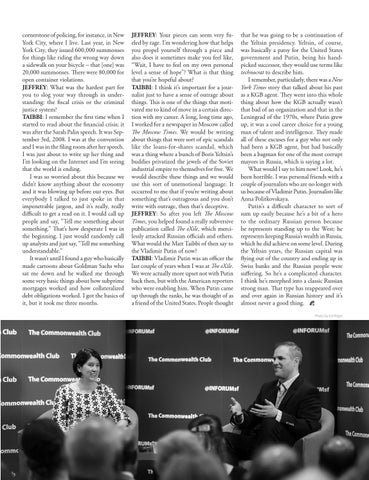
that he was going to be a continuation of the Yeltsin presidency. Yeltsin, of course, was basically a patsy for the United States government and Putin, being his handpicked successor, they would use terms like technocrat to describe him. I remember, particularly, there was a New York Times story that talked about his past as a KGB agent. They went into this whole thing about how the KGB actually wasn’t that bad of an organization and that in the Leningrad of the 1970s, where Putin grew up, it was a cool career choice for a young man of talent and intelligence. They made all of these excuses for a guy who not only had been a KGB agent, but had basically been a bagman for one of the most corrupt mayors in Russia, which is saying a lot. What would I say to him now? Look, he’s been horrible. I was personal friends with a couple of journalists who are no longer with us because of Vladimir Putin. Journalists like Anna Politkovskaya. Putin’s a difficult character to sort of sum up easily because he’s a bit of a hero to the ordinary Russian person because he represents standing up to the West; he represents keeping Russia’s wealth in Russia, which he did achieve on some level. During the Yeltsin years, the Russian capital was flying out of the country and ending up in Swiss banks and the Russian people were suffering. So he’s a complicated character. I think he’s morphed into a classic Russian strong man. That type has reappeared over and over again in Russian history and it’s almost never a good thing. Photo by Ed Ritger
J U N E/J U LY 2014
THE COMMO N WE AL TH
17
Programs For up-to-date information on programs, and to subscribe to our weekly newsletter, go to commonwealthclub.org
OVERVIEW
TICKETS
The Commonwealth Club organizes more than 450 events every year – on politics, the arts, media, literature, business and sports. Programs are held throughout the Bay Area.
Prepayment is required. Unless otherwise indicated, all Club programs – including “Members Free” events – require tickets. Programs often sell out, so we strongly encourage you to purchase tickets in advance. Tickets are available at will call. Due to heavy call volume, we urge you to purchase tickets online at commonwealthclub.org; or call (415) 597-6705. Please note: All ticket sales are final. Please arrive at least 10 minutes prior to any program. If a program is sold out and your tickets are not claimed at our box office by the program start time, they will be released to our stand-by list. Select events include premium seating; premium refers to the first several rows of seating.
STANDARD PROGRAMS Typically one hour long, these speeches cover a variety of topics and are followed by a question and answer session. Most evening programs include a networking reception with wine.
PROGRAM SERIES CLIMATE ONE programs are a conversation about America’s energy, economy and environment. To understand any of them, it helps to understand them all. GOOD LIT features both established literary luminaries and upand-coming writers in conversation. Includes Food Lit. INFORUM is for and by people in their 20s to mid-30s, though events are open to people of all ages.
MEMBER–LED FORUMS (MLF) Volunteer-driven programs focus on particular fields. Most evening programs include a wine networking reception. MEMBER-LED FORUMS CHAIR Dr. Carol Fleming carol.fleming@speechtraining.com
www.commonwealthclub.org/events
FORUM CHAIRS ARTS Anne W. Smith asmith@ggu.edu Lynn Curtis lynnwcurtis@comcast.net ASIA–PACIFIC AFFAIRS Cynthia Miyashita cmiyashita@hotmail.com BAY GOURMET Cathy Curtis ccurtis873@gmail SF BOOK DISCUSSION Barbara Massey b4massey@yahoo.com BUSINESS & LEADERSHIP Kevin O’Malley kevin@techtalkstudio.com ENVIRONMENT & NATURAL RESOURCES Ann Clark cbofcb@sbcglobal.net GROWNUPS John Milford Johnwmilford@gmail.com
18
THE COMMO N WE AL TH
HEALTH & MEDICINE William B. Grant wbgrant@infionline.net Patty James patty@pattyjames.com HUMANITIES George C. Hammond george@pythpress.com INTERNATIONAL RELATIONS Norma Walden norwalden@aol.com LGBT James Westly McGaughey jwes.mcgaughey@me.com MIDDLE EAST Celia Menczel celiamenczel@sbcglobal.net PERSONAL GROWTH: Stephanie Kriebel stephanie@sunspiritwellness.com PSYCHOLOGY Patrick O’Reilly oreillyphd@hotmail.com SCIENCE & TECHNOLOGY Chisako Ress chisakoress@gmail.com JU NE/JU LY 2014
RADIO, VIDEO AND PODCASTS Hear Club programs on about 200 public and commercial radio stations throughout the United States. For the latest schedule, visit commonwealthclub.org/broadcast. In the San Francisco Bay Area, tune in to: KQED (88.5 FM) Fridays at 8 p.m. and Saturdays at 2 a.m. KRCB Radio (91.1 FM in Rohnert Park) Thursdays at 7 p.m. KALW (91.7 FM) Inforum programs on select Tuesdays at 7 p.m. KOIT (96.5 FM and 1260 AM) Sundays at 6 a.m. KLIV (1590 AM) Thursdays at 7 p.m. KSAN (107.7 FM) Sundays at 5 a.m. KNBR (680 and 1050 AM) Sundays at 5 a.m. KFOG (104.5 and 97.7 FM) Sundays at 5 a.m.
Watch Club programs on the California Channel Thursdays at 9 p.m. and on KRCB TV 22 on Comcast & DirecTV the last Sunday of each month at 11 a.m. Select Commonwealth Club Silicon Valley programs air on CreaTV in San Jose (Channel 30). View hundreds of streaming videos of Club programs at fora.tv and youtube.com/commonwealthclub
Subscribe to our free podcasting service to automatically download a new program recording to your personal computer each week: commonwealthclub.org/podcast.
HARD OF HEARING? To request an assistive listening device, please e-mail Andre Heard at aheard@commonwealthclub.org seven working days before the event.
JUNE
Two Month Calendar SAT/SUN
1
MONDAY
2 5:30 p.m. Book Discussion: Caesar’s Commentaries: On The Gallic War and On The Civil War by Julius Caesar FM 6:00 p.m. Preserving China’s Traditional Folk Arts FM 6:30 p.m. Week to Week
7/8
14/15
9
TUESDAY
3
WEDNESDAY
6:00 p.m. Fixing Global Poverty: What Works and What Doesn’t
6:00 p.m. Stormy Science
7:00 p.m. Mars and Venus: The Next Generation
10
6:00 p.m. GMOs: Necessary in a Hot and Crowded World?
17 5:15 p.m. Self Made Gangster Exclusively Reveals All to His Nephew 6:00 p.m. Bay Power
28/29 1:00 p.m. Ultra Chocolate Tour of San Francisco
30
24 1:45 p.m. Nob Hill Walking Tour 6:00 p.m. Food Fights for the 21st Century: Women’s Voices Driving Change
25
13
1:45 p.m. Russian Hill Walking Tour 6:00 p.m. Laurence Tribe 6:00 p.m. Bay Area Housing Revolution: The Future of Green and Affordable People-Centered Community
18
19
6:00 p.m. An Emerging Epidemic: Food Allergies 6:00 p.m. Maurice Kanbar
20
12:00 p.m. HALO Afghanistan: Clearing the Deadly Debris of War 6:30 p.m. An Evening of Botany & Booze with the Drunken Botanist 7:00 p.m. Deborah Rodriguez
25
26
12:00 p.m. Gene Steuerle 6:00 p.m. Robert Bryce 6:00 p.m. How Colleges and Universities Are Leading a Nationwide Transformation to Meet Sustainability Challenges
9:00 a.m. Mineta National Policy Summit FE
27
6:00 p.m. Corporate Wealth or Public Health?
12:00 p.m. Charles Lewis: Blurred Lines Between Truth and Spin FM
6:00 p.m. David Boies and Theodore Olson 7:00 p.m. John Krumboltz: Abolishing Fear of Failure
26
27
28
5:30 p.m. Middle East Discussion Group FE 6:00 p.m. Utah’s National Parks: A Showcase in the Evolution of Park Policy FM 6:30 p.m. Week to Week Political Round Table and Member Social
J U N E/J U LY 2014
THE COMMO N WE AL TH
19
www.commonwealthclub.org/events www.commonwealthclub.org/events
12:00 p.m. Kenneth Turan FM 5:15 p.m. Decoding the New Consumer Mind FM 6:00 p.m. Jenny Bowen: A Personal Tale of Action to Save Orphaned Children FM
6:00 p.m. Dr. Ezekiel Emanuel
12
6:00 p.m. California Book Awards
23
6
11
6:00 p.m. Magic Theatre Virgin Play Readings: “Sojourners” FE
21/22
5
6:00 p.m. The ADHD Explosion: Myths, Medication, Money and Today’s Push for Performance
6:30 p.m. Will Durst: Midterm Madness
12:00 p.m. Jack Devine
5:15 p.m. Earn Save Spend Give: Four Things to Do With Your Money and How to Make It All Work FM
FRIDAY
4
6:00 p.m. Secrets of Treasure Island: Uncovering the Navy’s Radioactive Legacy
12:00 p.m. Resource Revolution FM
16
THURSDAY
Legend
San Francisco East Bay/North Bay Silicon Valley
MONDAY
TUESDAY
1
JULY FM
Free program for members
FE
Free program for everyone
MO
Members–only program
WEDNESDAY
THURSDAY
2
3
FRIDAY
SAT/SUN
4
5/6
Independence Day Club offices closed
7
8
5:30 p.m. SF Book Discussion: The Dinner, by Herman Koch FM 6:00 p.m. Pecha Kucha 20 x 20: Japan-Inspired Design FM 6:00 p.m. Breaking Bread FM
6:00 p.m. Michael Waldman
15
6:00 p.m. The Art of Collaboration FM
16 6:00 p.m. Is Ozone the Miracle Cure Everyone is Talking About?
www.commonwealthclub.org/events
6:30 p.m. Week to Week Political Round Table and Member Social
21
22
5:15 p.m. Healing Pain and Injury FM
23 7:00 p.m. Creating the New Work Paradigm: Employee Loyalty and Retention
28
6:30 p.m. Week to Week Political
29 6:00 p.m. Former U.S. Naval Operations Chief Admiral Gary Roughead: Disorder, Disruption and Military Intervention
Round Table and Member Social
20
10
11
12/13
18
19/20
25
26/27
1:45 p.m. Chinatown Walking Tour
7:00 p.m Creativity and the Cloud
14
5:15 p.m. Sheldon W. Helms: Gay Conversion Therapy FM 5:30 p.m. Middle East Discussion Group FE
9
THE COMMO N WE AL TH
JU NE/JU LY 2014
30
17 6:00 p.m. Empowering Girls Through Sport: Giving Girls a Voice and a Choice!
24 1:45 p.m. San Francisco Architecture Walking Tour
31 6:00 p.m. Ralph Nader
M O N 02 | San Francisco
M O N 02 | San Francisco
Book Discussion: Caesar’s Commentaries: On The Gallic War and On The Civil War by Julius Caesar
Preserving China’s Traditional Folk Arts
Week to Week
There was a time when Latin was a widespread educational rite of passage starting with “Veni, vidi, vici.” This discussion will focus on the English translation of the Commentaries by Julius Caesar, one of the most important people of his age, some would say second only to Jesus Christ. Caesar’s Commentaries is required reading at U.S. service academies, where it is still considered relevant even in this high-tech jet, drone, smart bomb, guided-missiles age. MLF: SF BOOK DISCUSSION Location: SF Club Office Time: 5:30 p.m. program Cost: $5 non-members, MEMBERS FREE Program Organizer: Barbara Massey
Lisa Deng, Founder, GreatSeed Inc.
Handmade oil-paper umbrellas, brocade textiles and other Chinese traditional arts are on the verge of extinction. In the face of China’s drive toward modernization and mass production, GreatSeed was started to preserve and promote China’s traditional arts and crafts. In the last 10 months, GreatSeed visited 65 state-level inheritors of folk arts and crafts in China. Deng will share the local traditions that she discovered and her mission to preserve China’s traditional folk arts. MLF: ASIA PACIFIC AFFAIRS Location: SF Club Office Time: 5:30 p.m. networking reception, 6 p.m. program Cost: $20 non-members, MEMBERS FREE, $7 students (with valid ID) Program Organizer: Kelly He
Josh Richman, State and National Politics Reporter, Bay Area News Group, San Jose Mercury News, Oakland Tribune, Contra Costa Times Additional panelists TBA
Let’s have a mid-year political check-in. Week to Week takes a look at the issues and the people in local, state and national politics. Join our panelists for informative and engaging commentary on political and other major news, audience discussion of the week’s events and our news quiz! And come early before the program to meet other smart and engaged individuals and discuss the news over wine and snacks at our member social (open to all attendees). Location: SF Club Office Time: 5:30 p.m. wine-and-snacks social, 6:30 program Cost: $15 non-members, $5 members, $7 students (with valid ID)
T U E 03 | San Francisco
Secrets of Treasure Island: Uncovering the Navy’s Radioactive Legacy
Stormy Science
The island in the middle of San Francisco Bay, where the city plans to build a second downtown, was once home to military training schools and ship operations that included dangerous radioactive substances, such as radium, cesium and plutonium. As the island prepares for even more construction, the U.S. Navy says there is now no risk to the island’s residents. Yet in March 2014, the military announced that it will test residents’ homes for radioactive waste. Some question whether the Navy’s investigation will permit and include independent research and findings in addition to the Navy’s testing. Come hear this panel of experts discuss what the military history of Treasure Island means for the island and for San Francisco Bay. MLF: ENVIRONMENT & NATURAL RESOURCES/HEALTH AND MEDICINE Location: SF Club Office Time: 5:30 p.m. networking reception, 6 p.m. program Cost: $20 non-members, $8 members, $7 students (with valid ID) Program Organizer: Ann Clark
Noah Diffenbaugh, Associate Professor, School of Earth Sciences, Stanford
How much of the wild weather we have been experiencing in the Bay Area is related to climate change? The recent Intergovernmental Panel on Climate Change report raised scientists’ confidence that burning fossil fuels is behind much of the climate disruption humans have experienced. But connecting individual weather events to our tailpipes is still controversial. Recent episodes of severe weather – Superstorm Sandy, the California drought – are consistent with established scientific understanding of how a disturbed climate behaves. What can we expect in the future? Location: SF Club Office Time: 5:30 p.m. check-in, 6 p.m. program Cost: $20 non-members, $12 members, $7 students (w/ valid ID)
J U N E/J U LY 2014
THE COMMO N WE AL TH
21
www.commonwealthclub.org/events
T U E 03 | San Francisco
George Moore, Scientist-in-Residence, James Martin Center for Nonproliferation Studies, Monterey Institute of International Studies Kai Vetter, Head, Applied Physics Program, Nuclear Science Division, Lawrence Berkeley National Laboratory Dale Smith, Member, Treasure Island Restoration Advisory Board Matt Smith, Reporter, The Center for Investigative Reporting – Moderator
June 2 – 3
M O N 02 | San Francisco
June 3 – 5
TUE 03 | East Bay
WED 04 | North Bay
Will Durst: Midterm Madness!
Mars and Venus: The Next Generation John Gray, Ph.D., Author, Men Are from Mars, Women Are from Venus; Co-author, Work with Me: The 8 Blind Spots Between Men and Women in Business Jan Yanehiro, Director, School of Multimedia Communications, Academy of Art University; Author, This Is Not the Life I Ordered: 50 Ways to Keep Your Head Above Water When Life Keeps Dragging You Down
American Political Satirist In conversation with Brian Copeland, Actor; Comedian; Host, KGO Radio
Durst is a five-time Emmy nominee, seven-time Stand Up of the Year nominee, author of a national syndicated humor column and frequent commentator on TV news. His off-Broadway one-man show, “The All-American Sport of Bipartisan Bashing” received rave reviews. With the midterm election season in full swing, join Durst for an evening of political satire as he pokes fun at the circus that is the American political process.
Celebrated author Gray has been helping us understand the differences between men and women in our communication styles, social interactions and perceptions of the world for decades. Has anything changed? Gray’s 17 books have sold over 50 million copies in 50 different languages and seek to teach men and women how to understand, respect and appreciate their differences in personal and professional relationships. Award-winning journalist and author Yanehiro has hosted numerous documentaries on redress and relocation issues for Japanese Americans. Join Gray and Yanehiro at Marin Conversations discussing this still-critical topic and the importance of understanding these differences in the workplace.
www.commonwealthclub.org/events
Location: Lafayette Library, 3491 Mt. Diablo Blvd., Lafayette Time: 5:45 p.m. check-in, 6:30 p.m. program Cost: $22 non-members, $12 members, $7 students (with valid ID)
Location: The Outdoor Art Club, One West Blithedale Ave, Mill Valley Time: 7 p.m. hors d’oeuvres and cash bar, 7:45 p.m. program Cost: $45 non-members, $35 members Also know: Marin Conversations, presented by The Commonwealth Club and Marin Community Foundation, is a monthly dialogue between Marin personalities and experts on important social issues. Marin Conversations take place the first Wednesday of the month in downtown Mill Valley. Attendees receive a 10% discount at Piazza D’Angelo the evening of the program.
W E D 04 | San Francisco
T H U 05 | San Francisco
Fixing Global Poverty: What Works and What Doesn’t
The ADHD Explosion: Myths, Medication, Money and Today’s Push for Performance
Thomas A. Nazario, Assistant Professor, USF School of Law; Author Living on a Dollar A Day; Founder and President, The Forgotten International
People often spend too much time discounting one proposal aimed at tackling a problem in order to shore up or push another. There is no silver bullet that will resolve all problems, but advocates insist that solutions do exist. Nazario will present some strategies he believes can help to end a great deal of the poverty and suffering presently experienced by one-sixth of the world’s people. MLF: INTERNATIONAL RELATIONS Location: SF Club Office Time: 5:30 p.m. networking reception, 6 p.m. program, 7 p.m. book signing Cost: $20 non-members, $8 members, $7 stu. Program Organizer: Linda Calhoun
22
THE COMMO N WE AL TH
Stephen Hinshaw, Ph.D., Professor of Psychology, UC Berkeley; Vice-Chair for Psychology, Department of Psychiatry, UCSF Richard M. Scheffler, Ph.D., Distinguished Professor, Health Economics and Public Policy, UC Berkeley; Director, Nicholas C. Petris Center; Director, Global Center for Health Economics and Policy Research
Attention Deficit Hyperactivity Disorder (ADHD) diagnosis is soaring, but is it a real psychiatric disorder – or a social construction used to label kids or adults who don’t fit the norm? The speakers argue for the reality of ADHD, with clear biological underpinnings and documented impairments, but only if diagnosis is done carefully. Competition for admission to the best schools and high-paying jobs intensifies today’s push for performance, fueling the ADHD explosion. Come hear a discussion of the various factors that could explain the sharp rise of ADHD diagnoses and medication treatments, such as high-stakes testing policies in schools, direct-to-consumer advertisements and the quality of diagnostic standards. MLF: HEALTH & MEDICINE Location: SF Club Office Time: 5:30 p.m. networking reception, 6 p.m. program, 7 p.m. book signing Cost: $20 non-members, $8 members, $7 students (with valid ID) Program Organizer: Bill Grant
JU NE/JU LY 2014
The Commonwealth Club of California’s
111th Anniversary & 26th Annual Distinguished Citizen Award Dinner
Celebrating Transformative Leadership Laura Arrillaga-Andreessen Founder, SV2, Stanford PACS, LAAF Reid Hoffman Co-founder and Executive Chairman, LinkedIn; Partner, Greylock Partners Eric Schmidt, PhD Executive Chairman, Google; Co-founder, Schmidt Ocean Institute Wendy Schmidt President, The Schmidt Family Foundation; Co-founder, Schmidt Ocean Institute John Gunn Former Chairman and Chief Executive Officer of Dodge & Cox Investment Managers Cynthia Fry Gunn San Francisco Fine Arts Museums Trustee; Philanthropist
A Truly Transformative Evening More than 500 of San Francisco’s business, technology and civic leaders gathered at the 26th Annual Distinguished Citizen Award Dinner to pay tribute to an incredible group of individuals whose professional and humanitarian contributions have had a profound impact on our local and global communities. With generous support from Premium Presenting Sponsors Dodge and Cox, and Pitch and Cathie Johnson; and Presenting Sponsor Chevron, the dinner was a resounding success. More than $1 million was raised to support The Commonwealth Club’s mission of contributing to an informed and engaged citizenry.
1
2
3
4
5
6
7
8
9
10
11
12
13
14
15
16
17
18
19
20
21
22
23
27
30
24
25
26
28
29
31
1. Leslie Saul Garvin, Dr. Gloria C. Duffy, Hon. Rod Diridon, Dr. Colleen Wilcox 2. Mary Huss, Tina Frank, Jeffrey Farber 3. Howard Hoover, Harriet Quarre, J. Dennis Bonney, Victor Revenko, Peggy Brumfield, Jim Brumfield 4. Dr. Eric Schmidt and Wendy Schmidt 5. Franklin P. and Cathie Johnson, Jr. 6. Lore Harp McGovern, Lauren Doliva, Dr. Jaleh Daie 7. Laurene Powell, Laura Arrillaga-Andreessen 8. Hon. Tad Taube, Cynthia Fry Gunn, John Gunn 9. Lata Krishnan Shah, Ajay Shah 10. Joseph Epstein, Charles Travers 11. Dr. Jaleh Daie, Reid Hoffman, Richard Wong 12. Dr. Mary Bitterman, Camilla and George D. Smith, Jr. 13. Linda Segre, Fred Reid, Frank Meerkamp, Jackie Anderson 14. Dan Ashley, Dinner Emcee 15. Dr. Charles Geschke 16. Shariq Yosufzai 17. Taylor Nairn, Courtland Alves 18. John Boland 19. Evelyn Dilsaver, Dinner Chair 20. Dr. Mohammad Qayoumi, Dr. Mary Marcy 21. Regina & John Scully 22. John & Gioia Arrillaga 23. Maryles Casto and Sallie Huntting 24. Paul Reulbach, Jon Steinberg, Marcia Smolens, Richard Rubin 25. Alec Hughes, Rita Myers, Herb Myers, Leroy Morishita, John Dilsaver, Barbara Morishita, Denise Tyson, Bernard Tyson 26. Sir Michael Moritz 27. Mary Schaefer, Skip Rhodes 28. Dr. Eric Schmidt 29. Anna Mok, Board Chair 30. Marc Andreessen, Laurene Powell, Laura Arrillaga-Andreessen, John Arrillaga, Jr. 31. Judy Koch, Mike Knych, Jennifer Ratay Photos by Drew Altizer Photography and Rikki Ward
M O N 09 | San Francisco
Dr. Ezekiel Emanuel: Reinventing American Health Care
Resource Revolution
Vice Provost for Global Initiatives and Chair, Department of Medical Ethics and Health Policy, UPenn; Author, Reinventing American Health Care
Emanuel has written a brilliant diagnostic explanation of why health care in America has become such a divisive social issue, how money and medicine have their own – quite distinct – American story, and why reform has bedeviled both liberal and conservative presidents for more than 100 years. He will forecast six mega trends in health that will determine the market for health care in 2020 and beyond.
June 5 – 11
T H U 05 | San Francisco
John Hofmeister, Former President, Shell Oil Company Matt Rogers, Director, McKinsey & Co.; Co-author, Resource Revolution: How to Capture the Biggest Business Opportunity in a Century
A new generation of companies, such as Tesla, Cree, OPower, Nest and others are disrupting industries and creating new markets in the way that General Electric and General Motors did in previous waves of innovation. Those companies and technologies are poised to capture the huge business potential presented by growing consumer classes in China and India and the need to transition to cleaner energy. The rise of 2.5 billion consumers in Asia and elsewhere will put further strain on water, food and other resources already under stress and drive commodity prices higher. But humans have adapted and doomsday scenarios have not materialized. Yet. Will business innovators be able to make enough stuff to satisfy the world’s burgeoning consumer class without wrecking the planet and triggering climatic chaos? Is technooptimism delusional? Join the conversation about the huge investment opportunity in tech-driven efficiency and decoupling economic growth from carbon pollution. Location: SF Club Office Time: 11:30 a.m. check-in, noon program, 1 p.m. networking reception and book signing Cost: $20 non-members, MEMBERS FREE, $7 students (with valid ID) Also know: The speakers and audience will be videotaped for broadcast on the Climate One TV show on KRCB TV 22 on Comcast & DirecTV.
M O N 09 | San Francisco
W E D 11 | San Francisco
The 83rd Annual California Book Awards
Jack Devine: An American Spymaster’s Story
Since 1931, the California Book Awards have honored literary excellence among authors in the Golden State. At our special awards ceremony, we will bestow gold and silver medals in several categories, including: fiction, nonfiction, first fiction, poetry, young adult, juvenile, Californiana and contribution to publishing. Hear from some literary giants and amazing writers. Location: SF Club Office Time: 5:00 p.m. check-in and awards reception with light refreshments, 6 p.m. awards ceremony, 7:15 p.m. book signing Cost: $10 non-members, $5 members Also know: Sponsored by Bank of the West, part of the Good Lit Series, underwritten by The Bernard Osher Foundation. Special thanks to Dr. Martha Cox and the late Ambassador Bill Lane for their generous endowment.
FOREIGN LANGUAGE GROUPS
Founding Partner and President, The Arkin Group; Author, Good Hunting: An American Spymaster’s Story
As one of the legendary spymasters of our time, Jack Devine served America’s interests for more than 30 years, ultimately overseeing a CIA division that watches over American covert operatives worldwide. Devine sees the agency trapped within a larger bureaucracy, losing swaths of turf to the military and, most ominous of all, being transformed into a paramilitary organization, thereby degrading its capacity to do what it does best. Location: SF Club Office Time: 11:30 a.m. check in, noon program, 1 p.m. book signing Cost: $20 non-members, $8 members, $7 students (with valid ID)
Free for members Location: SF Club Office FRENCH, Intermediate Class Thursdays, noon Pierrette Spetz, Graziella Danieli, danieli@sfsu.edu FRENCH, Advanced Conversation Tuesdays, noon Gary Lawrence, (925) 932-2458 GERMAN, Int./Adv. Conversation Wednesdays, noon Sara Shahin, (415) 314-6482 ITALIAN, Intermediate Class Mondays, noon Ebe Fiori Sapone, (415) 564-6789 SPANISH, Advanced Conversation (fluent only) Fridays, noon Luis Salvago-Toledo, lsalvago@comcast.net
J U N E/J U LY 2014
THE COMMO N WE AL TH
27
www.commonwealthclub.org/events
Location: SF Club Office Time: 5:30 p.m. check-in, 6 p.m. program, 7 p.m. book signing Cost: $20 non-members, $12 members, $7 students; Premium (priority seating and book): $40 non-members, $40 members
June 11 – 12
W E D 11 | San Francisco
T H U 12 | San Francisco
GMOs: Necessary in a Hot and Crowded World?
Russian Hill Walking Tour
Robert Fraley, Executive VP, Chief Technology Officer, Monsanto Andrew Kimbrell, Founder and Executive Director, Center for Food Safety Nathanael Johnson, Food Writer, Grist; Author, All Natural: A Skeptic’s Quest to Discover If the Natural Approach to Diet, Childbirth, Healing, and the Environment Really Keeps Us Healthier and Happier Jessica Lundberg, Seed Nursery Manager, Lundberg Family Farm
With the global population climbing toward 10 billion, food security is a growing concern. Extreme droughts and floods have slammed agricultural exports from the United States, Australia and Russia in recent years. Future severe weather is expected to put upward pressure on crop prices. That prospect raises thorny questions: Is there a role for seeds that are genetically modified to be drought resistant? Can 10 billion people be fed without GMO crops? Can organics feed a growing and hungry world? Consumer support for the full labeling of GMO products is getting the attention of food producers and retailers. Whole Foods recently said all GMO foods on its shelves must be labeled by 2018. General Mills announced that Cheerios would not include GMOs. Labeling laws are also being put before voters around the country. Join us for a discussion about the prospect and perils of tinkering with the genetics of our food supply as we brace for more climate disruption. Location: SF Club Office Time: 5:30 p.m. check-in, 6 p.m. program Cost: $20 non-members, $12 members, $7 students (with valid ID)
Join a more active Commonwealth Club Neighborhood Adventure! Russian Hill is a magical area with secret gardens and amazing views. Join Rick Evans for a two-hour hike up hills and staircases and learn about the history of this neighborhood. See where great artists and architects lived and worked, and walk down residential streets with historically significant houses. Location: Meet in front of Swensen’s Ice Cream, 1999 Hyde Street at Union. The tour ends about six blocks from the Swensen’s Ice Cream, at the corner of Vallejo and Jones. Time: 1:45 p.m. check-in, 2–4 p.m. tour Cost: $45 non-members, $35 members Also know: Steep hills and staircases, recommended for good walkers. Parking difficult. Limited to 20. Must pre-register. Tour operates rain or shine.
www.commonwealthclub.org/events
T H U 12 | San Francisco
T H U 12 | San Francisco
Laurence Tribe: The Supreme Court and the Constitution
Bay Area Housing Revolution: The Future of Green and Affordable People-Centered Community
Laurence Tribe, Prof. of Constitutional Law, Harvard Law Sch.; Co-author, Uncertain Justice Jeffrey Brand, Prof. and Chair, Ctr. for Law and Global Justice, USF Law Sch. – Moderator
From Citizens United to its momentous rulings regarding Obamacare and gay marriage, the Supreme Court under Chief Justice John Roberts has profoundly affected American life. Yet the court remains a mysterious institution, and the motivations of the nine men and women who serve for life are often obscure.Tribe will discuss how the Supreme Court and the Constitution frame the way we live. Location: SF Club Office Time: 5:30 p.m. check-in, 6 p.m. program, 7 p.m. book signing Cost: $20 non-members, $12 members, $7 students (with valid ID)
28
THE COMMO N WE AL TH
Bob Massaro, Co-founder and CEO, Thriving Communities James Schaffer, Partner, Schaffer&Combs Peter Slaugh, Founder and Managing Director, OpenPath Investments Kristine Leja, Senior Director of Development & Communications, Habitat for Humanity Greater San Francisco James Lee, Partner, Schaffer&Combs – Moderator
Innovation in affordable residential real estate is creating huge social, environmental and economic impact. Forward-thinking real estate developers are transforming “boxed living” complexes into vibrant, resilient communities without sacrificing investor returns. Society’s definition of “green construction” in residential housing may be making a quantum leap over the next 18 months and Bay Area developers are leading the way as nonprofit housing programs become a primary driver of workforce development and social equity in major metro areas. MLF: BUSINESS & LEADERSHIP Location: SF Club Office Time: 5:30 p.m. networking reception, 6 p.m. program Cost: $20 non-members, $8 members, students free (with valid ID) Program Organizer: Kevin O’Malley
JU NE/JU LY 2014
M O N 16 | San Francisco
T U E 17 | San Francisco
Earn Save Spend Give: 4 Things to Do With Your Money and How to Make It All Work
Magic Theatre Virgin Play Readings: “Sojourners”
Self-made Gangster Exclusively Reveals All to His Nephew
Mfoniso Udofia, Playwright; Actress; Educator; Author, “Sojourners”
Bruce Farrell Rosen, Author, Bombed in His Bed: The Confessions of Jewish Gangster Myer Rush; Banker
Denise Hughes, Author
Hughes speaks about what is needed to make money work in life. Viewing money as a portal, she focuses on the behaviors that create one’s personal financial numbers. Come hear how any of us can change our financial picture if we look within and begin to change the mindsets, negative emotions and sabotaging actions we practice when it comes to money.
Come hear the reading of a new play and meet playwright Mfoniso Udofia, who will hold a conversation after the reading. “Sojourners” tells a story of duty and desire. Abasiama Ekpeyoung came to America with high hopes for her arranged marriage and her future, intent on earning a degree and returning to Nigeria. But when her husband is seduced by America, she is forced to choose between the Nigerian and the American dream.
The gangster Myer Rush was front-page news around the world in the late 1960s when he was accused of a $100 million stock fraud. Hours before he was expected to appear in court, a bomb went off under his bed and, after dying twice on the way to the hospital, he survived the explosion. Rosen, Meyer’s nephew, reveals an astounding journey that traverses love, honor, betrayal, grief, joy and greed.
Location: SF Club Office Time: 5:30 p.m. networking reception, 6 p.m. program Cost: FREE ($12 donation suggested) Also know: Underwritten by The Bernard Osher Foundation
MLF: GROWNUPS Location: SF Club Office Time: 4:45 p.m. networking reception, 5:15 p.m. program Cost: $20 non-members, $8 members, $7 students (with valid ID) Program Organizer: John Milford
T U E 17 | San Francisco
W E D 18 | San Francisco
W E D 18 | San Francisco
Bay Power
An Emerging Epidemic: Food Allergies
Maurice Kanbar: A Unique Inventor and His Amazing Inventions
Though it’s known as one of the most environmentally friendly places in the country, the Bay Area is also among the top exporters of fossil fuels. Five refineries in the East Bay process heavy crude oil and the number of rail cars carrying oil into the Bay Area is forecast to increase. Can California be a climate leader while getting increasingly involved with tar sands and other dirty fuels? Location: SF Club Office Time: 5:30 check-in, 6 p.m. program Cost: $20 non-members, $12 members, $7 students (with valid ID) Also know: Generously underwritten by The San Francisco Foundation
Mireille Schwartz, Founder & CEO, Bay Area Allergy Advisory Board; Food Allergy Expert; Author, The Family Food Allergy Book
Since the mid-1990s, food allergies have shifted into high gear; what used to be a relative rarity has become increasingly commonplace, with scientists estimating that the problem is continuing to get worse. Schwartz explains the pragmatic stress involved with managing food allergies, as well as step-by-step solutions. MLF: HEALTH & MEDICINE Location: SF Club Office Time: 5:30 p.m. networking reception, 6 p.m. program, 7 p.m. book signing Cost: $20 non-members, $8 members, $7 students (with valid ID) Program Organizer: Bill Grant
Inventor; Author, Secrets From an Inventor’s Notebook: Advice on Inventing Success
Long before there was “Shark Tank,” there was inventor Maurice Kanbar, whose inventions include a broad range of items: the DFuzz-It sweater comb, SKYY Vodka and durable eyeglasses for use in developing countries. Here’s a rare chance to meet one of America’s top creative minds and see his creations up close. Location: SF Club Office Time: 5:30 p.m. check-in, 6 p.m. program, 7 p.m. book signing Cost: $20 non-members, $12 members, $7 stu.; Premium (includes seating in first rows and copy of book): $45 non-members, $35 members Also know: Part of the Good Lit series. Underwritten by The Bernard Osher Foundation
J U N E/J U LY 2014
THE COMMO N WE AL TH
29
www.commonwealthclub.org/events
MLF: GROWNUPS Location: SF Club Office Time: 4:45 p.m. networking reception, 5:15 p.m. program Cost: $20 non-members, MEMBERS FREE, $7 students (with valid ID) Program Organizer: John Milford
John Avalos, Supervisor, City and County of SF Board of Supervisors Jess Dervin-Ackerman, Conservation Organizer, SF Bay Chapter, Sierra Club
June 16 – 18
M O N 16 | San Francisco
June 19 – 23
T H U 19 | San Francisco
THU 19 | East Bay
T H U 1 9 | S i l i co n Va l l e y
HALO Afghanistan: Clearing the Deadly Debris of War
An Evening of Botany and Booze with the Drunken Botanist
Deborah Rodriguez
Farid Homayoun, Afghanistan Program Manager, HALO Trust Atta Arghandiwal, Author, Lost Decency: The Untold Afghan Story and Immigrant Success Planning – Moderator
For over 20 years, Homayoun has been working to clear hazardous debris from Afghanistan. The HALO Trust is a nonprofit, non-political charity, which is dedicated to the removal of the deadly debris of war. The trust has made large areas safe in war-torn lands. Homayoun will discuss his humanitarian work with HALO Trust in Afghanistan.
Amy Stewart, Author, The Drunken Botanist; Blogger, GardenRant
Wondering how to enhance your garden and become a better bartender? Join Stewart as she blends together one part science, one part history and just a splash of mixology to explore the fascinating world of botany and booze – with a few gardening tips and drink recipes along the way. Following the program, wet your whistle with a complimentary cocktail provided by Hendrick’s Gin.
Author, Kabul Beauty School and Margarita Wednesdays: Making a New Life by the Mexican Sea Marcela Davison Aviles , Pres. and CEO/ Exec. Producer, ¡VivaFest! – Moderator
Rodriguez spent five years with the Kabul Beauty School, the first modern beauty academy and training salon in Afghanistan. In 2007 she was forced to leave the country and was unsure of what to do next. A new journey began when she moved to Mexico. Hear more about her inspiring journey of determination and self-discovery.
www.commonwealthclub.org/events
MLF: MIDDLE EAST Location: SF Club Office Time: 11:30 a.m. check-in, noon program Cost: $20 non-members, $5 members, students free (with valid ID) Program Organizer: Celia Menczel
Location: Lafayette Library, 3491 Mt. Diablo Blvd., Lafayette Time: 6 p.m. check-in, 6:30 p.m. program, 7:30 p.m. book signing and botanical cocktail reception Cost: $25 non-members, $15 members Also Know: Must be 21+ to attend
F R I 20 | San Francisco
M O N 23 | San Francisco
M O N 23 | San Francisco
Mineta National Policy Summit
Kenneth Turan: Lifetime of Film
Panelists TBA
Film Critic, LA Times and NPR’s “Morning Edition”; Author, Not to be Missed
Decoding the New Consumer Mind: How and Why We Shop and Buy
This year’s Mineta Transportation Institute policy summit will feature experts representing viewpoints from both the national and state level discussing the financing challenges facing the U.S. transportation infrastructure. Location: SF Club Office Time: 8:15 a.m. check-in and continental breakfast; 9:00-10:30 a.m. program Cost: Free Also know: Underwritten by the Mineta Transportation Institute
Turan’s favorite films span a century of the world’s most satisfying romances, funniest comedies, the most heartstopping dramas and chilling thrillers from All About Eve to Seven Samurai to Sherlock Jr. Come hear about these timeless films and judge for yourself the truth of director Ingmar Bergman’s observation that “no form of art goes beyond ordinary consciousness as film does, straight to our emotions, deep into the twilight room of the soul.” Location: SF Club Office Time: 11:30 a.m. check-in, noon program, 1 p.m. book signing Cost: $20 non-members, MEMBERS FREE, $7 students (with valid ID)
30
THE COMMO N WE AL TH
JU NE/JU LY 2014
Location: Schultz Cultural Hall, Oshman Family JCC, 3921 Fabian Way, Palo Alto Cost: $15 non-members, $10 members, $7 stu. Time: 6:30 p.m. check-in, 7 p.m. program, 8 p.m. book signing Also know: Good Lit event underwritten by the Bernard Osher Foundation; in assn. w/ ¡VivaFest!
Kit Yarrow, Ph.D., Consumer Psychologist; Former Chair of Psych. Dpt. ,Prof. of Psych. and Marketing, Golden Gate U; Author, Decoding the New Consumer Mind
Yarrow notes that a decade of swift and stunning change has profoundly affected our psychology and consequently how, when and why we shop. Drawing on hundreds of ethnographies and interviews, Yarrow shares surprising insights on the deeply psychological and often unconscious relationships that people have with products, marketing communications and brands. MLF: PSYCHOLOGY Location: SF Club Office Time: 4:45 p.m. networking reception, 5:15 p.m. program Cost: $20 non-members, MEMBERS FREE, $7 stu. Program Organizer: Patrick O’Reilly, Ph.D.
T U E 24 | San Francisco
Jenny Bowen: A Personal Tale of Action to Save Orphaned Children
Food Fights for the 21st Century: Women’s Voices Driving Change
Founder, Half the Sky; Author, Wish You Happy Forever
Bowen and her husband adopted a little girl from China. Their new daughter came home weak, malnourished, delayed and shutdown, common maladies from an orphanage upbringing. Bowen was overcome with a new resolve: She had to do what she could to bring the same nurturing care and love to those many thousands of children left behind. Location: SF Club Office Time: 5:30 p.m. check-in, 6 p.m. program, 7 p.m. book signing Cost: $20 non-members, MEMBERS FREE, students free (with valid ID) Also Know: Part of The Good Lit Series, underwritten by the Bernard Osher Foundation
Deborah Koons Garcia, Filmmaker, Director, Symphony of the Soil and The Future of Food Zen Honeycutt, Founder and Executive Director, Moms Across America Robyn O’Brien, Founder, AllergyKids; Author, The Unhealthy Truth Christie Dames, CEO, TechTalk/Studio; Co-author, The Unruly Guide – Moderator
There’s a new culture of food developing in America and around the world. Food experts, particularly women, are finding their voices and engaging with corporations, governments and media – aiming to create a healthier, less toxic and more nutritious future for their children and beyond. Learn how grassroots organizations, writers, filmmakers and local communities are mobilizing to ensure, enhance and accelerate this new understanding and approach to our relationship with food. MLF: BUSINESS & LEADERSHIP Location: SF Club Office Time: 5:30 p.m. networking reception, 6 p.m. program Cost: $20 non-members, $8 members, students free (with valid ID) Program Organizer: Kevin O’Malley
W E D 25 | San Francisco
W E D 25 | San Francisco
Nob Hill Walking Tour
The Key to Regaining American Opportunity and Fiscal Freedom
Robert Bryce: Energy Innovation
Explore one of San Francisco’s 44 hills, and one of its original “Seven Hills.” Because of great views and its central position, Nob Hill became an exclusive enclave of the rich and famous on the West Coast. This included prominent tycoons, such as Leland Stanford and other members of the Big Four. Highlights include the history of four landmark hotels: The Fairmont, Mark Hopkins, Stanford Court and Huntington Hotel. Discover architectural tidbits and anecdotes about the railroad barons and silver kings. A true San Francisco experience of elegance, urbanity, scandals and fabulous views.
C. Eugene Steuerle, Fellow, Urban Institute; Fmr. Deputy Asst. Secretary, U.S. Treasury; Author, Dead Men Ruling Frank Yeary, Co-founder & Chair, Level Money Robert Friedman, Founder & Chair, Corp. for Enterprise Development – Moderator
Senior Fellow, Manhattan Institute; Author, Smaller Faster Lighter Denser Cheaper: How Innovation Keeps Proving the Catastrophists Wrong
Steuerle argues that we no more live in an age of austerity than did Americans at the turn of the 20th century. Conditions are ripe to advance opportunity in ways never before possible. Come hear Steuerle explain how the key to realizing these opportunities is “breaking the political logjam that … was created largely by now dead (and retired) men.” Location: SF Club Office Time: 11:30 a.m. check-in, noon program, 1 p.m. book signing Cost: $20 non-members, $12 members, students free (with valid ID)
In the face of today’s environmental and economic challenges, some people predict that the only way to stave off disaster is for humans to reverse course: to deindustrialize, re-localize and ban the use of modern energy sources. Bryce argues that innovation and the inexorable human desire to make things smaller, faster, denser and cheaper is providing consumers with cheaper and more abundant energy, faster computing, lighter vehicles, unprecedented prosperity, greater liberty and better environmental protection. Location: SF Club Office Time: 5:30 p.m. check-in, 6 p.m. program, 7 p.m. book signing Cost: $20 non-members, $12 members, $7 stu.
J U N E/J U LY 2014
THE COMMO N WE AL TH
31
www.commonwealthclub.org/events
T U E 24 | San Francisco
Location: Meet in front of the Fairmont Hotel’s Caffe Centro, 801 Powell St. (at California St.) Time: 1:45 p.m. check-in, 2–4:30 p.m. tour Cost: $45 non-members, $35 members Also know: Limited to 20. Must pre-register. Tour operates rain or shine.
June 23 – 25
M O N 23 | San Francisco
June 25 – 26
W E D 25 | San Francisco
T H U 26 | San Francisco
How Colleges and Universities Are Leading a Nationwide Transformation to Meet Sustainability and Environmental Challenges
Corporate Wealth or Public Health?
Dianne F. Harrison, President, CSU Northridge; Former President, CSU Monterey Bay William Shutkin, President and CEO and Richard M. Gray Fellow in Sustainability Practice, Presidio Graduate School Maria Harper-Marinick, Executive Vice Chancellor and Provost, Maricopa Community College District Mitchell Thomashow, President Emeritus, Unity College; Director, The Second Nature Presidential Fellows Program; Author, The Nine Elements of a Sustainable Campus Kerry Curtis, Professor Emeritus, Golden Gate University; Member, Board of Governors, Commonwealth Club of California; Emeritus Chair, Environment and Natural Resources Member-Led Forum – Moderator
Robert H. Lustig, M.D.; Professor of Clinical Pediatrics, Division of Endocrinology, UCSF; Director, Weight Assessment for Teen and Child Health Program, UCSF
www.commonwealthclub.org/events
American colleges and universities are taking a major leadership role in promoting sustainability solutions, practices and behaviors. This program will feature prominent higher education executives who are integral in this process. They will discuss the importance of leadership in taking bold steps and actions that serve as a model for other communities.
The ideology of “personal responsibility” has at one time or another been championed as the solution for every one of our societal ills. But according to Lustig, every “personal responsibility” issue eventually morphs into a public health crisis because these diseases are not caused by behaviors but rather exposures. He argues that though politicians are supposed to protect us, sometimes wealth speaks louder than public health.
MLF: BUSINESS & LEADERSHIP/ENVIRONMENT & NATURAL RESOURCES Location: SF Club Office Time: 5:30 p.m. networking reception, 6 p.m. program, 7 p.m. book signing Cost: $20 non-members, $8 members, students free (with valid ID) Program Organizer: Ann Clark
MLF: HEALTH & MEDICINE Location: SF Club Office Time: 6 p.m. program Cost: $20 non-members, $8 members, $7 stu. Program Organizer: Patty James
T H U 26 | San Francisco
T H U 2 6 | S i l i co n Va l l e y
David Boies and Theodore Olson: The Case for Marriage Equality
John Krumboltz: Abolishing Fear of Failure
David Boies, Chairman, Boies, Schiller & Flexner LLP; Co-author, Redeeming the Dream: The Case for Marriage Equality Theodore B. Olson, Partner, Gibson, Dunn & Crutcher, Co-author, Redeeming the Dream: The Case for Marriage Equality In conversation with California Lt. Governor Gavin Newsom Introduction by Actor/Activist George Takei
John Krumboltz, Professor of Education and Psychology, Stanford University; Coauthor, Fail Fast, Fail Often: How Losing Can Help You Win
Come hear the riveting inside story of the Supreme Court’s landmark rulings on the Defense of Marriage Act and Proposition 8. On June 26, 2013, the U.S. Supreme Court issued a pair of landmark decisions, reinstating the freedom to marry for same-sex couples in California. Boies and Olson – who argued against each other all the way to the Supreme Court in Bush v. Gore – joined forces to forge the unique legal argument that would carry the day. Now they discuss the story of the five-year struggle to win the right for gay couples to marry, from Proposition 8’s adoption in 2008 to its defeat before the highest court in Hollingsworth v. Perry in 2013. Location: Grand Ballroom, Fairmont Hotel, 950 Mason Street, San Francisco Time: 5:15 p.m. check in, 6 p.m. program, 7 p.m. book signing Cost: $25 non-members, $15 members, $10 students (with valid ID); Premium (includes priority seating and copy of book): $60 non-members, $45 members
32
THE COMMO N WE AL TH
JU NE/JU LY 2014
What if your biggest mistake is that you never take the risk of making mistakes? Drawing from his extensive research in human development, Krumboltz discusses why successful and happy people spend less time planning and more time acting. Learn why making mistakes is so important. Krumboltz is one of the co-creators behind the popular Stanford University course “Fail Fast, Fail Often: Creating a Life of Passionate Action.” Location: Silicon Valley Bank, 3005 Tasman Drive, Santa Clara Time: 6:30 p.m. check-in, 7 p.m. program, 8 p.m. book signing Cost: $15 non-members, $8 members, $5 students (with valid ID)
M O N 30 | San Francisco
M O N 30 | San Francisco
Ultra Chocolate Tour of San Francisco
Middle East Discussion Group
Week to Week
Make your voice heard in an enriching, provocative and fun discussion with fellow Club members as you weigh in on events shaping the face of the Middle East. Each month, the Middle East Member-Led Forum hosts an informal roundtable discussion on a topic frequently suggested by recent headlines. After a brief introduction, the floor will be open for discussion. All interested members are encouraged to attend. There will also be a brief planning session.
Panelists TBA
Nicole Lewis, Tour Guide
San Francisco is in the midst of an artisan chocolate renaissance! This walking and tasting tour will visit gourmet chocolate and pastry shops throughout the downtown area. Participants will learn about chocolate history, health benefits, production and trends. Generous chocolate tastings will include drinking chocolate, Parisian macarons, single-origin bars and infused truffles. We will end the tour with a celebratory cacao-based cocktail at the Mandarin Oriental. The walk will be about 1.75 miles total, over flat ground. MLF: BAY GOURMET Location: Meet at Hyatt Embarcadero Atrium Level, Lobby 5 Embarcadero Center, San Francisco Time: Meet at 1 p.m., 1-4:30p.m. tour Cost: $85 non-members, $75 members Program Organizer: Cathy Curtis
MLF: Middle East Location: SF Club Office Time: 5:30 p.m. program Cost: FREE Program Organizer: Celia Menczel
California’s electing new leaders this year, and issues like income inequality and affordability are dominating the headlines. Week to Week will take a look at the issues and the people in local, state and national politics. In its first two years, Week to Week has become a must-attend political discussion and social event. Join our panelists for informative and engaging commentary on political and other major news, audience discussion of the week’s events and our news quiz! And stay after the program to meet other smart and engaged individuals and discuss the news over snacks and wine at our member social (open to all attendees). Location: SF Club Office Time: 5:30 p.m. wine-and-snacks social, 6:30 program Cost: $15 non-members, $5 members, $7 students (with valid ID)
M O N 07 | San Francisco
Breaking Bread: Returned Peace Corps Volunteers’ Stories of Sharing Lives and Cultures
Pecha Kucha 20 x 20: Japan-Inspired Design
Justina Wu, Returned Peace Corps Volunteer, Kenya 2005–2007 Zach Matheson, Returned Peace Corps Volunteer, Mali 2011–2012 Alan Toth, Returned Peace Corps Volunteer, South Africa 2010–2012
Panelists TBA Paul Jamtgaard, Architect, Coordinator, Pecha Kucha San Francisco - Moderator
Breaking Bread is a series of personal stories of Peace Corps volunteers and their journeys to integrate into the communities in which they were placed. Each story illustrates the challenges faced by Peace Corps volunteers of earning trust, gaining understanding and sharing lives. Storytellers will relate their compelling experiences for 10 minutes each and then discuss with the audience.
The unique, ingenious aesthetics of Japanese culture, both historic and modern, have influenced western art and design for centuries. Pecha Kucha Night, conceived by westerners living in Japan, will explore this continuing influence in a quick and fun way. Each one of the inspiring designers, architects and craftsmen will share brief presentations of their work, personal observations and big ideas in the 20-slides, 20-seconds Pecha Kucha format. MLF: ASIA PACIFIC AFFAIRS Location: SF Club Office Time: 5:30 p.m. networking reception, 6 p.m. program Cost: $20 non-members, MEMBERS FREE, $7 students (with valid ID) Program Organizer: Cynthia Miyashita
J U N E/J U LY 2014
THE COMMO N WE AL TH
33
www.commonwealthclub.org/events
M O N 07 | San Francisco
MLF: INTERNATIONAL RELATIONS Location: SF Club Office Time: 5:30 p.m. networking reception, 6 p.m. program Cost: $20 non-members, MEMBERS FREE, $7 students (with valid ID) Program Organizer: Norma Walden Also know: In association with Northern California Peace Corps Association
June 28 – July 7
S AT 2 8 | S a n F r a n c i s c o
July 9 – 14
WED 09 | North Bay
W E D 09 | San Francisco
Creativity and the Cloud: Tiffany Shlain and Ken Goldberg
Michael Waldman
Tiffany Shlain, Filmmaker; Founder, Webby Awards; Co-founder, International
President, Brennan Center for Justice at NYU School of Law; Author, The Second Amendment: A Biography Mark Follman, Senior Editor, Mother Jones – Moderator
Academy of Digital Arts and Sciences; Director, Brain Power, Official Selection of American Film Showcase 2013, U.S. State Department Ken Goldberg, Roboticist; Artist; Craigslist Distinguished Professor of New Media, UC Berkeley; Founding Director, Art, Technology, and Culture Lecture Series, UC Berkeley
Filmmaker Tiffany Shlain and artist Ken Goldberg have explored the creative potential of the Internet since the first web browser appeared in 1994. Using slides, stories and films, they will present highlights from 20 years of experiments and projects. Examples include what they have pursued independently, such as founding The Webby Awards and the Telegarden, and their ongoing collaborations on films and art installations. The Mill Valley couple will reveal their latest projects in cloud filmmaking and cloud robotics, and open a discussion with the audience on the role of love, technology and the cloud in the creative process. Location: The Outdoor Art Club, One West Blithedale Avenue, Mill Valley Time: 7 p.m. hors d’oeuvres and cash bar, 7:45 p.m. program Cost: $45 non-members, $35 members Also know: Marin Conversations, presented by The Commonwealth Club and Marin Community Foundation, is a monthly dialogue between Marin personalities and experts on important social issues. Marin Conversations take place the first Wednesday of the month in downtown Mill Valley. Attendees receive 10% discount at Piazza D’Angelo the evening of the program.
The right to bear arms might be the most controversial, volatile and misunderstood provision of the Bill of Rights. The amendment was written to calm public fear that the government would crush state militias. The present debate picked up in the 1970s – part of a backlash to the liberal ‘60s. In 2008, the U.S. Supreme Court ruled that the Constitution protects gun ownership. Waldman argues that our view of the amendment is set, not by a pristine constitutional text, but by the rough and tumble of political advocacy and public agitation. Location: SF Club Office Time: 5:30 p.m. check-in, 6 p.m. program, 7 p.m. book signing Cost: $20 non-members, $12 members, $7 stu.
www.commonwealthclub.org/events
T H U 10 | San Francisco
M O N 14 | San Francisco
M O N 14 | San Francisco
Chinatown Walking Tour
The Art of Collaboration
Week to Week
Enjoy a Commonwealth Club Neighborhood Adventure. Join Rick Evans for a memorable midday walk and discover the history and mysteries of Chinatown. Explore colorful alleys and side streets. Visit a Taoist temple, an herbal store, the site of the first public school in the state and the famous Fortune Cookie Factory.
Stewart Levine, Author, Getting to Resolution: Turning Conflict Into Collaboration and The Book of Agreement
Panelists TBA
Location: Meet at corner of Grant and Bush, in front of Starbucks, near Chinatown Gate Time: 1:45 p.m. check-in, 2–5 p.m. tour Cost: $45 non-members, $35 members Also know: Temple visit requires walking up three flights of stairs. Limited to 12 people. Participants must pre-register. Tour operates rain or shine. Photo by H Sanchez/Flickr.
34
THE COMMO N WE AL TH
Monday Night Philosophy investigates the patterns of effective collaborations. Though some people think functional collaboration is just a matter of luck, organizational consultant Levine takes it out of the realm of mystery. The essentials are emotional intelligence, interpersonal skills and the capacity to move through the inevitable conflicts that arise. Through personal collaborations, Stewart will also describe his method for creating shared vision. MLF: HUMANITIES Location: SF Club Office Time: 5:30 p.m. networking reception, 6 p.m. program Cost: $20 non-members, MEMBERS FREE, $7 students (with valid ID) Program Organizer: George Hammond
JU NE/JU LY 2014
California’s electing new leaders this year, and issues like income inequality and affordability are dominating the headlines. Week to Week will take a look at the issues and the people in local, state and national politics. In its first two years, Week to Week has become a must-attend political discussion and social event. Join our panelists for informative and engaging commentary on political and other major news, audience discussion of the week’s events and our news quiz! And stay after the program to meet other smart and engaged individuals and discuss the news over snacks and wine at our member social (open to all attendees). Location: SF Club Office Time: 5:30 p.m. wine-and-snacks social, 6:30 program Cost: $15 non-members, $5 members, $7 students (with valid ID)
T H U 17 | San Francisco
Is Ozone the Miracle Cure Everyone Is Talking About?
Empowering Girls Through Sport: Giving Girls a Voice and a Choice!
Robert Rowen, M.D.; Board-certified Member, American Boards of Family Medicine and Emergency Medicine and Clinical Metal Toxicology
Rowen’s talk will feature global research on how ozone is being used to treat inflammatory conditions and macular degeneration. Rowen will show videos of “miraculous” instant results of patients in his own office. These are not miracles at all, he says, but what can be expected when you treat the body to get it to heal itself.
Lorrie Fair, Member, U.S. Women’s 1999 World Cup Champion Team; Athlete Ambassador, Right to Play Nick Gates, Founder and Global Strategist, Coaches Across Continents Lisa Tarver, Co-founder and Chief Giving Officer, One World Futbol Luis Enrique Bazán, Ph.D., Founder, Friends of Casa Generación; Associate Director for Global Social Justice and Community Action, University of San Francisco Ben Gucciardi, Founding Director, Soccer Without Borders Scott Golde, Founder, Sustainable Sports Travel – Moderator
For the first time in modern history, the 2012 U.S. Summer Olympic Team consisted of more females than males. The 40th anniversary of Title IX celebrates two in five young women participating in girls’ varsity sports compared to one in 27 in 1972. NGOs worldwide are using sports as a vehicle to raise awareness, build confidence and educate young women and girls about health issues, including HIV, unwanted pregnancies and STDs. Enjoy some of the remarkable success stories and difficult challenges from these extraordinary people changing lives in the Americas, Asia and Africa by getting back to the basics of playing. MLF: INTERNATIONAL RELATIONS Location: SF Club Office Time: 5:30 p.m. networking reception, 6 p.m. program Cost: $20 non-members, $8 members, $7 students (with valid ID) Program Organizer: Norma Walden
M O N 21 | San Francisco
W E D 2 3 | S i l i co n Va l l e y
Healing Pain and Injury
Creating the New Work Paradigm: Employee Loyalty and Retention
Dr. Nerman shares her 30 years of clinical experience helping patients recover from seemingly intractable health problems, including headaches, back pain and traumatic brain injury. Weaving stories of recovery with the healing tradition of osteopathic medicine and contemporary science, she explains how seeming miracles of healing occur and how patients can be empowered to take charge of their healing and their health.
Naomi Chavez Peters, Global Executive Talent, Salesforce Jennifer Trzepacz, Senior Vice President of Human Resources, Lithium Technologies Pat Schoof, Vice President of Human Resources, Udemy Steven Rice, Executive Vice President of Human Resources, Juniper Networks Divyasmita Ghatak, Chief People Officer, GoodData Dan Grosh, Managing Partner, Calibre One – Moderator
To attract and retain employees, some companies are now offering unconventional perks like luxury transportation, free meals, onsite massages, babysitting and even dry cleaning services. Is this the new standard for companies? Are these additional perks meeting employee expectations and keeping them engaged and happy? How cost-effective is this practice? Hear the latest retention strategies from the talent development leaders at Salesforce, Juniper Networks, GoodData, Udemy and Lithium Technologies. Location: Silicon Valley Bank, 3005 Tasman Drive, Santa Clara Time: 6:30 p.m. check in, 7 p.m. program Cost: $20 non-members, $10 members, $7 students (with valid ID)
MLF: GROWNUPS Location: SF Club Office Time: 4:45 p.m. networking reception, 5:15 p.m. program Cost: $20 non-members, MEMBERS FREE, $7 students (with valid ID) Program Organizer: John Milford
J U N E/J U LY 2014
THE COMMO N WE AL TH
35
www.commonwealthclub.org/events
MLF: HEALTH & MEDICINE Location: SF Club Office Time: 5:30 p.m. reception, 6 p.m. program Cost: $20 non-members, $8 members, $7 students (with valid ID) Program Organizers: Bill Grant & Adrea Brier
Maud Haimson Nerman, DO CSPOMM CCH CA, Author, Healing Pain and Injury
July 16 – 23
W E D 16 | San Francisco
July 24 – 29
T H U 24 | San Francisco
M O N 28 | San Francisco
M O N 28 | San Francisco
San Francisco Architecture Walking Tour
Gay Conversion Therapy
Middle East Discussion Group
Explore San Francisco’s Financial District with historian Rick Evans and learn the history and stories behind some of our city’s remarkable structures, streets and public squares. Hear about the famous architects that influenced the building of San Francisco after the 1906 Earthquake. Discover hard-to-find rooftop gardens, Art Deco lobbies, unique open spaces and historic landmarks. This is a tour for locals, with hidden gems you can only find on foot! Location: Lobby of Galleria Park Hotel, 191 Sutter St. Time: 1:45 p.m. check-in, 2–4:30 p.m. tour Cost: $45 non-members, $35 members Also know: Tour operates rain or shine. Limited to 20 people. Participants must preregister. The tour covers less than one mile of walking in the Financial District. Note: This tour involves walking up and down stairs.
Sheldon W. Helms, Associate Professor of Psychology, Ohlone College
As our country tackles the issue of marriage equality and open homosexuality in the military, fringe religious and therapeutic organizations continue to “convert” their homosexual clients to heterosexuality through a mixture of prayer and pseudoscience. Some forms of gay conversion therapy have been outlawed in California, and one of the primary institutions that promoted it has announced its closure, but what are the real stories behind these announcements and do they go far enough?
www.commonwealthclub.org/events
T U E 29 | San Francisco
Week to Week
Former U.S. Naval Operations Chief Admiral Gary Roughead: Disorder, Disruption and Military Intervention
California’s electing new leaders this year, and issues like income inequality and affordability are dominating the headlines. Week to Week will take a look at the issues and the people in local, state and national politics. In its first two years, Week to Week has become a must-attend political discussion and social event. Join our panelists for informative and engaging commentary on political and other major news, audience discussion of the week’s events and our news quiz! And stay after the program to meet other smart and engaged individuals and discuss the news over snacks and wine at our member social (open to all attendees). Location: SF Club Office Time: 5:30 p.m. wine-and-snacks social, 6:30 program Cost: $15 non-members, $5 members, $7 students (with valid ID)
36
THE COMMO N WE AL TH
MLF: MIDDLE EAST Location: SF Club Office Time: 5:30 p.m. program Cost: FREE Program Organizer: Celia Menczel
MLF: PSYCHOLOGY Location: SF Club Office Time: 4:45 p.m. networking reception, 5:15 p.m. program Cost: $20 non-members, MEMBERS FREE, $7 stu. Program Organizer: Patrick O’Reilly
M O N 28 | San Francisco
Panelists TBA
Make your voice heard in an enriching, provocative and fun discussion with fellow Club members as you weigh in on events shaping the face of the Middle East. Each month, the Middle East Member-Led Forum hosts an informal roundtable discussion on a topic frequently suggested by recent headlines. After a brief introduction, the floor will be open for discussion. All interested members are encouraged to attend. There will also be a brief planning session.
Gary Roughead, Admiral; Former Chief of Naval Operations, U.S. Navy
While Russia increases patrols in the Atlantic and the Pacific, Iran and North Korea make threats to sink U.S. ships. In this context, what factors should determine U.S. military intervention? With an eye on the U.S. military’s involvement, Admiral Gary Roughead will discuss current and past conflict regions where the U.S. was asked to intervene. How do past interventions influence present actions? Location: SF Club Office Time: 5:30 p.m. check-in, 6 p.m. program Cost: $20 non-members, $12 members, $7 stu. Also Know: Admiral Roughead is the Club Study leader on our fall trip to the Balkans.
JU NE/JU LY 2014
Podcast Ad
Podcasting Subscribe to our podcasts! Receive a new program recording each week. IT’S FREE! For more information, visit commonwealthclub.org/media
M O N 04 | San Francisco
Ralph Nader
Hollywood and the LGBT Journey
Political Activist; Author, Unstoppable: The Emerging Left-Right Alliance to Dismantle the Corporate State
Nader has fought for decades on behalf of American citizens against what he sees as the pervasive influence of corporations on our society. Large majorities tell pollsters that big corporations have too much political power, and Nader believes that the ever-tightening influence of big business on the mainstream media, elections and our government have caused many Americans to believe they have no political voice. Nader draws on a half century of his own experience working with the grassroots and Congress and tells of many surprising victories that have united progressive and conservative forces. Far from espousing compromises that meet halfway, Nader argues that citizens of different political labels must join in the struggle against the corporate state because, if left unchecked, that corporate state will ruin the republic, shred the Constitution and stampede over the rights of the American people.
Donna Sachet, Media Personality; Actor; Community Activist Jan Wahl, Film Critic, KRON 4
Donna Sachet has been a San Francisco performer and icon for decades, from being elected Empress of San Francisco to serving as Grand Marshal for the SF Pride parade. In 2009, Sachet became the first drag performer to sing the national anthem at a Major League Baseball game. Donna Sachet and film critic Jan Wahl “dish-cuss” the LGBT journey in Hollywood. MLF: THE ARTS Location: SF Club Office Time: 11:30 a.m. check-in, noon program Cost: $20 non-members, MEMBERS FREE, $7 stu. Program Organizer: Anne W. Smith Also know: This program is part of the 2014 Platforum series The LGBT Journey sponsored by Ernst & Young.
M O N 04 | San Francisco
T U E 05 | San Francisco
W E D 06 | San Francisco
From Ignorance to Acceptance: How the LGBTQ Movement Has Evolved in a Lifetime
Trans in the Tenderloin: A Story of Community Resilience
LGBT Retirement Living: A Panel Discussion
Robyn L. Stukalin, MS, LCSW
Marcy Adelman, Ph.D., LGBT Activist; Founder, Openhouse
James C. Hormel, Former U.S. Ambassador, Luxembourg; Author; Philanthropist; Political Activist
James Hormel realized that he was gay at a time when homosexuality wasn’t accepted. He will review the social history of the United States since 1945 to see how LGBTQ Americans progressed from exclusion to inclusion. Looking toward the future, he will discuss the key to moving towards equality.
The 2011 National Transgender Discrimination Study found that “transgender and gender non-conforming people face rampant discrimination in every area of life: education, employment, family life, public accommodations, housing, health.” Gender specialist and psychotherapist Stukalin examines the effect that trauma and discrimination have on the lives of trans and gender non-conforming people and the resilience of members of the community.
MLF: INTERNATIONAL RELATIONS Location: SF Club Office Time: 5:30 p.m. networking reception, 6 p.m. program Cost: $20 non-members, MEMBERS FREE, $7 stu. Program Organizer: Norma Walden Also know: This program is part of the 2014 Platforum series The LGBT Journey sponsored by Ernst & Young.
MLF: PSYCHOLOGY Location: SF Club Office Time: 4:45 p.m. networking reception, 5:15 p.m. program Cost: $20 non-members $8 members, $7 stu. Program Organizer: Patrick O’Reilly, Ph.D. Also know: This program is part of the 2014 Platforum series The LGBT Journey sponsored by Ernst & Young.
Adelman will highlight some of the remarkable societal changes that have brought the LGBT community to the point of having its own retirement living options. A discussion will follow by panelists from The Sequoias in San Francisco and Fountaingrove Lodge in Santa Rosa. They’ll talk about their choices to live in their respective communities. MLF: GROWNUPS Location: SF Club Office Time: 4:45 p.m. networking reception, 5:15 p.m. program Cost: $20 non-members, $8 members, $7 students (with valid ID) Program Organizer: John Milford Also know: Sponsored by Ernst & Young, assisting organizations, Openhouse, The Sequoias and Fountaingrove Lodge.
J U N E/J U LY 2014
THE COMMO N WE AL TH
37
www.commonwealthclub.org/events
Location: SF Club Office Time: 5:30 p.m. check-in, 6 p.m. program, 7 p.m. book signing Cost: $25 non-members, $15 members, $10 students (with valid ID); Premium (includes priority seating and copy of book): $55 non-members, $45 members
July 31 – August 6
T H U 31 | San Francisco
August 7
T H U 07 | San Francisco
Continuing through June 27
JUST ADDED! | June 27
The Quest for an HIV/AIDS Vaccine
Art Exhibition: “Befriending the Imagination”
Charles Lewis: Blurred Lines Between Truth and Spin
Donald P. Francis, M.D., DsC, Executive Director, Global Solutions for Infectious Diseases; Former Director, AIDS Laboratory, Centers for Disease Control
HIV was identified in 1983. By that time, Donald Francis was already researching the virus. Years later, with Francis’ help, the Bay Area company Genentech initiated efforts to develop a vaccine. From Genentech to a spin-off called VaxGen, and later to a nonprofit company called Global Solutions for Infectious Diseases, Francis has been a fierce advocate for the creation of an HIV vaccine. MLF: HEALTH & MEDICINE Location: SF Club Office Time: 5:30 p.m. check-in, 6 p.m. program Cost: $20 non-members, $8 members, $7 stu. Program Organizer: Bill Grant Also know: Part of the 2014 Platforum series The LGBT Journey sponsored by Ernst & Young.
J. Ruth Gendler, Artist; Author, The Book of Qualities and Notes on the Need for Beauty
In celebration of National Poetry Month artist and author J. Ruth Gendler has gathered a soulful, insightful selection of poems and picture poems from children focusing on identity and feeling, the hand and imagination. This exhibit will also include Gendler’s bright, metaphorical monotypes and paintings. MLF: THE ARTS Location: SF Club Office Time: Regular Club business hours Cost: FREE Program Organizer: Lynn Curtis
www.commonwealthclub.org/events
JUST ADDED! | July 07
Utah’s National Parks: A Showcase in the Evolution of Park Policy
San Francisco Book Discussion: The Dinner, by Herman Koch
Though the national parks and monuments of southern Utah are geologically and ecologically related, visiting them provides differing experiences. As the parks emerged, one by one between 1909 and 1996, the accommodations and facilities that were deemed appropriate within them changed. Ackerman will speak about technological changes and scientific observations that influenced this evolution. Ackerman will also be the study leader on the Club’s upcoming Utah trip in September. Location: SF Club Office Time: 5:30 p.m. check-in, 6 p.m. program Cost: $20 non-members, MEMBERS FREE, $7 students (with valid ID)
38
THE COMMO N WE AL TH
A government “of the people, by the people, for the people” assumes some sort of informed citizenry, but how many citizens feel accurately informed about what our leaders are up to? Unfortunately for citizens of the United States and throughout the world, distinguishing fact from fiction is more confusing than ever. Lewis reveals the many ways in which truth can be distorted by those groups and individuals wielding power. Location: SF Club Office Time: 11:30 a.m. check-in, noon program, 1 p.m. book signing Cost: $20 non-members, MEMBERS FREE, $7 stu.
JUST ADDED! | June 30
Frank Ackerman, Retired National Park Ranger
Charles Lewis, Reporter; Founder, Center for Public Integrity Robert Rosenthal, Exec. Director, Center for Investigative Reporting – Moderator
It’s a summer’s evening in Amsterdam, and two couples meet at a fashionable restaurant for dinner. Between mouthfuls of food and over the scrapings of cutlery, the conversation remains a gentle hum of polite discourse. But behind the empty words, terrible things need to be said, and with every forced smile and every new course, the knives are being sharpened. Each couple has a 15-year-old son. The two boys are united by their accountability for a single horrific act, an act that has triggered a police investigation and shattered the comfortable, insulated worlds of their families. MLF: SF BOOK DISCUSSION Location: SF Club Office Time: 5:30 p.m. program Cost: $5 non-members, MEMBERS FREE Program Organizer: Barbara Massey
JU NE/JU LY 2014
Join The Club Membership is open to all. Support for The Club’s work is derived principally from membership dues. For more information, visit commonwealthclub.org/join
new & improved! The Commonwealth Club’s new iPhone app Find upcoming programs Buy tickets Listen, download, share podcasts & more! Free in the iTunes store or go to commonwealthclub.org/app2014
Developed by
Rediscovering other metrics for achievement. Excerpted from Inforum’s “Redefining Success,” March 27, 2014. ARIANNA HUFFINGTON President and Editor-in-Chief, Huffington Post Media Group; Author, Thrive In conversation with
SHERYL SANDBERG
Chief Operating Officer, Facebook; Author, Lean In SANDBERG: How did this start for you? This is an amazing journey and an amazing story. HUFFINGTON: It actually started on April 6, 2007. I was lying on the floor of my office in a pool of blood having collapsed from exhaustion. [I] hit my head on my desk, broke my cheekbone and got four stitches on my right eye. So it really starts with a very rude awakening – a wake-up call that only got more intense during the weeks that followed when I was going from doctor to doctor, from MRI to echocardiogram, to find out what was really wrong with me medically. They thought it could be a brain tumor; it could be a heart problem. It turned out there was nothing medically wrong with me, but just about everything wrong with the way I was leading my life. And that’s really when I started asking the question, “Why the success?” Because by the conventional definition of success – which, in our culture right now, is really two metrics: money and power – I was successful: the Time 100 list, covers of magazines. But by any sane definition of success, if you’re lying in a pool of blood on the floor of your office, you’re not successful. SANDBERG: How long did it take you to make changes in your life? HUFFINGTON: They say that if you want to change your life, you need to begin with changing one habit. They call it the keystone habit. The habit I changed was to go from four to five hours of sleep a night to seven to eight hours of sleep a night. That was transformational. SANDBERG: One of the many pieces of
40
THE COMMO N WE AL TH
JU NE/JU LY 2014
ARIANNA WITH SHERY
REDEFINING
SUCCESS
A HUFFINGTON YL SANDBERG J U N E/J U LY 2014
THE COMMO N WE Photo AL TH 41 by Ed Ritger
advice in this book, and she actually says specifically to women, Arianna advises sleeping your way to the top. It’s part of my journey as well. That did not come out right – let me finish the thought. For many years, I thought that the way I would get everything done was just to get less sleep. Every time I would see Arianna, her first question always, before even saying hello, was, “How much sleep are you getting? You look tired. Darling, you look tired.” I was tired. She really kept saying, “You need to sleep more. You need to sleep more. You need to sleep more.” And it was a very interesting journey for me, because the reason I learned to sleep more was that when I had children, I watched them. For those of you who have seen children, if your child does not get enough sleep, everything is a disaster, right? If your child does get enough sleep, nothing can go wrong. I thought how interesting it was that children were that way. Then I thought, “Wait a second. Arianna keeps telling me I’m that way, too.” I figured out that when I got enough sleep, everything went well, and when I didn’t get enough sleep… How did you learn how important sleep was, and do you still advise women to sleep their way to the top? HUFFINGTON: So the way I realized this was because I started reading. The science about sleep is absolutely incontrovertible and it’s only gotten even more profound since 2007. When you read the science from the biggest universities and hospitals, you’ll see that sleep is really a wonder drug. What you said about children is so key, but you can also look at athletes. Now elite athletes are prioritizing sleep, meditation, yoga – I don’t know if you saw the video of LeBron James meditating that went so viral. But there’s also another thing that Charlie Rose, in a conversation with Andy Murray – the great tennis player – talked about: when you’re recharged and rested on the court, the ball is coming at you in slow motion, which means you can handle anything. You have time to make decisions. And I feel this is a great metaphor for life because I know that when I’m burnt out, whatever happens, I feel kind of overwhelmed by it. I feel like it’s all coming at me and I have to react. It’s not a good way to live. The biggest realization I had when I switched to seven to eight hours sleep is that it had been a very long time since I was
42
THE COMMO N WE AL TH
actually really rested. And in the last few days, speaking to different groups, I’ve had so many women come up to me and say, “I don’t remember the last time I wasn’t tired.” Why are we doing that to ourselves? That’s really the big question that I’m asking: Why do we think this is the good life? You know, Greek philosophers used to ask this question, “What is a good life?” And we kind of shrunk the definition down to money and power. And now we need to expand it again to include what I’m calling “the third metric.” SANDBERG: So let’s talk about “the third metric.” In the book, it has four elements: well-being, wisdom, wonder and giving. You talk about all of this adding up to a “third metric.” So what is it? HUFFINGTON: So the third metric is what really gives life meaning, purpose and joy. Joy is very important. One of the things I want all of us to do is to put joy back in our everyday lives. Again, why did we sort of decide that we’re just going to go after whatever it is that we want and that that’s all that matters, and define ourselves by whatever that is? I had this kind of realization (which is really the realization of every major religion, philosophy, everything, but we don’t have to believe in God or a particular religion to believe it) which is that, ultimately who we are inside ourselves – the essence of who we are – is greater and more magnificent than whatever we are in the world. And that’s kind of a big shift in how we look at our lives. It means that we can never shrink ourselves down to our to-do lists. SANDBERG: So you’re arguing for something pretty profound, which is a change in the definition of success. I know that you also argue that everyone should define success for themselves. So how do you go about doing it? For this amazing audience here, we’re going to go home tonight and we’re all going to redefine success. How? HUFFINGTON: The first thing is to look at what it is that you want to do in your life. And that is what you want – not what society wants you to do, what you read in a magazine everybody should want to do. But what is it that [we] want? To not let our own fears stop us. In the book, I call these fears, “the obnoxious roommate living in our head.” I was recently on Stephen Colbert’s show and I told him that “my obnoxious roommate,” I said, “Stephen, sounds exactly like you.” You know, obnoxious roommates are of-
JU NE/JU LY 2014
ten sardonic. They put us down; they tell us we’re not good enough. So overcoming that is a big step. Once that happens, then we will decide what it is that we want. Then to realize that while we are going for our dreams, that we cannot be defined by them. Because that’s often what also stops people: the fear that they are going to fail. And then if they fail, it’s almost like their survival is at stake. SANDBERG: You describe this “third metric” redefinition of success, as the third women’s revolution. I think the book’s principles and practices are equally applicable to men, but you said that you found women more interested. HUFFINGTON: First of all, let me just say, what I mean by the third women’s revolution. The first women’s revolution was giving us the vote. The second women’s revolution was giving us equal access to all the fields of work at the top of every field, equal pay – and this is a very incomplete revolution. But I think that we are never going to complete the second revolution if we don’t launch the third. Because the third women’s revolution is about women saying, “We don’t just want to be at the top of the world. We want to change the world.” Because the world the way it is now is not really working. And the world the way it is now is designed by men and run by men. SANDBERG: It’s true. It turns out men still run the world, and I’m not sure how well that is going. You talk about wisdom, which is a big word and something, I think, everyone wants more of. My favorite line in the book, other than the obnoxious roommate, is “the power of the hunch.” You say, “When your inner voice speaks, shut up and listen.” Is this how you think we achieve wisdom? HUFFINGTON: Yes. SANDBERG: Is wisdom learning from others? Is wisdom learning from ourselves? HUFFINGTON: Obviously learning from others, but I think [also] learning from ourselves. I believe two things. One is that we all have that place of wisdom, strength, peace and joy in us. We all have it. We’ve all had glimpses of it. We’ve all experienced it, however fleetingly. The second thing is that most of the time, we’re not going to live there. So life is really about how quickly [we can] get back to that place. It can actually be done very quickly. In order to have an impeccable Photos by Ed Ritger
course-correcting mechanism, we really need to listen to our inner wisdom, listen to our intuition; the more we listen to it, the more it develops. But we need a little more silence for that. SANDBERG: Giving [is] the last of the four elements of the third metric. You talk about how it shouldn’t take a natural disaster for us to give. Charitable donations go way up in a natural disaster, but there is a lot of need that exists every single day. You talk about the power of giving and why it’s good, not just for the recipient but for the giver. HUFFINGTON: Yes. I think that’s going to be a transformational moment when each person really gets that. In our DNA, we are actually wired to give; biologically, nature rewards us when we give. They’ve done studies that our biological inflammation markers, which are a precursor of disease, go down when we give and go up when our pleasures are purely what they call hedonic, meaning purely self-gratification. Obviously, life is going to be a mixture. But if it is all one without the giving part, we pay a price. Richard Davidson, the professor of neuroscience in Wisconsin, has done amazing work showing that giving is a shortcut to happiness. One of the reasons is when we are in a “getting mode,” which obviously we all are in aspects of our lives, we are operating from lack because no matter how much we have, we are trying to get something that we don’t have. When we are giving, no matter how little we have, we are operating from abundance. So we’re more expanded. That’s why one of the things I write in the book is, “How do we move in our culture from honoring go-getters to honoring go-givers?” [By] getting our children to learn that giving is part of life from very early on, so it’s not something they dwell on [only] on Thanksgiving or Christmas, but something that is part of their everyday experience. SANDBERG: We’re going to take audience questions. [Here’s one] from Facebook: What do you see as the biggest barrier to redefining success, and how will we get past it? HUFFINGTON: The biggest barrier is that our world sends us insistent, flashing signals to keep climbing the ladder, making more money, to basically live our lives based on the first two metrics. Therefore we need to create our own rituals, our own tribe to support us as we’re making these changes. I love this passage by Ian Thomas, the writer, who
J U N E/J U LY 2014
THE COMMO N WE AL TH
43
says that every day, the world will yank you by the hand and say, “This is important and this is important and this is important and you must worry about this and worry about this and worry about that.” You must yank your hand back and put it on your heart and say, “No. This is important.” AUDIENCE MEMBER: I’ll be honest that I’m not entirely convinced. A part of me really wonders, would the two of you be where you are right now – to use the term, “success,” which is a very loaded term – to be in positions of such tremendous influence and prestige and power and even wealth, if you had really, up until this point, practiced what you are preaching right now on this stage? SANDBERG: You know, for me, I think a lot of what Arianna writes about remains really aspirational for me. I mean, I am really trying to meditate for five minutes. It’s hard and I’m certain I’m not doing it at all well, not even for a minute. So I don’t know and I’m learning along with the rest of us. But the one thing I’m sure she’s right about is sleep —and I resisted the pressure directly from her for years. I have now become completely convinced that when I sleep less, I waste more time. Whatever time I think I’m getting by [giving up] an hour or two of sleep, I make more mistakes that take more than an hour or two to clean up or I’m kind of groggy or I get more frustrated more easily, and then I regret things I say and do. So, on that one piece, I really believe that getting more sleep is something I don’t always do perfectly, but the extent that I do do it more has made huge changes and has made me much more effi-
44
THE COMMO N WE AL TH
cient and I’m using my time more effectively. That part I have experienced and believe. HUFFINGTON: That’s a fantastic answer, because that’s all you have to do, just make one little change. You don’t have to do all my 12 steps as it happened that there are — that
“Our world sends us insistent, f l a s h i n g s i g n a l s t o ke e p climbing the ladder, making more money, to live our lives based on the first two metrics.” –Huffington is accidental. Just pick one step. If you don’t want to pick sleep – although I highly recommend it – you can pick doing a gratitude list every day, which seems trivial, but it’s incredibly important because it focuses us on what we are grateful for rather than what we are upset about. AUDIENCE MEMBER: Well I just got a couple hours of sleep last night, so hopefully this will come out right. But… HUFFINGTON: But that was your last night of two hours of sleep, right? AUDIENCE MEMBER: Three hours. My name’s Tim and as writers and speakers, you both have advocated the benefits of gender equality. Many men feel that gender equality
JU NE/JU LY 2014
and feminism come at some kind of cost to men, in terms of power, in terms of influence. So how would you suggest enlisting men, specifically younger men, in seeing that equality actually gives them benefits as a gender, instead of taking away their power? SANDBERG: I love the question, and it’s so key to so much of what I believe. I don’t believe we can say to men, “You should do this; gender equality is good for someone else.” The truth is it’s good for them. There are a lot of men that have spoken out on HuffPost and other places saying that. Here’s what we know. We know that if you’re better at working with half the population, whether you’re the most junior-level employee or the most senior-level CEO, you’re more effective at work. You either can be better because you’re a better partner and people want to work with you more or you can be better because your whole company can use half the population better and be more effective. Lots of studies show this. We also know that when men are more active partners at home, particularly in heterosexual couples, where the dynamic and the amount of housework and child work is usually so uneven, those marriages are happier (more sex) – very compelling for a lot of people, men and women. Importantly, at any income level, no matter how active a mother is, children with more active fathers and involved fathers are happier or have better educational attainment and outcomes. So gender equality is important for all of us, for men as well [as women] and it only happens with men like you who ask the question and take the steps.
Photo by Ed Ritger
AUDIENCE MEMBER: Hi, my name is Alicia Robb. I’m with the Kauffman Foundation, which is a foundation with a focus on entrepreneurship. One of the areas where we haven’t gained gender equality is entrepreneurship. How do we get more women in entrepreneurship and women investing in entrepreneurs? SANDBERG: My answer to this is we have to fight the stereotypes, that the stereotypes are completely self-reinforcing. When we expect something to look and act a certain way, we don’t like it when it doesn’t. So this is what’s happening with technology: Women are getting 13 percent of the computer science degrees in this country, 13 percent—down from 35 percent three decades ago. Then we expect computer scientists to look male. There’s a magazine that was doing an article on female entrepreneurs, and they did that article by putting them on male bodies, on the bodies that look like Larry Page and Mark Zuckerberg because that was the only image of entrepreneurship. When we tell women they can code, they code. When we tell women they can lead, they lead. When we tell women that they can be entrepreneurs, they can, and I think that’s incumbent upon all of us to do that. HUFFINGTON: Also just one more quick thing, which is to publicize and put a spotlight more on the women who have done it. We were talking last night about Padmasree Warrior, who is the chief technology officer of Cisco and she’s obviously phenomenal at her job, running thousands of engineers,
but she’s doing it her way. She talks about getting eight hours of sleep. She’s the chief technology officer of a major company. She talks about taking Saturdays off for what she calls “digital detox” and that’s the time when she writes haikus and paints and
“A
lot of the things that
become memes on social media are very positive stories ... of compassion, individuals fixing something, of connecting. ” –Sandberg she meditates. We don’t have a lot of role models like that, and when we talk about it, it encourages the rest of women. AUDIENCE MEMBER: Being a black American Muslim, there’s a lot of different stories that I’m connected to and narratives that matter to me. I constantly see this perpetuation of negative stories around my community and the communities that I associate with. I’m curious to know about the responsibility of media and social media in sharing stories that are positive around humanity not just within the Muslim community but [also] the global humanity. We have a lot of amazing people in the world doing lots of amazing things, but we
constantly hear about negativity going on, specifically in the black community and also in the Muslim community. What roles do you see as the responsibility of media today? HUFFINGTON: That’s incredibly important. I think the media are not doing a good enough job at spotlighting what is working, at spotlighting the good things – the examples of generosity, ingenuity, compassion. [At the Huffington Post,] we have multiple dedicated sections doing that, including The Good News Section that is one of our most popular sections, a section called Impact, a section called What Is Working, because I think we need to put as much attention on covering what is good, what is generous, as we put on covering what is dysfunctional, what is corrupt. Social media here has a very positive role to play, because these are the stories that people like to share. SANDBERG: Yeah, the data are very strong; a lot of the things that become the memes in social media, become memes on Facebook, are positive stories; stories of compassion, stories on individuals fixing something, stories of connecting. Those actually are very viral and we also have a lot of data to suggest that as people connect more with other people, their personal happiness goes up, which makes them more likely to share happy moments. I think your point is really real. This is a world with a lot of stereotypes to overcome, a lot of assumptions that things will go wrong to overcome. So positivity from all different role models is so important.
J U N E/J U LY 2014
THE COMMO N WE AL TH
45
InSight
D R . G LO R I A C . D U F F Y P R E S I D E N T & C E O
Escape to Fuel Efficiency?
I
t’s been a long time since I’ve gets high points for adopting the best of available technology and owned a conventional, internal design, something for which American cars have not been noted combustion engine car made in recent years. by one of the major American But what about the key advertised feature, the fuel efficiency? auto manufacturers. We’ve had The 2.0 liter four-wheel-drive EcoBoost engine is advertised at an assortment of energy efficient 22 mpg for city driving and 30 mpg on the highway. To achieve cars in recent years, including two these results, which would be about 30 percent better than my old General Motors EV1 electric cars, Mercedes SUV results of 15 mpg city and 20 mpg on the highway, a hybrid Prius, and now an electric designers of the EcoBoost Escape have taken some smart guidance Nissan Leaf. from electric and hybrid vehicle design. The car has been designed While we drive an electric car with lighter-weight interiors, including thinner but still comfortable around the Bay Area, we do keep seats. It has a small gas tank – only 15 gallons – to cut down on the a conventionally powered SUV for weight of carrying around all that fuel. And it has an aerodynamic, Photo courtesy of Gloria Duffy trips to the mountains. There is no swept-back design to decrease wind resistance. electric SUV in existence, and a Tesla SUV that is supposed to come But we pretty quickly noticed that the Escape didn’t seem to be online in the next couple of years, the Model X, will be well above our getting the advertised mileage. Tanks of gas vanished quickly, even price range. There is currently no hybrid SUV with a range over 100 after factoring out the small size of the gas tank, which accentuates miles and significantly better gas mileage the impression that one is constantly refilling than vehicles with a conventional engine. the tank. So when I needed to replace our old There is some discussion online of whethord is on the right path. er the EcoBoost engine gets the projected SUV in December, I wanted to find one with the best gas mileage possible. A family I t i s e s p e c i a l l y s m a r t t o mileage. Some auto review sites recommend member suggested that I look at a new line switching from regular to premium gas to of Fords with the “EcoBoost” engine. These b o r r o w d e s i g n f e a t u r e s optimize the fuel efficiency by about 3 mpg. cars are equipped with a four-cylinder, gasOther drivers opine that it takes some thoupowered engine, built in Valencia, Spain, f r o m t h e l ow - a n d z e r o - sands of miles to break in the new engine, designed to be ultra-efficient. I took a after which the gas mileage will go up. Others look and was duly impressed by these cars’ e m i s s i o n s c a r i n d u s t r y.” suggest having the car checked by the service aesthetics, functions and estimates of fuel department at one’s Ford dealership. efficiency. So are the advertised claims for fuel efI leased a Ford Titanium Escape SUV with the 2.0L 4WD ficiency for the EcoBoost engine an example of “greenwashing” EcoBoost engine, which is a beautiful car. Since December, I’ve – exaggerated claims of environmental friendliness by a major noticed an increasing number of the EcoBoost cars on the road, car manufacturer trying to win back market share from Toyota, both the Escape SUV and the Ford Fusion sedan. But is this new Nissan and other companies that have led in the race to greater line of cars with conventional engines all it is cracked up to be? energy efficiency? It’s too early to tell. Our car is about to go to Is it a greener alternative among the various options available for the dealership for its first service, and we will ask questions about environmentally sounder vehicles? Is it an effective stake by one of the fuel mileage then. And of course we will continue to drive our the major American car companies in the market for fuel-efficient electric car to the maximum extent possible. vehicles with long driving ranges? Even if the fuel mileage of the EcoBoost is not all it has been The Ford Escape EcoBoost is an incredibly well-designed ma- cracked up to be, Ford is on the right path. It’s especially smart to chine, with amazing electronics and safety systems. It practically borrow back design features from the low- and zero-emissions car inthinks for itself. The hands-free communication system that pairs dustry. This is only the second year of the EcoBoost engine, and Ford with numerous digital devices, sensors all over the outside to warn will continue to evolve and improve the design of these vehicles. of possible hazards, and the hands-free cargo door that opens And any improvement in automobile fuel efficiency helps, given when you wave your foot under the bumper are just a few of the the increasing evidence of climate change and the imperative to smart features. Cargo space is capacious, and it drives nicely. Ford reduce carbon emissions.
“F
46
THE COMMO N WE AL TH
JU NE/JU LY 2014
Cuba
Art, culture, music, history and politics in Commonwealth Club style. Meet experts, writers, artists and musicians and witness the vibrant intellectual and artistic talent for which Cuba is known.
Havana and the Viñales Valley October 31 – November 7, 2014
“Although I have been on other excellent trips, I have never had such access to so many intelligent, articulate speakers in such a short time.” – Elliot Morrison “We were provided a fantastic cross-section of Cuba.” – Charles Reid “The balance of formal presentations and other experiences was quite perfect.” – Joan Sieber “You completely undersold our recent trip to Cuba. I was completely blown away by all the things we were able to do and see in a short time.” – Nikki Young “It’s difficult to pre-describe the excellent nuances of the trip.” – Ken Colley “Program exceeded my expectations in all aspects! Thank you!” – Barry Herstein
Cost: $4,699 per person, based on double occupancy and including charter air from Miami to Havana, 7 nights at the Parque Central Hotel, most meals, all gratuities, Cuban visa. For a full list of inclusions, see the detailed trip brochure on our website. Single room supplement is $450. Trip is limited to 25 travelers.
Commonwealth Club Travel CST: 2096889-40
Detailed brochure available at: commonwealthclub.org/travel Contact: (415) 597-6720 • travel@commonwealthclub.org Photos: PRDH/flickr
The Commonwealth Club of California 595 Market Street, 2nd Floor San Francisco, CA 94105
Purchase event tickets at commonwealthclub.org or call (415) 597-6705
PERIODICALS POSTAGE PAID IN SAN FRANCISCO, CALIFORNIA
or (800) 847-7730 To subscribe to our free weekly events email newsletter, go to commonwealthclub.org and click on “MY CLUB ACCOUNT” in the menu at the bottom of the page.
PROGRAMS YOU WON’T WANT TO MISS Monday, June 9
Wednesday, June 11
The 83rd Annual California Book Awards
GMOs: Necessary in a Hot and Crowded World?
Since 1931, the California Book Awards have honored literary excellence among authors in the Golden State. At our special awards ceremony, we will bestow gold and silver medals in several categories, including: fiction, nonfiction, first fiction, poetry, young adult, juvenile, Californiana and contribution to publishing. Hear from some literary giants and amazing writers.
Robert Fraley, Chief Technology Officer, Monsanto Andrew Kimbrell, Founder and Executive Director, Center for Food Safety Nathanael Johnson, Food Writer, Grist; Author, All Natural: A Skeptic’s Quest to Discover If the Natural Approach to Diet, Childbirth, Healing, and the Environment Really Keeps Us Healthier and Happier Jessica Lundberg, Seed Nursery Manager, Lundberg Family Farms
Sponsored by:
for event details, see page 27
for event details, see page 28
Thursday, June 26
Thursday, July 31
The Case for Marriage Equality David Boies, Chairman, Boies, Schiller, and Flexner LLP; Co-Author, Redeeming the Dream: The Case for Marriage Equality Theodore B. Olson, Partner, Gibson, Dunn, and Crutcher; Co-Author, Redeeming the Dream: The Case for Marriage Equality In conversation with: Gavin Newsom, California Lieutenant Governor Introduction by: George Takei, Actor/Activist for event details, see page 32
Ralph Nader Political Activist; Author, Unstoppable: The Emerging Left-Right Alliance to Dismantle the Corporate State Ralph Nader has fought for decades on behalf of American citizens against what he sees as the pervasive influence of corporations on our society. Nader argues that citizens of different political labels must join in the struggle against the corporate state, because if left unchecked, that corporate state will ruin the republic, shred the Constitution and stampede over the rights of the American people. Photo by: Sage Ross for event details, see page 37